

Medically reviewed | Last updated: June 2026 | Next review: June 2027 | Reading time: ~13 minutes
Adrenal burnout is one of the most searched burnout terms online, and one of the least supported by mainstream endocrinology, which makes it important to get it right.
“Adrenal burnout” or adrenal fatigue is not a medically recognised diagnosis; no major endocrine society endorses it as a clinical condition. The symptoms people describe as adrenal burnout — fatigue, brain fog and low resilience to stress — are real, but they are better explained by chronic stress, HPA-axis dysregulation, burnout, or another diagnosable condition. Genuine adrenal insufficiency (Addison’s disease) is a distinct, rare, diagnosable medical condition confirmed by blood tests, not a ‘wear and tear’ result of everyday stress.
What People Mean by Adrenal Burnout
Quick summary: Adrenal burnout is a non-medical term used to describe fatigue, low energy and poor stress tolerance, often attributed to ‘exhausted’ adrenal glands. Current medical evidence does not recognise it as a diagnosis. Symptoms described this way are better evaluated for workplace burnout, chronic stress, or an underlying medical condition by a GP.
Adrenal burnout and adrenal gland burnout are terms used in some wellness and alternative health spaces to describe the idea that the adrenal glands become “exhausted” from chronic stress and stop producing adequate cortisol. Symptoms of adrenal burnout typically cited include persistent fatigue, salt or sugar cravings, low blood pressure on standing, and reduced stress tolerance.
What the Evidence Actually Shows
Major endocrine societies, including the Endocrine Society and the Australian Society of Endocrinology, do not recognise adrenal fatigue or adrenal burnout as a clinical diagnosis. The adrenal glands do not simply “wear out” from stress in healthy individuals; true adrenal insufficiency (Addison’s disease) is a distinct, diagnosable medical condition with specific blood test markers, unrelated to everyday stress or burnout. An adrenal burnout test sold as a wellness product is not the same as a validated medical assessment of adrenal function, and results from such tests should not be used to self-diagnose or guide treatment without a doctor’s involvement.
Myth: The adrenal glands can become “exhausted” from chronic stress, causing low cortisol and “adrenal burnout.”
Fact: No major endocrine society recognises this process. A 2016 systematic review (Cadegiani & Kater) found no consistent evidence that healthy adrenal glands fail this way; symptoms attributed to adrenal fatigue are better explained by chronic stress, HPA-axis dysregulation, burnout, or other diagnosable conditions.
What is well supported by evidence is HPA-axis (hypothalamic–pituitary–adrenal axis) dysregulation under chronic stress, which can produce many of the same signs and symptoms that people attribute to adrenal burnout, including fatigue, disrupted sleep and reduced stress resilience. This is part of why the symptoms of adrenal burnout overlap so closely with general burnout itself.
Key Definitions
HPA axis: The hypothalamic–pituitary–adrenal axis is the body’s central stress-response system. The hypothalamus and pituitary gland signal the adrenal glands to release cortisol in response to stress; under chronic stress, this signalling pattern can become dysregulated, contributing to fatigue and disrupted sleep.
Cortisol: A hormone released by the adrenal glands that helps regulate the stress response, metabolism and inflammation. Cortisol levels naturally rise and fall across the day rather than being simply “high” or “low.”
ACTH: Adrenocorticotropic hormone, released by the pituitary gland, which signals the adrenal glands to produce cortisol. It is used in the ACTH stimulation test to assess adrenal function.
Adrenal insufficiency: A genuine, diagnosable medical condition in which the adrenal glands do not produce enough cortisol. It can be primary (Addison’s disease, usually autoimmune) or secondary (caused by pituitary or hypothalamic dysfunction, or long-term steroid use).
Adrenal Burnout vs Burnout
| Feature | “Adrenal Burnout” | Burnout (Occupational Phenomenon) |
| Cause | Claimed adrenal gland “exhaustion” resulting from chronic stress. | Chronic workplace or caregiving stress combined with ongoing structural mismatches between demands and available resources. |
| Evidence | Not supported by current endocrine research or recognised as a medical diagnosis. | Well described in occupational health and psychology literature with substantial supporting evidence. |
| Diagnosis | No validated diagnostic criteria. Informal online tests are not medical assessments. | Assessed through clinical history and validated tools such as the Maslach Burnout Inventory. |
| Treatment | Often focuses on supplements that have limited supporting evidence. | Centres on adequate rest, structural workplace or caregiving changes, psychological therapy, and treatment of any co-occurring conditions. |
| Prognosis | Unclear because the underlying premise has not been scientifically established. | Generally improves with appropriate rest and meaningful structural change, although recovery time varies between individuals. |
Adrenal Fatigue vs Addison’s Disease
It is important to distinguish the informal idea of “adrenal fatigue” from genuine adrenal insufficiency, since the latter is a serious medical condition requiring treatment.
| Feature | “Adrenal Fatigue” (Informal) | Addison’s Disease (Primary Adrenal Insufficiency) |
| Recognised Condition | No — not endorsed by any major endocrine society or recognised as a medical diagnosis. | Yes — a recognised and diagnosable condition, most commonly caused by autoimmune disease. |
| Cause | Claimed stress-related adrenal “wear out,” but this has not been scientifically proven. | Autoimmune destruction of the adrenal cortex or, less commonly, other medical causes. |
| Diagnosis | Often based on informal quizzes or unvalidated wellness tests. | Confirmed through blood tests, including morning cortisol measurement and the ACTH stimulation test. |
| Urgency | Not considered a medical emergency. | Can be life-threatening if untreated because of the risk of an adrenal crisis. |
| Treatment | No established medical treatment because the condition is not recognised by mainstream medicine. | Lifelong hormone replacement therapy under the care of an endocrinologist. |
Burnout vs Chronic Fatigue Syndrome (ME/CFS)
Burnout and Chronic Fatigue Syndrome (ME/CFS) can both involve profound, persistent fatigue, but they differ in important ways. Burnout is tied to a specific chronic stressor, typically improves with rest and structural change, and is not classified as a medical illness. ME/CFS is a recognised, complex medical condition involving post-exertional malaise (a worsening of symptoms after even minor activity), is not resolved simply by stress reduction, and requires diagnosis and management by a GP, often with specialist input. Anyone with severe, unexplained fatigue lasting more than a few weeks, particularly with post-exertional malaise, should be assessed by a GP rather than assuming the cause is burnout or adrenal-related.
Central Nervous System Burnout
Central nervous system burnout, or CNS burnout, is a related informal term describing the sense of mental and physical depletion from prolonged stress exposure. As with adrenal burnout, this is not a formal diagnosis, but it reflects a real physiological pattern: sustained activation of the stress response system without adequate recovery, which is consistent with how clinicians understand chronic stress and burnout.
Adrenal Burnout Supplements: What to Know
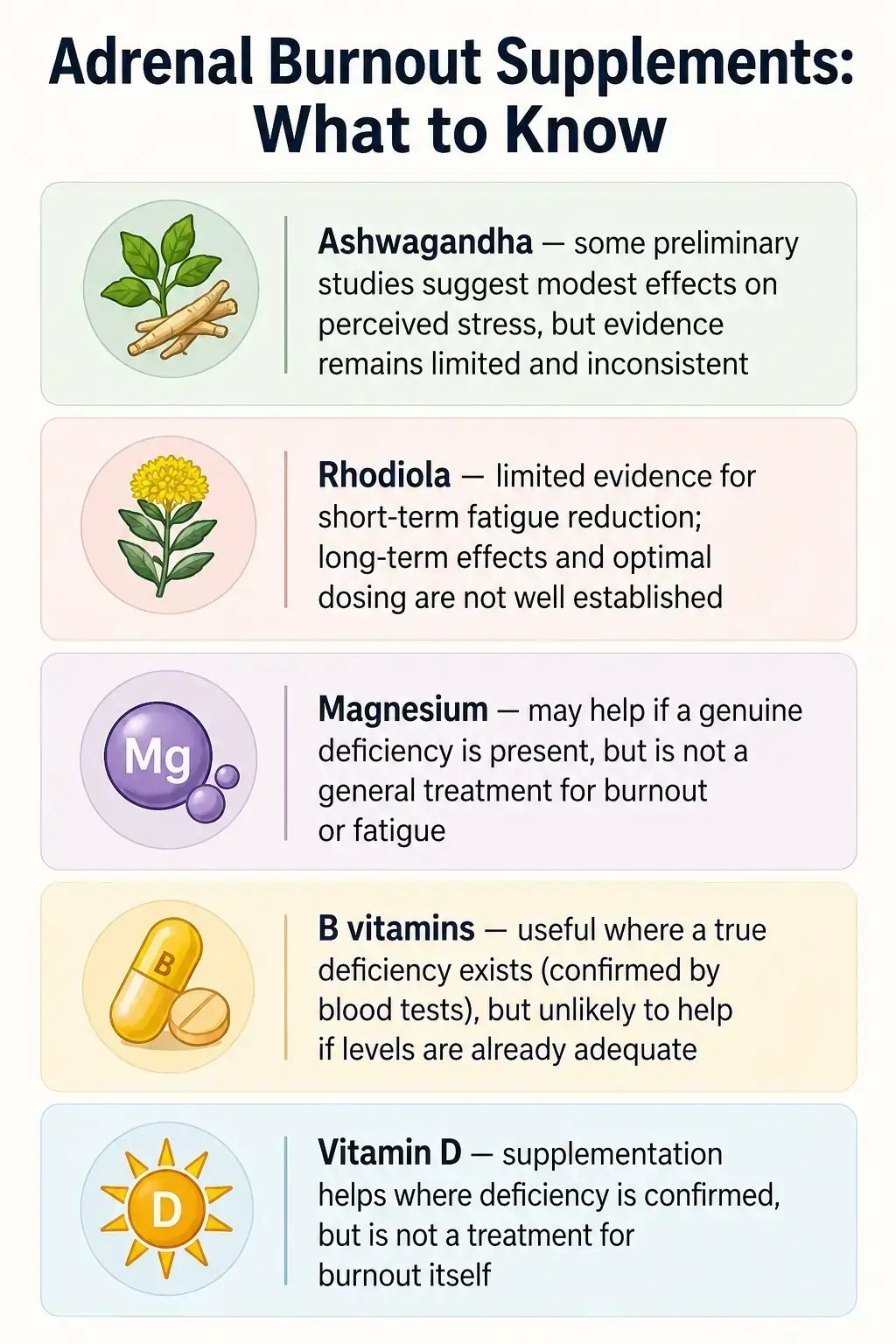
Adrenal burnout supplements are widely marketed but lack strong, consistent clinical evidence for treating burnout symptoms. Common ingredients and their evidence base include:
- Ashwagandha — some preliminary studies suggest modest effects on perceived stress, but evidence remains limited and inconsistent
- Rhodiola — limited evidence for short-term fatigue reduction; long-term effects and optimal dosing are not well established
- Magnesium — may help if a genuine deficiency is present, but is not a general treatment for burnout or fatigue
- B vitamins — useful where a true deficiency exists (confirmed by blood tests), but unlikely to help if levels are already adequate
- Vitamin D — supplementation helps where deficiency is confirmed, but is not a treatment for burnout itself
Across all of these, current evidence remains limited, and supplements should not replace addressing the underlying chronic stress or burnout. Claims that any supplement “cures” adrenal burnout should be treated with caution, and any supplement use should be discussed with a GP, particularly if taking other medications.
Empath Burnout and Social Burnout
Empath burnout and empathy burnout describe exhaustion specifically linked to high emotional absorption from others’ distress, often reported by people in caring and high-stress professional roles or those who identify strongly as highly sensitive. Empathy and burnout research overlaps with compassion fatigue literature in healthcare and counselling professions. Social burnout describes a related but distinct pattern: depletion from sustained social interaction demands, which can affect introverted individuals or those in highly social roles even without a strong empathic component. Neurodivergent individuals, including those with autistic and ADHD burnout, can also experience this kind of social and sensory depletion differently from the general population, and often benefit from tailored recovery approaches.
Mindfulness and Burnout
Mindfulness and burnout research shows genuine, moderate evidence for Mindfulness-Based Stress Reduction (MBSR) as a supportive tool for burnout, particularly for the emotional exhaustion dimension. Other approaches such as Acceptance and Commitment Therapy (ACT) and Cognitive Behavioural Therapy (CBT) also have evidence for supporting recovery. However, mindfulness burnout can occur if mindfulness is used as a substitute for addressing structural causes, such as unsustainable workload, rather than as one part of a broader recovery plan. Evidence is strongest when mindfulness-based approaches are combined with structural workplace changes rather than used alone.
Sobriety Burnout
Sobriety burnout describes the exhaustion some people experience during early recovery from alcohol or substance use, as the nervous system adjusts without its previous coping mechanism while other life stressors continue unchanged. This is a recognised challenge in addiction recovery support and benefits from the same staged recovery approach used for general burnout, alongside addiction-specific support.
Evidence-Based Management
Regardless of what term is used, the management approach that has actual evidence behind it is broadly consistent: for a full breakdown of each stage, see this burnout recovery and treatment guide:
- Sleep optimisation — addressing sleep disruption early, since it both reflects and worsens chronic stress
- Cognitive Behavioural Therapy (CBT) — evidence-based support for stress appraisal and coping patterns
- Exercise — moderate activity, introduced gradually, to support mood and stress regulation
- Pacing — gradual rather than abrupt increases in activity and responsibility during recovery
- Workload reduction — addressing the structural drivers of chronic stress, not just symptoms
- Mindfulness-based approaches — used alongside, not instead of, structural change
- GP involvement — to investigate physical causes and coordinate care
- Psychologist involvement — for therapy-based support
- Psychiatrist involvement — where medication or specialist assessment is needed
- Medication — only where another diagnosis (such as depression, anxiety, or genuine adrenal insufficiency) is confirmed
How Doctors Investigate Persistent Fatigue
Because fatigue has many possible causes, a GP will typically take a structured approach rather than assuming any single explanation, including:
- Medical history and physical examination
- Morning cortisol testing where adrenal function needs assessment
- ACTH stimulation test, if adrenal insufficiency is suspected
- Thyroid function tests, since thyroid disease commonly causes similar fatigue
- Iron studies, to rule out iron deficiency anaemia
- Vitamin B12 and vitamin D levels
- Blood glucose, to screen for diabetes-related fatigue
- Inflammatory markers, where an underlying inflammatory or autoimmune condition is suspected
Why do online adrenal fatigue tests differ from my GP’s results? Online or wellness “adrenal burnout tests” are not validated medical assessments and often use different (non-standard) reference ranges or saliva-based methods not used in mainstream clinical practice. A GP uses standardised blood tests interpreted against established medical reference ranges, which is why results and conclusions can differ significantly.
When Symptoms Need Medical Assessment
See a GP rather than starting supplements or following an online quiz if you are experiencing:
- Persistent fatigue that is not improving
- Dizziness or light-headedness, particularly on standing
- Unexplained weight loss
- Fainting
- Persistently low blood pressure
- Severe weakness
- Ongoing vomiting
- Recurrent infections
Emergency Symptoms — Call 000 Immediately
- Collapse
- Confusion
- Severe dehydration
- Loss of consciousness
- Severe abdominal pain
- Suspected adrenal crisis (e.g. sudden severe weakness, vomiting, low blood pressure and confusion together)
This rules out genuine medical causes, including thyroid dysfunction, anaemia, or in rare cases adrenal insufficiency, before assuming the cause is burnout-related stress.
The Bottom Line
- “Adrenal burnout” is not a medically recognised diagnosis, though the underlying fatigue and stress symptoms are real and deserve proper assessment.
- Genuine adrenal insufficiency (Addison’s disease) is a distinct, rare, and potentially serious medical condition diagnosed with blood tests.
- Burnout is a real, measurable state of exhaustion, not a personal failing.
- Early recognition shortens recovery time significantly.
- Recovery requires both rest and structural change, not rest alone.
- Persistent symptoms beyond a few weeks warrant a conversation with a GP or psychologist.
Further Reading From Trusted Sources
- Endocrine Society / Hormone Health Network — information on adrenal fatigue and adrenal insufficiency
- Royal Australian College of General Practitioners (RACGP) — guidance on fatigue assessment
- Australian Society of Endocrinology — information on adrenal conditions
- Healthdirect Australia — general health information and symptom guidance
- Beyond Blue — mental health support and resources
- World Health Organization — ICD-11 classification of burnout as an occupational phenomenon
References
- Endocrine Society. Adrenal fatigue is not a real medical condition. Hormone Health Network; 2024.
- Cadegiani FA, Kater CE. Adrenal fatigue does not exist: a systematic review. BMC Endocrine Disorders. 2016;16(1):48.
- Figley CR. Compassion fatigue: psychotherapists’ chronic lack of self-care. Journal of Clinical Psychology. 2002;58(11):1433-1441.
- World Health Organization. Burnout an “occupational phenomenon”: International Classification of Diseases (ICD-11). WHO; 2019.