

Medically reviewed | Last updated: 2026 | Reading time: ~14 minutes
Clinical Note: Autistic burnout and ADHD burnout are increasingly described in emerging clinical and participatory research. While neither is currently a formal diagnostic category in DSM-5-TR or ICD-11, they are recognised by many clinicians, autistic-led researchers and professional bodies as clinically significant presentations. Assessment and support should be provided by an AHPRA-registered psychologist or psychiatrist with experience in neurodivergent presentations.
Quick Answer: Autistic burnout and ADHD burnout are forms of neurodivergent burnout caused by prolonged masking, sensory overload or executive function strain — not workload alone. Symptoms include skill regression, increased sensory sensitivity and shutdowns or meltdowns. Recovery typically requires reducing masking demands, not just resting. Generic burnout advice often falls short because it does not address the underlying neurodivergent-specific drivers.
Key Takeaways
- Neurodivergent burnout is driven by masking, sensory overload and executive dysfunction — not hours alone.
- Autistic burnout and ADHD burnout have different primary drivers and different recovery priorities.
- Skill regression — temporary loss of previously held abilities — is a hallmark of autistic burnout not seen in general burnout.
- AuDHD (co-occurring autism and ADHD) involves compounded and sometimes conflicting burnout patterns.
- NDIS supports, occupational therapy and neurodivergent-affirming psychology are key Australian pathways.
- Autistic burnout is not the same as depression — though both can co-occur.
- Seek GP or psychologist support if symptoms persist beyond a few weeks or are affecting daily safety.
What Is Neurodivergent Burnout?
Neurodivergent burnout describes burnout that arises specifically from the demands of navigating a world built around neurotypical expectations — including sustained autistic masking, managing sensory input, and maintaining executive function effort well beyond what is neurologically sustainable. It can occur alongside, but is distinct from, general occupational burnout. For a broader overview of how burnout itself is defined and recognised, it’s worth understanding the general presentation before looking at how neurodivergent burnout diverges from it.
The core distinction from general burnout is the mechanism: where occupational burnout arises from structural job mismatches (workload, control, reward), neurodivergent burnout arises from the chronic neurological cost of compensating for a nervous system that processes the world differently. This is why standard stress management and burnout recovery advice — which targets job structure — often produces limited results for autistic and ADHD individuals.
Neurodivergent burnout can occur in people with Autism Spectrum Disorder (ASD), Attention Deficit Hyperactivity Disorder (ADHD), or both (AuDHD), and may also be a presenting feature in late-diagnosed adults who have been masking for years without support or accommodation.
Why Neurodivergent Burnout Is Different From Occupational Burnout
Five mechanisms drive neurodivergent burnout that are not present — or not primary — in general occupational burnout: Standard advice for workplace burnout is typically built around reducing hours or redistributing tasks, which addresses structural mismatch but leaves the neurological drivers below largely untouched:
| Mechanism | What It Involves | Who It Affects Most |
| Masking Fatigue | Continuous suppression of natural autistic or ADHD traits to appear neurotypical, including managing facial expressions, maintaining eye contact, adjusting speech patterns, and hiding stimming behaviours. | Primarily autistic individuals; also people with ADHD who frequently mask impulsivity or distractibility. |
| Sensory Overload / Sensory Fatigue | Nervous system dysregulation caused by prolonged exposure to sensory input such as noise, bright lights, crowds, clothing textures, or smells that exceed an individual’s sensory processing threshold. | Autistic individuals and some people with ADHD who experience sensory sensitivities. |
| Executive Dysfunction Overload | Ongoing mental effort required to compensate for challenges with planning, task initiation, task switching, organisation, and working memory in environments that assume these skills are automatic. | Most common in ADHD, but also experienced by many autistic adults. |
| Monotropism Strain | The cognitive cost of maintaining multiple attention channels in environments that demand constant attention switching, despite a preference for deep, single-focus processing. | Autistic individuals, particularly those with co-occurring autism and ADHD (AuDHD). |
| Cognitive Load Accumulation | The cumulative effort of interpreting the neurotypical social world in real time, including reading ambiguous communication, managing unpredictability, and navigating implicit social rules. | Both autistic and ADHD individuals, especially in unfamiliar or unpredictable environments. |
Autistic Burnout
Autistic burnout is increasingly described in emerging clinical and participatory research as a distinct experience involving chronic exhaustion, loss of previously held skills, and heightened sensitivity to sensory input. Research by Raymaker et al. (2020) and Mantzalas et al. (2022) — both of which prioritised the voices of autistic adults — identified these features as central to autistic burnout and distinct from general burnout presentations.
Autism burnout is closely tied to prolonged autistic masking — the effortful suppression of natural autistic traits to meet neurotypical social or workplace expectations. The longer and more intensely masking is sustained without relief, the higher the autistic burnout risk. Masking is cognitively and emotionally costly; it does not become easier with practice. While the general signs and symptoms of burnout provide a useful baseline, autistic burnout presents with several additional features not typically seen in occupational burnout.
Autistic Burnout Symptoms
- Reduced or lost verbal communication ability — sometimes temporarily (selective mutism or reduced speech fluency)
- Withdrawal from social interaction, including with trusted people — not preference, but reduced capacity
- Skill regression: loss of previously manageable abilities such as cooking, driving, self-care or work tasks
- Heightened sensory sensitivity — increased reaction to noise, light, touch, smell or texture
- Increased frequency or severity of autistic meltdowns or shutdowns
- Autism fatigue — a pervasive, whole-body exhaustion that rest alone does not resolve
- Loss of ability to mask — previously automatic social compensation becomes impossible
- Increased rigidity — reduced capacity for flexibility or unexpected change
Skill Regression in Autistic Burnout
Skill regression — the temporary loss of abilities that were previously functional — is one of the most distressing and least understood features of autistic burnout. It is not present in general occupational burnout and is a key diagnostic indicator that distinguishes autistic burnout from depression or work-related exhaustion.
Skills that can regress during autistic burnout include:
- Verbal communication — word-finding difficulties, reduced sentence fluency, or temporarily losing the ability to speak
- Executive function tasks — scheduling, planning, cooking, managing finances or appointments
- Driving or navigating familiar routes — Difficulty recalling directions or navigating places that were once familiar.
- Working memory — forgetting familiar procedures, names, or recently learned information
- Social scripts — losing access to practiced social responses that previously felt automatic
- Sensory regulation — becoming unable to tolerate previously manageable environments
Skill regression typically improves with adequate rest and reduced demand, though recovery timelines vary considerably. Regression does not indicate permanent loss of ability.
Sensory Overload and Sensory Fatigue
Sensory overload occurs when the volume or intensity of sensory input exceeds an individual’s processing capacity, triggering nervous system dysregulation. In autistic burnout, the sensory processing threshold is significantly lowered — stimuli that were previously manageable may become intolerable.
Common sensory triggers that intensify during autistic burnout:
- Sound — background noise, overlapping conversations, alarms, open-plan office noise
- Light — fluorescent lighting, screen brightness, sunlight intensity
- Crowds — the combined sensory and social processing demand of busy environments
- Touch and clothing — textures, seams, tags or fabric weight that were previously tolerable
- Smell — food, cleaning products, perfumes or workplace environments
- Temperature — heightened sensitivity to heat, cold or sudden temperature changes
Sensory fatigue — the cumulative exhaustion from sustained sensory management throughout the day — is a primary driver of autistic burnout and often goes unrecognised in workplace settings. Workplace accommodations that reduce sensory load (noise-cancelling headphones, quiet spaces, flexible environments) are among the most effective prevention strategies.
ADHD Burnout
ADHD burnout stems from a different but related mechanism: the constant cognitive effort of managing executive function demands — planning, time management, emotional regulation, task initiation and task-switching — while compensating for difficulties that are largely invisible to others. ADHD masking, like autistic masking, carries a significant cognitive cost that accumulates over time.
ADHD burnout is frequently triggered by periods of hyperfocus or overcommitment followed by a crash — the boom-bust cycle characteristic of ADHD executive function. During the hyperfocus phase, the ADHD individual may appear highly productive; the subsequent crash involves ADHD emotional exhaustion, ADHD overwhelm, and a sudden inability to sustain motivation even for preferred tasks.
ADHD Burnout Symptoms
- Rejection sensitivity flares — heightened emotional responses to perceived criticism, failure or exclusion
- Sudden, complete loss of motivation even for tasks and interests that are normally engaging
- ADHD mental exhaustion — a specific cognitive fatigue from sustained executive function effort
- Emotional dysregulation — tearfulness, irritability or emotional numbing
- Task paralysis — inability to initiate tasks despite intending to and understanding their importance
- ADHD overwhelm — the sensation of all tasks becoming simultaneously urgent and unmanageable
- Physical fatigue resembling general burnout, often following a hyperfocus or overcommitment period
- Increased forgetfulness and working memory failures beyond the individual’s usual baseline
Executive Dysfunction and ADHD Burnout
Executive dysfunction refers to difficulties with the cognitive processes that regulate goal-directed behaviour: planning, initiation, working memory, cognitive flexibility, task-switching and impulse control. In ADHD, executive function challenges are neurological rather than motivational — they are not resolved by trying harder.
During ADHD burnout, executive dysfunction becomes significantly more pronounced:
- Planning — inability to sequence tasks or anticipate steps in a process
- Task initiation — task paralysis; knowing what to do but being unable to start
- Task-switching — becoming ‘stuck’ on tasks or unable to shift attention when needed
- Working memory — losing track of conversations, instructions or intentions mid-task
- Cognitive flexibility — reduced ability to adapt to changes, unexpected events or plan revisions
Executive dysfunction during ADHD burnout is frequently misread as laziness, low motivation or poor character — a misattribution that compounds shame and delays help-seeking. Appropriate accommodations and clinical support are more effective than effort-based approaches.
ADHD Burnout vs Autistic Burnout
These two forms of neurodivergent burnout share overlapping features but have distinct primary drivers and different recovery priorities. Understanding the distinction helps with targeted intervention.
| Feature | ADHD Burnout | Autistic Burnout |
| Primary Driver | Executive function strain, ADHD masking, and the hyperfocus–crash cycle. | Prolonged autistic masking, sensory overload, and monotropism-related strain. |
| Common Pattern | A boom-and-bust cycle following periods of hyperfocus or overcommitment. | A gradual, cumulative decline that may progress to skill loss and eventual shutdown. |
| Hallmark Feature | Sudden collapse in motivation, emotional dysregulation, and heightened rejection sensitivity. | Skill regression, selective mutism, and reduced ability to maintain masking. |
| Sensory Component | Present in some people but generally less central. | A core feature, often involving a markedly lowered sensory threshold. |
| Social Withdrawal | May occur as a result of emotional exhaustion. | Common and often significant, reflecting reduced social capacity rather than reduced interest. |
| Recovery Focus | Reducing executive demands, using structured rest, and providing task scaffolding. | Reducing masking demands, lowering sensory input, and prioritising quiet, low-demand recovery environments. |
| Response to Stimulation | Boredom and understimulation can worsen symptoms. | Additional stimulation typically worsens burnout, making low-demand periods essential. |
| Co-occurring Risk | Anxiety, depression, and rejection sensitivity dysphoria (RSD). | Depression, anxiety, and post-traumatic features associated with prolonged masking. |
Source: Raymaker DM, et al. Autism in Adulthood. 2020;2(2):132-143. Mantzalas J, et al. Autism. 2022.
AuDHD Burnout: When Autism and ADHD Co-Occur
AuDHD refers to co-occurring Autism Spectrum Disorder and ADHD — a combination more common than previously recognised. AuDHD burnout involves compounded and sometimes conflicting burnout patterns, making it particularly complex to navigate.
Key features of AuDHD burnout:
- Both executive dysfunction strain (ADHD) and masking fatigue (autism) operate simultaneously, depleting resources from two directions
- ADHD traits — novelty-seeking, impulsivity, flexibility — can conflict directly with autistic traits — routine preference, predictability, monotropism — creating internal friction that accelerates burnout
- The boom-bust cycle of ADHD can mask early autistic burnout signals until skill regression is already underway
- Stimulation needs differ: ADHD may drive towards stimulation while autistic sensory sensitivity drives away from it — a tension that is difficult to resolve without individualised support
- Late diagnosis is particularly common in AuDHD — many AuDHD adults present for the first time in burnout, having spent years compensating without understanding why
Assessment and support for AuDHD burnout should be provided by a clinician experienced in both presentations — ideally a clinical psychologist or psychiatrist registered with AHPRA with demonstrated expertise in neurodivergent assessment.
ADHD Spouse Burnout
ADHD spouse burnout refers to the exhaustion experienced by a partner of someone with ADHD, frequently linked to taking on a disproportionate share of household planning, reminders and emotional labour — often described as a ‘parent-child dynamic’ that neither partner wants. This is distinct from the ADHD partner’s own burnout and frequently goes unaddressed in couples therapy unless specifically raised.
ADHD spouse burnout is best addressed through couples therapy with a therapist experienced in ADHD relationship dynamics, combined with ADHD management support for the partner with ADHD. Psychoeducation for both partners about executive dysfunction — reframing it as neurological rather than motivational — is an important early step.
Early Warning Signs of Neurodivergent Burnout
Early Warning Checklist — Autistic Burnout
- Increasing difficulty maintaining masking in social or work situations
- New or returning sensitivity to previously tolerable sensory environments
- Reduction in ability to sustain eye contact or manage social scripts
- Returning to or intensifying stimming behaviours as a regulation response
- Reduced capacity for verbal communication, particularly in demanding environments
- Loss of access to previously routine skills — cooking, organisation, timekeeping
- Increased rigidity or distress around changes to routine
- Fatigue that does not improve with a night’s sleep or a weekend
Early Warning Checklist — ADHD Burnout
- Increasing difficulty initiating tasks — even preferred or low-stakes ones
- Emotional reactivity escalating beyond your typical baseline
- Hyperfocus episodes becoming harder to exit or recover from
- Rejection sensitivity disproportionate to the situation
- Working memory failures increasing in frequency or severity
- Motivation collapsing for activities that previously provided dopamine regulation
- Physical fatigue following periods of intense focus or overcommitment
- Increasing overwhelm from tasks that are individually manageable
Autistic Burnout Recovery
Autistic burnout recovery differs from standard burnout recovery and treatment in one critical way: reducing masking demands is often more important than reducing hours or workload. Rest without masking reduction typically provides limited or temporary relief.
Recovery strategies with clinical support in autistic burnout:
- Reduce sensory load as a priority — noise-cancelling headphones, quieter environments, reduced fluorescent lighting, comfortable clothing without sensory triggers
- Lower social masking demands where possible, even temporarily — this may mean renegotiating social obligations with trusted people
- Return to special interests and stimming as legitimate regulation tools — not distractions to manage or suppress
- Create predictable, low-demand recovery periods in daily structure
- Work with a neurodivergent-affirming psychologist — generic CBT without adaptation is often ineffective and can worsen burnout if it increases masking demands
- Explore NDIS supports — psychology, occupational therapy and autism support coordination may be fundable under psychosocial disability or autism-specific pathways
- Occupational therapy assessment — an OT experienced in sensory processing can provide workplace and home environment recommendations
ADHD Burnout Recovery
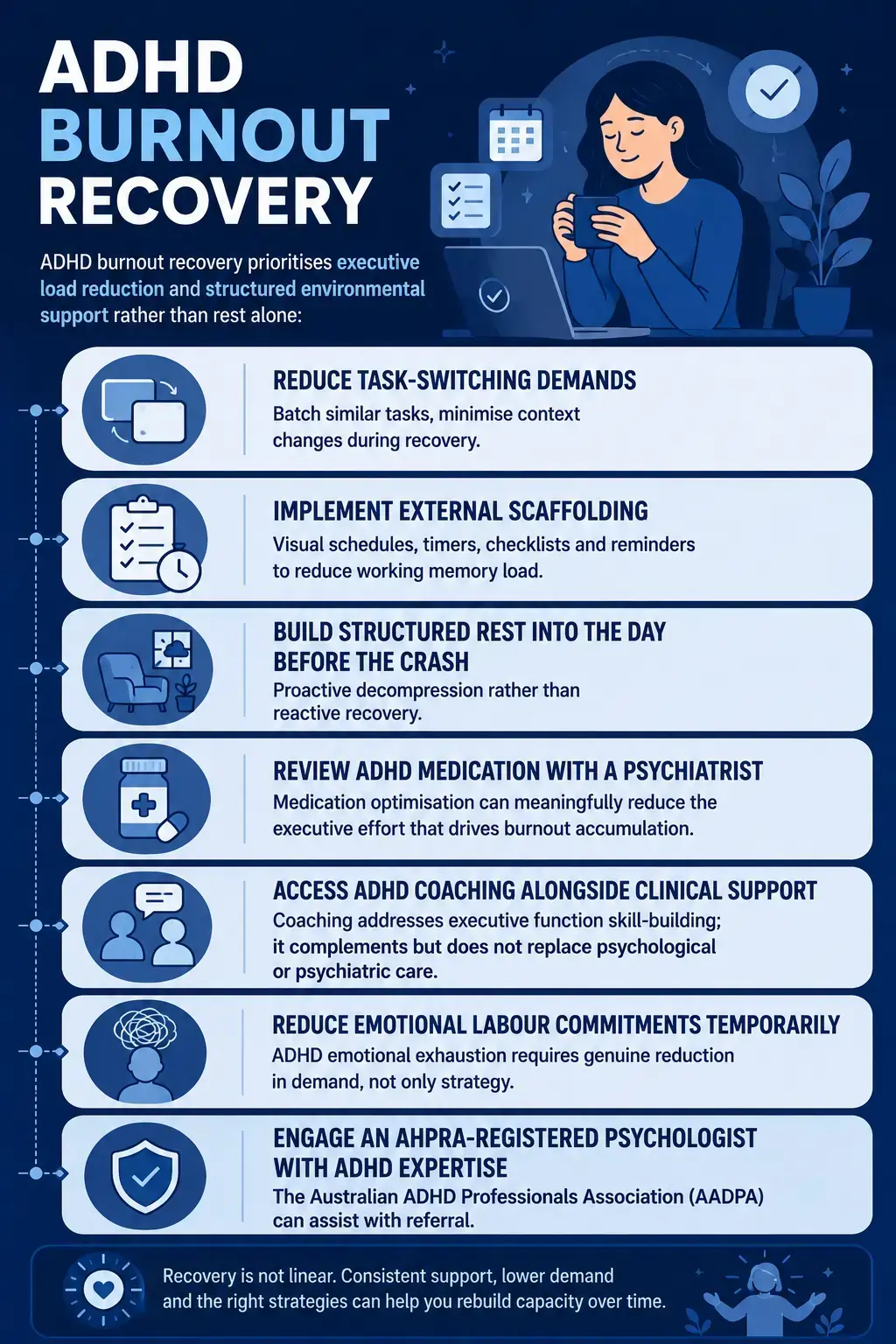
ADHD burnout recovery prioritises executive load reduction and structured environmental support rather than rest alone:
- Reduce task-switching demands — batch similar tasks, minimise context changes during recovery
- Implement external scaffolding — visual schedules, timers, checklists and reminders to reduce working memory load
- Build structured rest into the day before the crash — proactive decompression rather than reactive recovery
- Review ADHD medication with a psychiatrist — medication optimisation can meaningfully reduce the executive effort that drives burnout accumulation
- Access ADHD coaching alongside clinical support — coaching addresses executive function skill-building; it complements but does not replace psychological or psychiatric care
- Reduce emotional labour commitments temporarily — ADHD emotional exhaustion requires genuine reduction in demand, not only strategy
- Engage an AHPRA-registered psychologist with ADHD expertise — the Australian ADHD Professionals Association (AADPA) can assist with referral
Recovery Timeline
Recovery timelines for neurodivergent burnout are highly individual. General indicators:
| Burnout Severity | Approximate Recovery Range | Key Factors |
| Mild | Several weeks to 2 months | Masking or executive demands are reduced early, a strong support network is available, and existing clinical relationships provide ongoing guidance. |
| Moderate | 2–6 months | Some structural changes are possible, clinical support is in place, and the sensory environment is reasonably manageable. |
| Severe (with Skill Regression) | 6–18 months or longer | Significant skill regression is present, workplace or environmental accommodations are limited, and co-occurring anxiety, depression, or a late diagnosis may complicate recovery. |
These ranges assume active reduction of masking and sensory demands. Recovery without structural change is typically incomplete and recurrence risk remains high.
Workplace Accommodations for Neurodivergent Burnout
Under the Disability Discrimination Act 1992 (DDA), Australian employers are required to provide reasonable adjustments for employees with disability, including autism and ADHD. This is particularly relevant for those in professional burnout-prone roles such as healthcare, education and other high-stress caring professions, where occupational demands compound with neurodivergent-specific burnout risk. Workplace accommodations that reduce neurodivergent burnout risk include:
| Accommodation | Addresses | How to Request |
| Flexible Hours or Compressed Week | Executive function challenges, energy management, and recovery from sensory fatigue. | Request through HR or your direct manager, supported by a GP or psychologist’s letter if required. |
| Remote or Hybrid Work | Sensory overload from open-plan offices, reduced masking demands, and greater control over the work environment. | Submit a flexible work request under applicable Fair Work Act provisions. |
| Noise-Cancelling Headphones | Sensory overload, auditory processing difficulties, and cognitive load caused by background noise. | Request as a reasonable workplace adjustment, as it is typically low cost and high impact. |
| Quiet Room or Breakout Space Access | Sensory decompression, prevention of meltdowns or shutdowns, and recovery from masking demands. | Request access through workplace wellbeing services or facilities management. |
| Written Instructions and Agendas | Working memory, task initiation, and meeting preparation for ADHD and autistic individuals. | Request through your manager as a standard workplace practice that often benefits the whole team. |
| Reduced or Asynchronous Meetings | Executive function demands, task switching, sensory load, and social masking. | Discuss with your team lead or manager and explain how the adjustment supports productivity. |
| Predictable Schedule and Fewer Last-Minute Changes | Autistic burnout prevention, monotropism support, and reduced anxiety. | Agree on a documented schedule with your team lead or manager wherever possible. |
| Extended Deadlines or Task Chunking | Executive dysfunction, task initiation challenges, and working memory demands. | Request as a reasonable adjustment through HR, with clinical documentation if required. |
NDIS and Australian Support Pathways
Several Australian funding and support pathways are relevant for autistic and ADHD individuals experiencing burnout:
- NDIS (National Disability Insurance Scheme) — autism and ADHD can qualify as NDIS-eligible conditions. Relevant support categories include psychology (Improved Daily Living), occupational therapy (Improved Daily Living), and support coordination. Apply via the NDIS Access Request process at ndis.gov.au
- Medicare — a GP-issued Mental Health Treatment Plan provides access to up to 10 Medicare-subsidised psychology sessions per year. Relevant for burnout, co-occurring anxiety and co-occurring depression
- Australian ADHD Professionals Association (AADPA) — provides clinician directories and clinical guidelines for ADHD assessment and treatment in Australia. aadpa.com.au
- Autism CRC — Australia’s national autism research cooperative provides evidence resources and service directories. autismcrc.com.au
- Amaze (Victoria) and state-based autism organisations — provide information, advocacy and service navigation for autistic Australians
- AHPRA — verify that your psychologist or psychiatrist is registered at ahpra.gov.au before engaging for neurodivergent assessment or treatment
Co-Occurring Conditions
Neurodivergent burnout frequently co-occurs with or can progress to clinical diagnoses that require separate assessment and treatment:
- Anxiety disorder — elevated risk in both autistic and ADHD individuals, and can be both a cause and a consequence of burnout
- Depression — prolonged autistic or ADHD burnout increases clinical depression risk; the two have overlapping but distinct presentations
- Post-traumatic stress features — particularly in late-diagnosed adults who have sustained years of masking without support or understanding
- Sleep disorders — sensory sensitivity, executive dysfunction and anxiety all commonly disrupt sleep; poor sleep in turn worsens burnout
- Rejection Sensitivity Dysphoria (RSD) — an ADHD-specific pattern of intense emotional response to perceived rejection, which can worsen during ADHD burnout and benefit from targeted treatment
A GP referral for comprehensive assessment is important when burnout is severe, persistent, or accompanied by any of the above features.
A Note on ADHD Medication
ADHD medication (stimulant and non-stimulant) can meaningfully reduce the executive function effort that drives ADHD burnout accumulation. However, medication is not a burnout treatment in isolation — structural change and psychological support remain important alongside it. Medication decisions should be made with an AHPRA-registered psychiatrist or paediatrician with ADHD expertise. The AADPA clinical guidelines provide the current Australian evidence base for ADHD pharmacotherapy.
⚠ Emergency Red Flags — Seek Immediate Support
- Suicidal thoughts or thoughts of self-harm
- Inability to eat, drink or maintain basic self-care for an extended period
- Catatonic features — inability to move or respond
- Psychotic symptoms — perceptual disturbances or severe disorganisation
- Severe self-neglect — inability to manage safety in daily life
- If you are in crisis: Lifeline 13 11 14 (24/7) | Beyond Blue 1300 22 4636 | Emergency services 000
When to See a GP or Psychologist
Seek professional support when:
- Autistic burnout symptoms — particularly skill regression or loss of speech — persist or worsen
- ADHD burnout involves significant emotional dysregulation affecting relationships or safety
- Symptoms are affecting daily functioning, self-care, work or study for more than 2–3 weeks
- You suspect co-occurring anxiety or depression
- You are seeking an autism or ADHD assessment and believe late diagnosis may be relevant to your burnout history
- Workplace accommodation support requires a clinical letter or formal diagnosis
A GP is the first port of call. They can provide a Mental Health Treatment Plan (up to 10 Medicare-subsidised psychology sessions), refer for psychiatric assessment, and coordinate NDIS access requests where relevant.
The Bottom Line
Neurodivergent burnout — whether autistic, ADHD or AuDHD — is driven by masking fatigue, sensory overload and executive dysfunction, not workload alone. Generic burnout advice often falls short because it does not address these underlying mechanisms. Recovery requires reducing masking and sensory demands, not just resting. If symptoms persist beyond a few weeks or are affecting daily functioning or safety, seek support from a GP or an AHPRA-registered psychologist with neurodivergent expertise.
References
- Raymaker DM, et al. “Having all of your internal resources exhausted beyond measure and being left with no clean-up crew”: defining autistic burnout. Autism in Adulthood. 2020;2(2):132-143.
- Mantzalas J, et al. Conceptualising autistic burnout: a participatory study. Autism. 2022.
- CHADD. ADHD and burnout. Children and Adults with Attention-Deficit/Hyperactivity Disorder; 2025.
- Australian ADHD Professionals Association (AADPA). Australian Evidence-Based Clinical Practice Guideline For Attention Deficit Hyperactivity Disorder. AADPA; 2022.
- Autism CRC. Autistic burnout resources and research. autismcrc.com.au
- NDIS. Accessing supports for psychosocial disability. ndis.gov.au
- Beyond Blue. Neurodivergence and mental health. beyondblue.org.au
- Healthdirect Australia. Autism spectrum disorder. healthdirect.gov.au
- Australian Government. Disability Discrimination Act 1992. legislation.gov.au
Last reviewed: 2026. This article is for general information only and does not replace personalised advice from a qualified health professional. If you are in crisis, contact Lifeline on 13 11 14 or Beyond Blue on 1300 22 4636.