

Medically reviewed | Last updated: 2026 | Reading time: ~12 minutes
Quick Answer: Workplace burnout is chronic, unmanaged work-related stress marked by emotional exhaustion, cynicism toward the job and reduced effectiveness. Recognised by the World Health Organization as an occupational phenomenon, burnout stems from structural mismatches between workload and resources — not a personal failing. It eases when those structural factors change.
Key Takeaways
- Burnout is a measurable occupational state — not a personal weakness.
- It involves 3 core dimensions: emotional exhaustion, cynicism and reduced effectiveness.
- Six structural mismatches drive burnout: workload, control, reward, community, fairness and values.
- Early recognition shortens recovery time significantly.
- Recovery requires both genuine rest and structural workplace change.
- Symptoms persisting beyond a few weeks warrant a GP or psychologist consultation.
- Australian employers have legal obligations under the Work Health and Safety Act.
What Is Occupational Burnout?
Occupational burnout — sometimes called work burnout, burnout at work or job burnout — refers to the work-specific form of burnout recognised by the World Health Organization in the International Classification of Diseases (ICD-11). The WHO’s classification ties burnout directly to employment, making it an occupational phenomenon rather than a purely personal condition.
Burnout at work symptoms are triggered and sustained by job-specific stressors including workload pressure, loss of control, inadequate reward, poor workplace community, perceived unfairness and values mismatch. The Maslach Burnout Inventory (MBI) remains the gold standard tool for measuring occupational burnout across its three core dimensions: emotional exhaustion, depersonalisation (cynicism), and reduced personal accomplishment.
The Job Demands-Resources (JD-R) model offers a complementary framework: when job demands — cognitive fatigue, emotional labour, time pressure — consistently exceed available resources such as supervisor support, autonomy and psychological safety, burnout risk escalates significantly.
How Workplace Burnout Develops
Burnout rarely arrives suddenly. Research identifies a progressive pattern that, if unrecognised, deepens over months or years. Understanding the stages of workplace burnout helps both employees and employers intervene earlier.
| Stage | What Typically Happens |
| 1. Honeymoon / High Engagement | High enthusiasm, willingness to overcommit. Early warning signs dismissed as temporary |
| 2. Stress Onset | Persistent fatigue, occasional irritability, difficulty switching off after work. Work engagement starts declining |
| 3. Chronic Stress | Presenteeism increases. Absenteeism begins. Cynicism and emotional exhaustion become routine. Physical symptoms emerge (sleep disruption, headaches) |
| 4. Burnout | Full exhaustion. Significant loss of motivation and effectiveness. Psychological injury risk escalates. Mental exhaustion is pervasive |
| 5. Habitual Burnout | Burnout becomes embedded. Risk of anxiety disorder, depression and long-term occupational disability if untreated |
Early signs of workplace burnout are easiest to catch when compared against your own six-to-twelve-month baseline, rather than against colleagues, since burnout tolerance varies significantly between individuals and roles.
Burnout vs Stress vs Compassion Fatigue
These three states are frequently confused. Understanding the distinctions guides more effective intervention.
| Condition | Key Distinguishing Features |
| Workplace Stress | A response to excessive pressure. Typically resolves when the stressor is removed. Associated with urgency and over-engagement. Can be temporary and manageable |
| Occupational Burnout | Emerges from chronic, unresolved workplace stress. Marked by emotional exhaustion, cynicism and reduced effectiveness. Persists even during quiet periods. Does not fully resolve with a holiday alone |
| Compassion Fatigue | Specific to caring roles (nurses, carers, teachers, social workers). Caused by repeated exposure to others’ distress. Characterised by emotional numbness, reduced empathy and secondary traumatic stress |
Early Warning Signs of Workplace Burnout
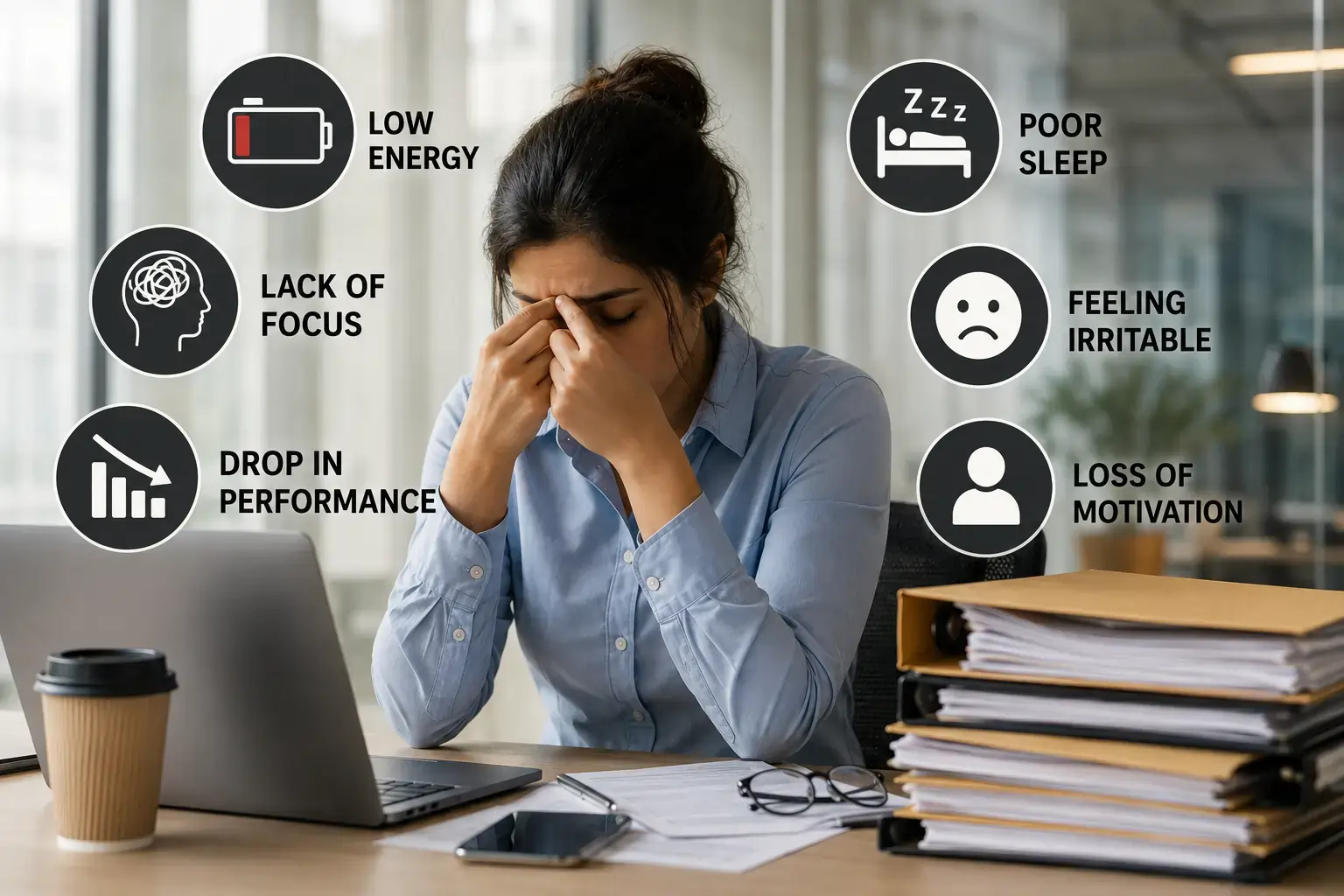
Catching burnout at the workplace stress stage — before it becomes chronic — significantly shortens recovery. Watch for these early indicators:
Early Warning Checklist — Employees
- Dreading the start of the workday before anything has gone wrong
- Persistent difficulty switching off in evenings or on weekends
- Reduced satisfaction from tasks that previously felt meaningful
- Increasing irritability toward colleagues or clients
- Difficulty concentrating during meetings or on routine tasks
- Using more sick leave or feeling ‘present but absent’ at work (presenteeism)
- Physical symptoms: headaches, disrupted sleep, digestive issues
- Feeling emotionally detached or numb about your role
Signs of Job Burnout
Fully developed worker burnout symptoms are more pronounced and more persistent than early warning signs:
- Cynicism or detachment toward colleagues, clients or the organisation — emotional exhaustion makes connection feel effortful or pointless
- Declining performance despite working the same or longer hours — a hallmark of occupational burnout
- Irritability, cognitive fatigue and difficulty concentrating, which can resemble anxiety disorder symptoms
- Absenteeism or presenteeism — showing up but not functioning effectively
- Physical manifestations: chronic headaches, sleep disruption, lowered immune response
- Emotional numbness or a sense of going through the motions — often described as psychological fatigue
- Reduced sense of professional accomplishment, even when objectively performing adequately
What Causes Burnout From Work
Burnout from work rarely comes down to hours alone. Maslach and Leiter’s organisational model identifies six areas of mismatch that drive occupational burnout. Psychosocial hazards — the psychological and social conditions of work — underpin each of these areas and are now a formal risk category under Australian workplace law.
| Mismatch Area | What It Looks Like in Practice |
| Workload | Job demands consistently exceed time, staffing, energy or skill available. Work overload is the most frequently cited driver of chronic workplace stress |
| Control | Limited autonomy over how, when or where work gets done. Loss of control is strongly associated with occupational stress and reduced work engagement |
| Reward | Pay, recognition or meaning fails to match effort. When flexible work arrangements or career progression are blocked, reward mismatch intensifies |
| Community | Poor supervisor support, interpersonal conflict or workplace isolation. Low psychological safety makes speaking up about burnout difficult |
| Fairness | Inconsistent treatment, favouritism or opaque processes. Perceived unfairness accelerates emotional exhaustion |
| Values | Personal values conflict with organisational culture or actual priorities. This is strongly associated with burnout in purpose-driven roles |
Source: Maslach C, Leiter MP. World Psychiatry. 2016;15(2):103-111.
Job Fatigue vs Burnout
Job fatigue refers to temporary tiredness from sustained effort — it resolves with rest. Burnout is a chronic state of emotional exhaustion and cynicism that does not resolve with short-term rest alone and is typically accompanied by reduced effectiveness even after time off. If work burnout symptoms persist after a holiday or break, burnout rather than simple fatigue is the more likely explanation.
Gen Z Workplace Burnout
Gen Z workplace burnout has become a distinct research area, with younger employees reporting burnout earlier in their careers than previous generations. Contributing factors include starting work during economic uncertainty, high digital connectivity that blurs work-life balance, entering workplaces with fewer in-person mentoring relationships, and navigating rapidly shifting organisational cultures without established peer support networks.
Employers addressing gen z burnout workers are increasingly focused on transparent career progression, explicit boundaries around after-hours digital contact, and normalising Employee Assistance Program (EAP) access without stigma from the start of employment.
Employer Responsibilities Under Australian Law
Australian employers have enforceable obligations to address workplace burnout as part of their psychosocial hazard management duties. The Work Health and Safety Act (WHS Act) requires employers to eliminate or minimise psychosocial risks so far as is reasonably practicable.
The Model Code of Practice: Managing Psychosocial Hazards at Work (Safe Work Australia, 2022) specifically identifies the following as notifiable psychosocial hazards: high job demands, low job control, poor support, and organisational change. Burnout resulting from these hazards can constitute a psychological injury and may be compensable under state workers compensation schemes.
Employers building a formal anti burnout plan should include:
- A written psychosocial hazard register aligned to WHS Act obligations
- Workload audit procedures to distinguish between sustained high performance and work overload
- Supervisor training in recognising occupational burnout and facilitating early support conversations
- Clear Employee Assistance Program (EAP) access pathways, communicated without stigma
- Return-to-work planning protocols for employees recovering from psychological injury
- Regular review of organisational culture factors that increase burnout risk
Your Australian Legal Rights
Workers experiencing workplace burnout in Australia have the following rights:
- Right to raise psychosocial hazard concerns with your employer under the WHS Act without adverse action
- Right to access workers’ compensation for psychological injury — burnout can qualify where it meets the relevant threshold under your state scheme
- Right to Fair Work protections — an employer cannot take adverse action against an employee for exercising workplace health and safety rights
- Right to reasonable adjustments — in some circumstances, burnout symptoms may engage obligations under anti-discrimination legislation
For authoritative guidance, see the Fair Work Ombudsman (fairwork.gov.au) and Safe Work Australia (safeworkaustralia.gov.au).
Employee Burnout and Organisational Cost
Burnout workers are statistically more likely to take extended leave, disengage from team goals, or leave the organisation entirely. Beyond individual impact, occupational burnout imposes measurable costs through absenteeism, presenteeism, increased turnover and reduced work engagement across teams. Many Australian workplaces are now integrating a formal anti burnout plan into their wellbeing strategy — recognising that psychosocial hazard management is both a legal obligation and an operational risk.
How to Deal With Job Burnout
Learning how to deal with job burnout typically requires action on two fronts simultaneously: personal recovery practices and structural workplace change. Rest alone — without addressing the conditions that caused burnout — is rarely sufficient for durable job burnout recovery.
Employee Checklist: Managing Workplace Burnout
- Set explicit, communicated boundaries around after-hours availability
- Use annual leave fully rather than banking it indefinitely
- Raise workload concerns with your manager directly and early, before resentment compounds
- Identify which of the six mismatch areas (workload, control, reward, community, fairness, values) is most acute
- Consult your GP if work burnout symptoms persist beyond 2–3 weeks
- Seek support from a registered psychologist — Cognitive Behavioural Therapy (CBT) has strong evidence for burnout recovery
- Access your workplace EAP if available — sessions are confidential
- Consider a Mental Health Treatment Plan through your GP (Medicare-subsidised psychology sessions)
Employer Checklist: Preventing and Responding to Burnout
- Audit workload distribution — distinguish sustained high performance from chronic overload
- Build a written anti burnout plan with clear escalation and support pathways
- Normalise EAP access and mental health conversations from onboarding
- Train supervisors in early recognition of occupational burnout and psychosocial hazard signals
- Review flexible work arrangements and whether role design enables work-life balance
- Conduct regular organisational culture assessments that surface fairness and values mismatches
- Establish return-to-work planning protocols for employees on mental health or psychological injury leave
- Comply with Safe Work Australia psychosocial hazard obligations under the WHS Act
Workplace Burnout Decision Tree
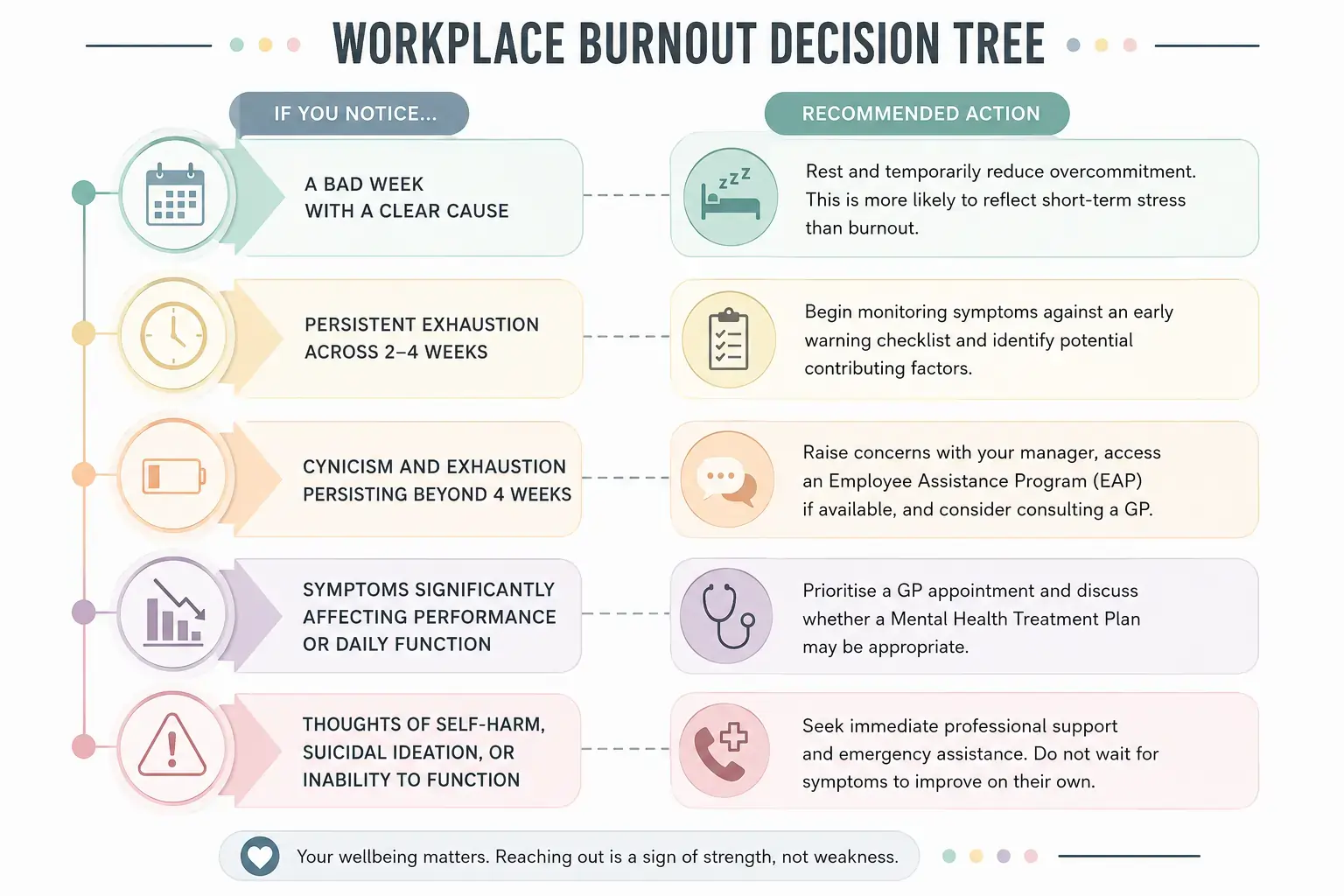
Use this decision framework to identify the appropriate next step:
| If you notice… | Recommended action |
| A bad week with a clear cause | Rest, reduce overcommitment temporarily — likely stress, not burnout |
| Persistent exhaustion across 2–4 weeks | Begin monitoring against the early warning checklist above |
| Cynicism and exhaustion persisting beyond 4 weeks | Raise with manager; access EAP; consider GP consultation |
| Symptoms significantly affecting performance or daily function | Prioritise GP appointment; request a Mental Health Treatment Plan |
| Thoughts of self-harm, suicidal ideation, or inability to function | Seek immediate support — see Emergency Red Flags below |
When to See a GP About Workplace Burnout
A GP is your first clinical port of call when:
- Work burnout symptoms persist beyond 2–3 weeks despite initial self-management
- You are experiencing significant sleep disruption, appetite changes or physical health decline
- Burnout is beginning to affect functioning outside work — relationships, daily activities
- You want to explore whether burnout may have progressed to anxiety disorder or depression
- You need a Medical Certificate for workplace leave or adjustments
- You wish to access a Mental Health Treatment Plan (up to 10 Medicare-subsidised psychology sessions per year)
A GP can also assess whether burnout has co-occurred with anxiety, depression or a physical health condition — and coordinate care accordingly. Burnout and anxiety frequently co-occur, as do burnout and depression when the condition is prolonged.
⚠ Emergency Red Flags — Seek Immediate Support
- Suicidal thoughts or thoughts of self-harm
- Inability to function in daily life — not eating, not leaving home
- Severe panic attacks or unmanageable anxiety
- Severe depression unresponsive to rest
If you are in crisis, call Lifeline on 13 11 14 (24/7) or Beyond Blue on 1300 22 4636, or go to your nearest emergency department.
Job Burnout Recovery: A Staged Roadmap
Job burnout recovery is most successful when it includes genuine workload reduction — not just a holiday that ends with the same conditions waiting on return. Recovery while continuing to work is possible, but requires structural change alongside individual strategies.
| Recovery Stage | What This Looks Like |
| 1. Recognition | Acknowledge that what you are experiencing is burnout, not a temporary rough patch. Name it — this reduces self-blame and opens up support conversations |
| 2. Immediate Rest | Take leave if possible. Disconnect genuinely. Avoid checking work communications during leave. Sleep and basic physical recovery come first |
| 3. Clinical Assessment | GP consultation to rule out co-occurring anxiety or depression and obtain a Mental Health Treatment Plan if indicated |
| 4. Structural Change | Identify and address the specific mismatch (workload, control, reward, etc.) driving burnout. This step is essential — without it, symptoms return |
| 5. Psychological Support | Engage a registered psychologist. CBT, ACT and mindfulness-based approaches all have evidence for burnout recovery. Schema therapy may be relevant for chronic patterns |
| 6. Return-to-Work Planning | If you have been on leave, collaborate with your GP, psychologist and employer on a graded return-to-work plan with clear workload and hours boundaries |
| 7. Prevention Systems | Identify early warning signs personal to you. Build in regular check-ins on your own wellbeing. Review organisational culture factors with your employer |
Burnout Prevention
Burnout prevention operates at two levels: organisational (structural) and individual (behavioural and psychological). Individual strategies alone are insufficient if organisational conditions remain unchanged — this is a key finding in occupational health research.
Individual Prevention Strategies
- Maintain explicit work-life boundaries — especially around digital availability outside contracted hours
- Use annual leave fully and regularly rather than banking it as a performance signal
- Build recovery time into your week — psychological detachment from work during rest periods is associated with lower burnout risk
- Develop realistic self-expectations around workload and recognise the early warning signs listed above
- Maintain social connection at work — perceived workplace community is a protective factor against burnout
Organisational Prevention Strategies
- Implement regular workload audits with genuine capacity assessment rather than output measurement alone
- Create psychologically safe channels for staff to raise concerns about work overload without fear of adverse consequence
- Build flexible work arrangements that support work-life integration, not just geographic flexibility
- Invest in supervisor support and training — line manager behaviour is one of the strongest determinants of team burnout risk
- Measure burnout using validated tools (e.g., Maslach Burnout Inventory) as part of regular workplace wellbeing assessment
Burnout in Gen Z and Young Workers
Burnout workers in the Gen Z cohort are reporting workplace exhaustion earlier than previous generations. Key risk factors for occupational burnout in younger workers include:
- High digital connectivity — the blurring of work-life balance through always-on messaging platforms
- Entry into workplaces during periods of economic uncertainty and high job insecurity
- Fewer in-person mentoring relationships, particularly in hybrid and remote roles
- Heightened expectations of workplace values alignment — when organisational culture fails to match stated values, Gen Z burnout risk is significantly elevated
Employers are increasingly recognising that return on investment in Gen Z burnout prevention — through clearer digital boundaries, transparent career pathways and genuine EAP promotion — exceeds the cost of early turnover.
The Bottom Line
Burnout is a real, measurable occupational state — not a personal failing. Early recognition shortens recovery time significantly. Recovery requires both genuine rest and structural workplace change — rest alone is rarely sufficient. Symptoms persisting beyond a few weeks warrant a GP or psychologist consultation. Australian employers have legal obligations under the Work Health and Safety Act to manage psychosocial hazards including burnout risk.
Related Reading
- Burnout: Signs and Symptoms – Learn how to recognise the early warning signs and common symptoms of burnout.
- Professional Burnout: Causes, Symptoms and Prevention – Explore burnout in high-stress professions and strategies to reduce workplace burnout.
- How to Recover From Burnout: Recovery and Treatment – A practical guide to burnout recovery, treatment options and long-term prevention.
- Autistic Burnout and ADHD Burnout – Understand how neurodivergent burnout differs from occupational burnout and how to support recovery.
- Burnout vs Depression vs Anxiety – Learn the key differences between burnout, depression and anxiety, including overlapping symptoms.
- Adrenal Burnout and Emotional Burnout – Explore the myths, symptoms and evidence-based approaches to emotional exhaustion and so-called adrenal burnout.
References
- World Health Organization. Burn-out an “occupational phenomenon”: International Classification of Diseases. WHO; 2019. Available at: who.int
- Maslach C, Leiter MP. Understanding the burnout experience: recent research and its implications for psychiatry. World Psychiatry. 2016;15(2):103-111.
- Safe Work Australia. Managing Psychosocial Hazards at Work: Model Code of Practice. Canberra: SWA; 2022.
- Safe Work Australia. Psychosocial hazards and workplace burnout. SWA; 2025.
- Beyond Blue. Burnout and mental health in the workplace. beyondblue.org.au
- Australian Psychological Society. Workplace wellbeing and burnout. psychology.org.au
- Black Dog Institute. Workplace mental health resources. blackdoginstitute.org.au
- Healthdirect Australia. Burnout. healthdirect.gov.au
- Fair Work Ombudsman. Mental health and workplace rights. fairwork.gov.au
Last reviewed: 2026. This article is for general information only and does not replace personalised advice from a qualified health professional. If you are experiencing distress, please contact Lifeline on 13 11 14 or Beyond Blue on 1300 22 4636.