

Medically reviewed by: Clinical Psychologist
Most people do not notice burnout arriving. They notice it once it has already taken the energy, motivation and patience they used to rely on every day.
Quick answer: Burnout is a state of physical, emotional and mental exhaustion caused by prolonged, unmanaged stress, most often linked to work. The World Health Organization classifies it as an occupational phenomenon, not a medical diagnosis, marked by exhaustion, cynicism or detachment, and reduced professional effectiveness. Most people see meaningful improvement within 4–12 weeks of addressing both rest and the underlying structural cause
What Is Burnout?
Burnout is what happens when chronic stress is left unaddressed for too long. It was first described by psychologist Herbert Freudenberger in the 1970s and later formalised by researcher Christina Maslach, whose work remains the basis for how clinicians and organisations measure it today. So what is burnout, in practical terms? It is the body and mind running on a deficit for so long that exhaustion stops being temporary and starts becoming the baseline.
The World Health Organization’s ICD-11 places burnout under “factors influencing health status,” in the category QD85, describing it specifically as an occupational phenomenon resulting from chronic workplace stress that has not been successfully managed. This is an important distinction: burnout is not classified as a medical condition or mental illness in its own right, although it shares symptoms with, and can contribute to, conditions such as depression and anxiety.
If someone asks what is the burnout they are experiencing, the honest answer is usually that it is not one single event but an accumulation — weeks or months of demands outweighing resources until the system runs dry.
Is Burnout Recognised in Australia?
Yes. Burnout is recognised in Australia in line with the WHO’s ICD-11 classification. Safe Work Australia treats chronic workplace stress and burnout as a psychosocial hazard that employers have a duty to manage under work health and safety law, alongside other psychosocial risks. This means Australian workplaces have legal obligations to identify and reduce burnout risk factors — not just respond after burnout occurs. For role-specific workplace detail, including what employers and employees can do, see our full guide to workplace and job burnout.
Burnout Meaning and Definition
The clinical definition of burnout, drawn from the Maslach Burnout Inventory (MBI), rests on three dimensions:
- Emotional exhaustion: feeling drained, depleted and unable to face another demand
- Depersonalisation or cynicism: a growing emotional distance from work, colleagues, clients or even family
- Reduced personal accomplishment: a creeping sense that nothing you do matters or is good enough
This three-part definition is why a one-line burnout meaning rarely captures the full picture. Two people with the same job title can experience burnout very differently depending on which of these three dimensions affects them most.
Burnout and Related Concepts: Key Entities
Several related frameworks and terms appear throughout burnout research and are worth understanding:
| Term | What It Means |
| Job Demands-Resources (JD-R) Model | An organisational psychology model explaining burnout as the result of high job demands combined with insufficient resources to meet them |
| Copenhagen Burnout Inventory (CBI) | An alternative validated burnout measure to the MBI, distinguishing personal, work-related, and client-related burnout |
| Professional Quality of Life Scale (ProQOL) | A tool measuring compassion satisfaction, burnout, and secondary traumatic stress, often used in caring professions |
| Psychological safety | A workplace condition where people feel safe to speak up, make mistakes, and ask for help — strongly protective against burnout |
| Occupational health | The branch of medicine and policy concerned with health and safety in the workplace, including psychosocial hazards like burnout |
| HPA axis (hypothalamic-pituitary-adrenal axis) | The body’s central stress-response system; chronic activation under prolonged stress is linked to many burnout symptoms |
Signs and Symptoms of Burnout
The signs of burnout build gradually, which is why they are so often missed until they become severe. Common burnout symptoms span three categories: physical, emotional/mental, and behavioural.
Physical symptoms of burnout
- Persistent fatigue that sleep does not fix
- Frequent headaches, muscle tension or stomach issues
- Lowered immunity and getting sick more often
- Changes in appetite or sleep patterns
Emotional and mental signs of burnout
- Irritability, cynicism or a short temper
- Feeling detached, numb or emotionally flat
- Loss of motivation and a sense of failure or self-doubt
- Difficulty concentrating or making decisions
Behavioural signs of burnout
- Withdrawing from colleagues, friends or family
- Procrastinating on tasks that used to feel manageable
- Increased use of alcohol, food or screen time to cope
A full breakdown of symptoms — including high functioning burnout, how signs differ between men and women, burnout self-assessment tools, and the stages of burnout in detail — is covered in our dedicated guide to the signs and symptoms of burnout.
A Quick Self-Check: Could This Be Burnout?
This is a general awareness check, not a diagnostic tool. If several of these resonate and have persisted for more than a few weeks, it is worth reading further or speaking with a GP or psychologist.
✓ I feel exhausted in a way that sleep and weekends no longer fix
✓ I feel cynical, detached or numb about work, study, or caregiving that used to matter to me
✓ I doubt whether what I am doing makes any real difference
✓ I am withdrawing from people or relying more on alcohol, food or screens to get through the day
✓ I dread starting tasks that used to feel manageable
For a more structured, validated assessment based on the Maslach Burnout Inventory, see the burnout test and self-assessment tools covered in our signs and symptoms of burnout guide.
Stages of Burnout
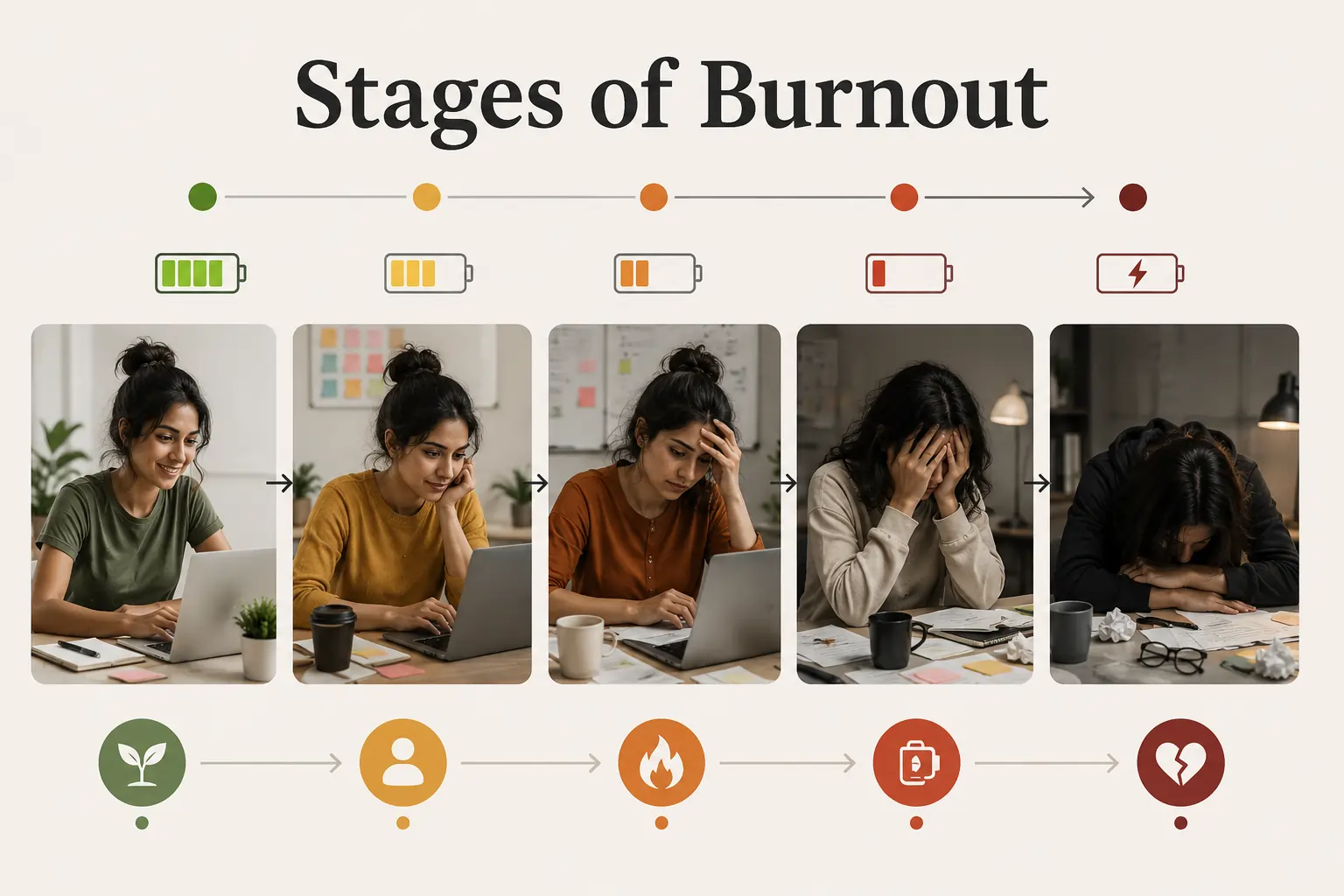
Burnout rarely appears overnight. Researchers commonly describe it unfolding in stages: an initial honeymoon phase of high engagement, onset of stress, chronic stress, the burnout stage itself, and finally habitual burnout if nothing changes. Recognising which stage you are in matters because early intervention is far easier than recovery from advanced burnout.
| Stage | What It Looks Like |
| 1.Honeymoon phase | High engagement and enthusiasm; some early stress but largely managed |
| 2. Onset of stress | Occasional fatigue, irritability, and reduced job satisfaction begin appearing |
| 3. Chronic stress | Persistent exhaustion, cynicism, and procrastination; physical symptoms emerge |
| 4. Burnout | Full presentation — significant exhaustion, detachment, and reduced effectiveness |
| 5. Habitual burnout | Burnout becomes embedded; may contribute to depression or chronic health problems if unaddressed |
For the complete stage-by-stage breakdown, including signs you are recovering and how stages map onto recovery, see signs and symptoms of burnout and our burnout recovery and treatment guide.
What Causes Burnout
Burnout is rarely caused by workload alone. Maslach and Leiter’s research identifies six mismatches between a person and their environment that drive it:
| Mismatch | What It Looks Like |
| Workload | Demands consistently exceed time, staffing or energy available |
| Control | Limited say over how, when or where work gets done |
| Reward | Pay, recognition or meaning fails to match effort |
| Community | Poor support, conflict or isolation among colleagues |
| Fairness | Inconsistent treatment, favouritism or unclear processes |
| Values | Personal values conflict with the organisation’s actual priorities |
Source: Maslach C, Leiter MP. World Psychiatry. 2016;15(2):103-111.
Burnout from work is the most studied form, but the same mechanism applies to parenting, caregiving and study. For the full breakdown of workplace-specific causes — including Gen Z workplace burnout and what employers can do — see our guide to workplace and job burnout. Burnout in specific high-risk roles — nursing, teaching, caregiving, parenting, and founders — is covered in our guide to burnout in caring and high-stress professions.
Risk Factors for Burnout
Certain individual, role-based, and organisational factors increase the likelihood of developing burnout. Understanding your own risk profile can support earlier recognition and prevention.
| Risk Factor Category | Examples |
| Individual | Perfectionism, difficulty setting boundaries, strong identification of self-worth with performance, limited social support |
| Role-based | High emotional labour roles (nursing, teaching, caregiving); high-autonomy-but-high-risk roles (founders, sole traders); unpaid caregiving and parenting |
| Organisational | Chronic understaffing, poor management support, unclear role expectations, lack of recognition, organisational injustice |
| Life stage / circumstance | Major life transitions, concurrent caregiving responsibilities, financial pressure, limited recovery time outside work |
| Neurodivergence | Autistic and ADHD individuals face additional burnout risk from masking, sensory overload, and executive function strain — distinct from general burnout |
Neurodivergent burnout (autistic burnout and ADHD burnout) has distinct causes and a different recovery path to general burnout, primarily centred on reducing masking and sensory load rather than simply reducing hours. See our dedicated guide to autistic and ADHD burnout for the full picture.
Protective Factors: What Reduces Burnout Risk
Just as certain factors increase burnout risk, others are consistently associated with lower risk and faster recovery when burnout does occur.
- Psychological safety — feeling safe to raise concerns, ask for help, or admit mistakes without fear of punishment
- Strong social support — both at work and outside it; isolation consistently predicts worse burnout outcomes
- Perceived control — even modest autonomy over how work is done significantly reduces burnout risk
- Values alignment — feeling that your role’s actual priorities match your personal values
- Adequate recovery time — protected non-work time that is genuinely free from work-related demands
- Early help-seeking — addressing rising stress before it becomes entrenched shortens recovery substantially
Burnout, Depression and Anxiety: How They Differ
Because burnout and depression share fatigue, low motivation and difficulty concentrating, people often ask whether what they are experiencing is burnout versus depression, or something closer to anxiety. The short answer is that burnout is tied to a specific source of chronic stress and tends to improve when that source changes, while depression and anxiety are clinical conditions that can occur independently of any single stressor and require their own diagnosis and treatment.
Prolonged, unaddressed burnout is also a recognised risk factor for developing depression — which is one reason ongoing symptoms should be assessed by a GP or psychologist rather than left unchecked.
Our full comparison breaks this down symptom by symptom, including a detailed feature-by-feature table and the distinction between burnout and anxiety specifically: see burnout vs depression vs anxiety
Diagnosing Burnout
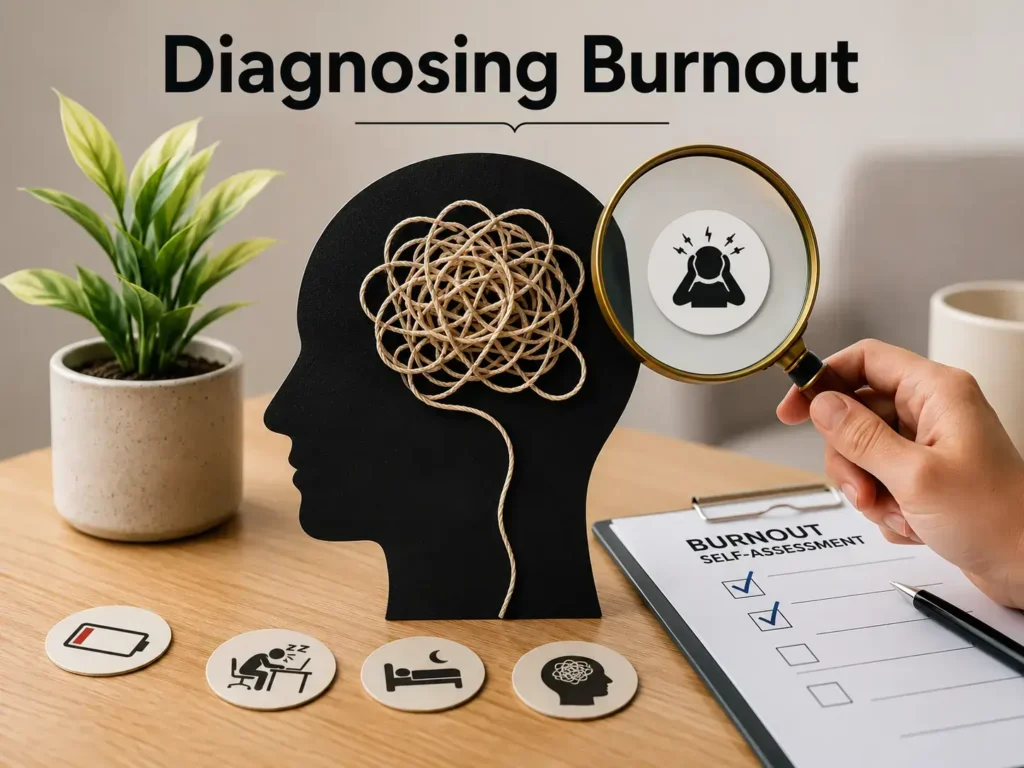
There is no single blood test or scan for burnout. The Maslach Burnout Inventory remains the most widely used and validated assessment tool, measuring the three dimensions above. The Copenhagen Burnout Inventory is a recognised alternative, particularly useful for distinguishing personal, work-related, and client-related burnout.
A psychologist or GP can use a combination of structured questionnaires and a clinical conversation to assess burnout severity and rule out depression, anxiety or a physical health condition presenting with similar symptoms — including thyroid dysfunction and anaemia, which can mimic burnout fatigue.
When Does Burnout Become a Medical Concern?
Burnout itself is not classified as a medical diagnosis, but it crosses into medical concern territory when symptoms persist beyond a few weeks, significantly affect daily functioning, or are accompanied by signs of depression (persistent low mood, hopelessness, loss of interest) or anxiety (excessive worry, panic symptoms). At this point, a GP or psychologist assessment is the appropriate next step — not because burnout itself is dangerous, but because untreated burnout increases the risk of developing a diagnosable mental health condition and can worsen physical health over time.
Burnout: Myths vs Facts
| Myth | Fact |
| Burnout means you are weak or lazy. | Burnout is a recognised occupational phenomenon caused by a structural mismatch between job demands and available resources, not a personal failing. |
| A holiday will fix burnout. | Time off help acute exhaustion, but rarely resolves burnout alone if the underlying structural cause is unaddressed. |
| Only high-pressure executives get burnout. | Burnout affect people across all roles, including unpaid caregivers, parents, students, and people in low-control, high-demand jobs. |
| Burnout and being tired are the same thing. | Ordinary tiredness resolves with sleep or a weekend off, whereas burnout is a sustained, multi-dimensional exhaustion that does not resolve with short-term rest alone. |
| You have to quit your job to recover. | Many people recover while remaining in their role once workload, boundaries, and support are genuinely addreseed. |
| Adrenal glands “burn out” and stop working from stress. | This is not supported by mainstream endocrinology. what’s well evidence is HPA-axis dysregulation under chronic stress, which produces similar symtoms. |
For a deeper look at adrenal fatigue claims specifically, and what the evidence actually supports, see our guide to adrenal fatigue and emotional burnout.
How to Recover From Burnout
Recovery is possible, and for most people it does not require leaving a job, relationship or life entirely; it requires structural change plus genuine rest. Most people see meaningful improvement within four to twelve weeks of properly addressing both rest and the structural cause, though full recovery from more severe or prolonged burnout can take three to twelve months.
Generic self-care advice — rest, exercise, eat well — matters, but on its own it rarely addresses the structural mismatch (workload, control, reward, fairness, community or values) that caused burnout in the first place. Effective recovery typically moves through three stages: acute rest, structural reset, and gradual, monitored re-engagement.
Our detailed recovery and treatment guide walks through this staged approach in full, including how to recover from burnout while still working, prevention strategies, and treatment options including therapy:
Workplace Support and Accommodations in Australia
Australian employees experiencing burnout have access to several formal support pathways, in addition to personal recovery strategies:
- Employee Assistance Programs (EAPs) — many Australian employers offer free, confidential counselling sessions through an EAP; check with HR for access details
- Safe Work Australia guidance — recognises psychosocial hazards including burnout, and outlines employer obligations to identify and manage these risks
- Reasonable workplace adjustments — temporary changes to workload, hours, or responsibilities while recovering, which can often be negotiated informally or formally with HR
- Medical certificates and leave — a GP can provide documentation supporting sick leave or a graduated return-to-work plan where needed
For specific guidance on raising burnout with an employer, anti-burnout workplace plans, and what to do if workplace conditions are the primary driver, see our guide to workplace and job burnout.
When to Seek Professional Help
Speak with a GP or psychologist if burnout symptoms have lasted more than a few weeks, are affecting your ability to function at work or home, or are accompanied by symptoms of depression such as persistent low mood, hopelessness or loss of interest in things you once enjoyed.
If you are having thoughts of self-harm, contact Lifeline on 13 11 14 or, in an emergency, call 000. Support is also available through Beyond Blue on 1300 22 4636.
The Bottom Line
- Burnout is an occupational phenomenon recognised by the WHO and by Safe Work Australia as a psychosocial hazard — not a personal weakness or a medical diagnosis in its own right
- It builds gradually across physical, emotional and behavioural domains, which is why early signs are easy to miss
- Six structural mismatches — workload, control, reward, community, fairness, and values — drive most burnout, regardless of role
- Burnout, depression and anxiety overlap but are not the same; persistent or worsening symptoms deserve a proper clinical assessment
- Neurodivergent burnout (autistic and ADHD burnout) has distinct causes and recovery needs compared with general occupational burnout
Recovery is realistic at every stage and improves significantly with both rest and structural change — most people see real improvement within 4–12 weeks
References
- World Health Organization. Burnout an “occupational phenomenon”: International Classification of Diseases. WHO; 2019.
- Maslach C, Leiter MP. Understanding the burnout experience: recent research and its implications for psychiatry. World Psychiatry. 2016;15(2):103-111.
- Maslach C, Jackson SE, Leiter MP. Maslach Burnout Inventory Manual. 4th ed. Mind Garden; 2018.
- Beyond Blue. Burnout: signs, causes and what to do. Beyond Blue; 2025.
- Safe Work Australia. Psychosocial hazards and workplace burnout. SWA; 2025.
- Salvagioni DAJ, et al. Physical, psychological and occupational consequences of job burnout: a systematic review of prospective studies. PLoS ONE. 2017;12(10).
- Bianchi R, Schonfeld IS, Laurent E. Burnout-depression overlap: a review. Clinical Psychology Review. 2015;36:28-41.
- Kristensen TS, et al. The Copenhagen Burnout Inventory: a new tool for the assessment of burnout. Work & Stress. 2005;19(3):192-207.
- Demerouti E, et al. The job demands-resources model of burnout. Journal of Applied Psychology. 2001;86(3):499-512.
- Australian Psychological Society. Workplace stress and burnout fact sheet. APS; 2025.
Last reviewed: 2026. This article is for general information only and does not replace personalised advice from a qualified health professional.