

Medically reviewed | Last updated: 2026 | Reading time: ~13 minutes
Burnout, depression and anxiety can feel almost identical from the inside — exhaustion, low motivation, a fog that will not lift — which is exactly why so many people struggle to tell them apart. Recognising the signs and symptoms of burnout early is often the first step toward untangling which of the three is actually happening.
Burnout may improve when the underlying stressors are addressed, although many people also require structured psychological support and recovery strategies; it does not always resolve simply because circumstances change. Depression and anxiety are clinical conditions that can occur independently of any single stressor, often need their own treatment, and do not necessarily resolve just because circumstances improve. The three frequently co-occur, so professional assessment is recommended when symptoms persist.
Burnout vs Depression
Burnout vs depression is one of the most common comparisons people search for, because the two share fatigue, poor concentration, and reduced motivation. The key difference lies in source and scope. Burnout is context-specific, usually tied to workplace burnout, caregiving or another sustained demand, and symptoms often ease noticeably when that context changes, such as during leave or after a job change. Depression is a clinical mood disorder — referred to as Major Depressive Disorder (MDD) under DSM-5-TR criteria — that affects mood, thinking and behaviour across all areas of life, regardless of context, and typically requires its own treatment such as therapy or medication.
| Feature | Burnout | Depression |
| Trigger | Tied to a specific chronic stressor (often work) | Can occur without any clear external trigger |
| Scope | Often improves when the stressor changes | Persists across contexts, even positive ones |
| Core feeling | Exhaustion, cynicism, detachment from the role | Persistent low mood, hopelessness, loss of interest |
| Self-worth | Tied to performance in the specific role | Often global, affecting self-worth broadly |
| Recovery | Structural change plus rest | Clinical treatment, therapy and/or medication |
Source: Bianchi R, Schonfeld IS, Laurent E. Clinical Psychology Review. 2015;36:28-41.
Burnout and depression are not mutually exclusive. Burnout or depression is rarely an either-or question in clinical reality; prolonged, unaddressed burnout is a recognised risk factor for developing depression, which is why ongoing burnout symptoms should be assessed by a GP or psychologist rather than left unchecked.
Burnout vs Anxiety
Burnout and anxiety overlap in symptoms such as irritability, poor concentration and physical tension, but the underlying experience differs. Anxiety — including Generalised Anxiety Disorder (GAD) — centres on persistent worry, fear or anticipation of threat, often regardless of current workload. Burnout centres on depletion from sustained demand, with less of the future-focused worry pattern typical of generalised anxiety. In practice, chronic burnout can trigger anxiety symptoms, particularly anticipatory dread about returning to the source of stress, which is part of why the two are so often confused.
Burnout vs Stress
Quick summary: Acute stress is a short-term response to a specific demand and resolves once the demand passes. Chronic stress is prolonged and unresolved. Burnout is what can develop when chronic stress continues unaddressed over months, adding cynicism and a sense of reduced accomplishment on top of exhaustion.
| Feature | Acute stress | Chronic stress | Burnout |
| Duration | Short-term, resolves quickly | Ongoing, weeks to months | Prolonged, typically months or longer |
| Core experience | Heightened alertness, urgency | Persistent tension, fatigue | Exhaustion, cynicism, detachment |
| Function | Can still feel capable and engaged | Coping but strained | Reduced sense of accomplishment |
| Recovery | Returns to baseline once demand ends | Improves once stressor is reduced | Needs rest plus structural change |
In short, burnout is best understood as the end stage of unaddressed chronic stress, rather than a separate, unrelated condition.
Burnout vs Compassion Fatigue
Compassion fatigue is a closely related but distinct concept, particularly relevant for nurses, carers, psychologists, teachers and others in caregiving or helping roles. While burnout stems broadly from sustained workload, control or reward mismatches, compassion fatigue specifically arises from repeated exposure to others’ suffering or trauma, sometimes described as secondary traumatic stress. This overlap is one of the reasons burnout in caring and high-stress professional roles looks and feels different from burnout in other lines of work.The two frequently coexist in helping professions, and distinguishing between them can guide more targeted support — for example, trauma-informed supervision for compassion fatigue versus workload and boundary changes for burnout.
Burnout vs Adjustment Disorder
Adjustment Disorder is a clinical diagnosis involving emotional or behavioural symptoms that develop in response to an identifiable stressor, typically within three months of onset, and that are out of proportion to what would normally be expected. It is frequently confused with burnout because both are linked to an identifiable stressor. The key difference is that adjustment disorder is a formal diagnostic category with defined criteria and a typical resolution within six months of the stressor (or its consequences) ending, while burnout is an occupational phenomenon, not a diagnosable mental disorder, and tends to be specifically tied to chronic workplace or caregiving demands rather than a single stressful event. A GP or psychologist can help clarify which pattern best fits a person’s presentation.
How Clinicians Distinguish Burnout, Depression and Anxiety
Because symptoms overlap substantially, clinicians rely on a combination of methods rather than a single test:
- Clinical history, including onset, context and whether symptoms are tied to a specific domain such as work
- Symptom duration and pattern — persistent and global versus context-specific and fluctuating
- Functional impairment across different areas of life (work, relationships, self-care)
- Validated screening tools, such as the PHQ-9 for depression, the GAD-7 for anxiety, and the Maslach Burnout Inventory (MBI) for burnout
These tools support clinical judgement but are not stand-alone diagnostic instruments — a Clinical Psychologist, GP or Psychiatrist interprets results alongside the full clinical picture.
Can Burnout, Anxiety and Depression Occur Together?
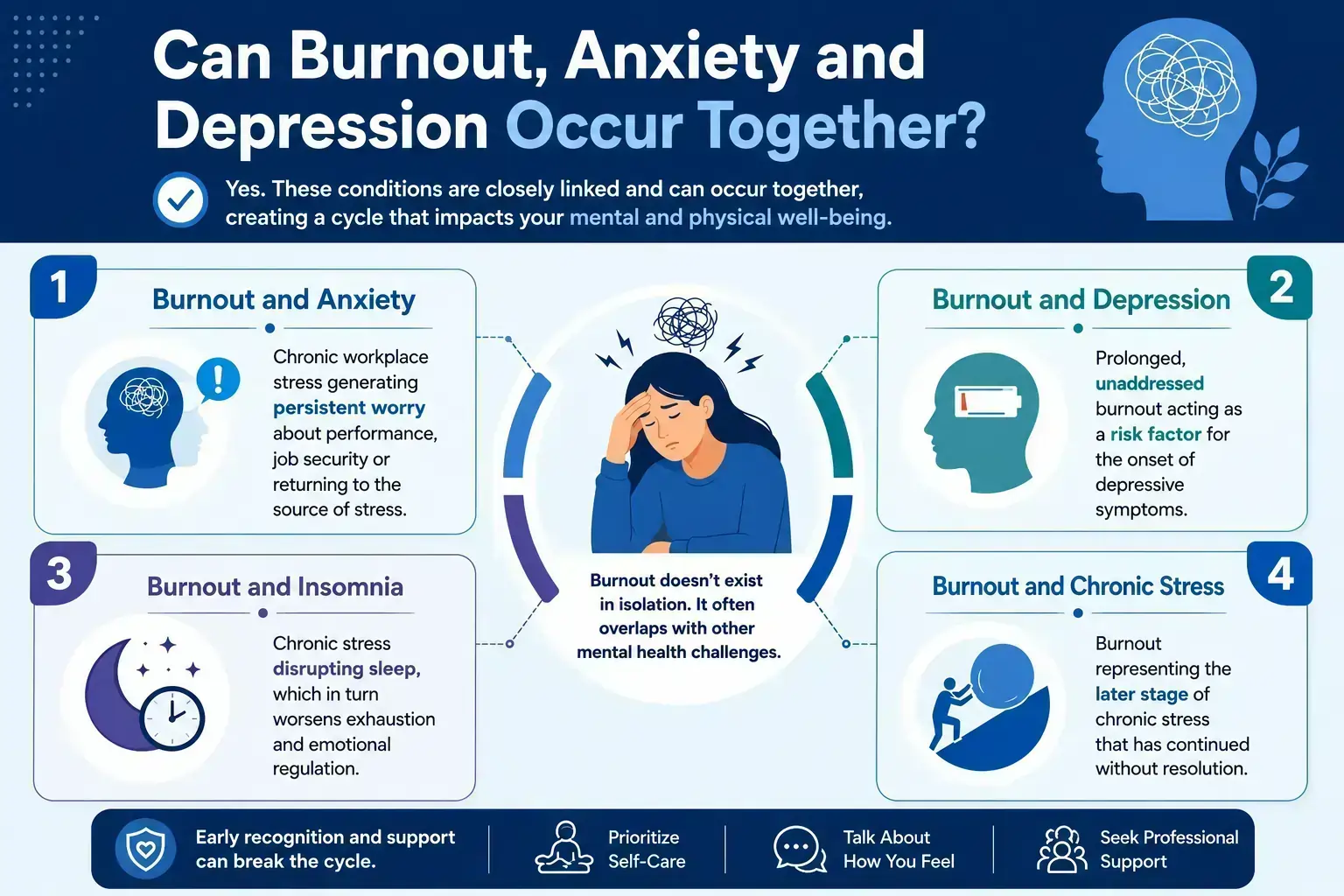
Yes, and this is common rather than the exception. Typical patterns include:
- Burnout and anxiety: chronic workplace stress generating persistent worry about performance, job security or returning to the source of stress
- Burnout and depression: prolonged, unaddressed burnout acting as a risk factor for the onset of depressive symptoms
- Burnout and insomnia: chronic stress disrupting sleep, which in turn worsens exhaustion and emotional regulation
- Burnout and chronic stress: burnout representing the later stage of chronic stress that has continued without resolution
Presentation can also vary by individual — for instance, autistic and ADHD burnout often shows up alongside sensory or executive-functioning strain that isn’t captured by standard burnout checklists. Co-occurrence is part of why self-diagnosis has real limits, and why a clinical assessment is recommended when more than one pattern seems to apply.
Burnout and Exhaustion
Burnout emotional exhaustion is one of the three core dimensions of burnout itself, alongside cynicism and reduced accomplishment, rather than a separate condition. General exhaustion, however, can stem from many causes unrelated to burnout, including poor sleep, medical conditions such as anaemia or thyroid dysfunction, or simply an unusually demanding short-term period. Some people also describe overlapping symptoms in the form of adrenal fatigue and emotional burnout, though this distinction is worth exploring with a GP rather than assuming. The distinguishing factor is duration and pattern: burnout-related exhaustion is chronic, tied to a specific ongoing demand, and accompanied by the cynicism and reduced-accomplishment dimensions described in the Maslach model.
Recovery Differences
Recovery pathways differ across the three conditions, although they often overlap in practice when conditions co-occur:
| Aspect | Burnout | Depression | Anxiety |
| Primary approach | Structural change (workload, boundaries) plus rest | Therapy and/or medication | Therapy (often CBT) and/or medication |
| Typical recovery time | Weeks to months, depending on severity | Varies; often months with treatment | Varies; often weeks to months with treatment |
| Workplace changes | Often central to recovery | May help but not sufficient alone | May help but not sufficient alone |
| Medication role | Not a direct treatment; may help co-occurring symptoms | Often a first-line or adjunct treatment | Often used alongside therapy for moderate-severe cases |
| Therapy role | Supportive (CBT, ACT, coaching) | Core treatment component | Core treatment component |
Does Medication Treat Burnout?
Medication does not directly treat burnout, since burnout is classified as an occupational phenomenon rather than a diagnosable medical condition. It may, however, be appropriate for co-occurring depression, anxiety or insomnia, following assessment by a GP or psychiatrist.
When to Seek a Professional Opinion
Because burnout, depression and anxiety can overlap or co-occur, self-diagnosis based on a comparison table has real limits. A GP or psychologist can use validated tools, including the Maslach Burnout Inventory alongside standard depression and anxiety screeners such as the PHQ-9 and GAD-7, to clarify what is actually happening and recommend the right treatment path.
Red Flag Symptoms — Seek Urgent Assessment
- Suicidal thoughts
- Self-harm
- Severe hopelessness
- Symptoms of psychosis
- Inability to function in daily life
- Panic attacks with chest pain
- Severe, prolonged insomnia
- Substance misuse
- Significant unintended weight loss
In an emergency call 000. For urgent support, contact Lifeline on 13 11 14 or Beyond Blue on 1300 22 4636.
Getting Assessed and Supported in Australia
- GP assessment: usually the first step to rule out physical causes and discuss referral options
- Medicare Mental Health Treatment Plan: enables rebated psychology sessions when arranged through a GP
- Psychology rebates: available under a Mental Health Treatment Plan, subject to Medicare eligibility criteria
- Employee Assistance Programs (EAPs): confidential, employer-funded short-term counselling, often a useful first point of contact
- Safe Work Australia: guidance on psychosocial hazards and employer obligations relevant to work-related burnout
- Fair Work Ombudsman: information on leave entitlements and flexible work arrangements during recovery
Is burnout covered by Medicare? Burnout itself is not a Medicare-billable diagnosis, but related conditions such as depression, anxiety or adjustment disorder identified during assessment can be covered under a Mental Health Treatment Plan.
The Bottom Line
- Burnout is a real, measurable state of exhaustion, not a personal failing.
- Early recognition shortens recovery time significantly.
- Burnout, depression and anxiety frequently overlap or co-occur, and self-diagnosis has real limits.
- Recovery requires both rest and structural change, not rest alone.
- Persistent symptoms beyond a few weeks warrant a conversation with a GP or psychologist.
References
- World Health Organization. Burnout an “occupational phenomenon”: International Classification of Diseases (ICD-11). WHO; 2019.
- Bianchi R, Schonfeld IS, Laurent E. Burnout-depression overlap: a review. Clinical Psychology Review. 2015;36:28-41.
- American Psychiatric Association. Diagnostic and Statistical Manual of Mental Disorders, 5th ed., text revision (DSM-5-TR). 2022.
- Beyond Blue. Anxiety and burnout: how they differ. Beyond Blue; 2025.
- Safe Work Australia. Work-related psychological health and safety guidance.
- Fair Work Ombudsman. Leave entitlements and flexible working arrangements.
Last reviewed: 2026. This article is for general information only and does not replace personalised advice from a qualified health professional. If you are having thoughts of self-harm, contact Lifeline on 13 11 14 or, in an emergency, call 000. The Burnout vs Stress, Compassion Fatigue and Adjustment Disorder sections were added to broaden topical coverage; confirm current search volume for these exact phrases before heavy additional SEO investment.