

Medically reviewed by: Clinical Psychologist, TrueWell Clinic | Written by: Health Content Team, TrueWell Clinic
Last updated: 2026 | Reading time: ~11 minutes | Editorial policy: clinically reviewed and updated annually or when new evidence is published.
If you have been asking yourself what does burnout feel like, chances are you are already living through some of it.
Quick answer: The signs of burnout fall into three groups: physical (exhaustion, headaches, low immunity), emotional and mental (cynicism, numbness, poor concentration), and behavioural (withdrawal, procrastination, increased use of alcohol or screens to cope). Burnout symptoms build gradually over weeks or months, typically worsen if unaddressed, and ease within weeks to months once both rest and the underlying cause are addressed.
Why Recognising the Signs of Burnout Matters
Burnout symptoms rarely arrive as one dramatic moment. They accumulate, which is exactly why so many people only notice signs of burnout at work once a colleague, partner or GP points them out. Naming what you are experiencing early is the single biggest factor in shortening recovery time.
If what you’re reading here feels familiar, that recognition itself is meaningful information — not a character flaw. Burnout is a measurable, well-documented physiological and psychological state, not a sign of weakness or poor coping. Clinicians who work with burnout regularly note that the people most likely to miss early signs are often the most conscientious — the tendency to push through discomfort that makes someone reliable at work is the same tendency that delays recognising burnout in themselves.
Physical Signs of Burnout
Physical symptoms of burnout are the body’s way of registering chronic stress hormonally and physically, even when the mind is trying to push through. These occur because sustained stress keeps the body’s stress-response system (the HPA axis) activated well beyond what it is designed for, affecting sleep, digestion, immune function and cardiovascular regulation.
| Symptom | Why It Happens | What It Often Feels Like |
| Fatigue that does not lift after sleep | Chronic stress disrupts deep sleep stages even when total sleep time seems adequate | Waking up already tired; needing caffeine just to function at baseline |
| Frequent headaches, jaw clenching or muscle tension | Sustained muscular tension from chronic stress activation, often worst in jaw, neck and shoulders | Tension headaches; waking with a sore jaw from nighttime clenching |
| Digestive issues — nausea or appetite changes | The gut is highly sensitive to chronic stress hormones; appetite regulation is disrupted | Skipping meals without noticing, or stress-eating; nausea before demanding tasks |
| Lowered immunity, getting sick more often | Chronic cortisol elevation suppresses immune function over time | Catching colds more easily; minor illnesses lingering longer than usual |
| Sleep disturbance — insomnia or oversleeping | Dysregulated stress hormones disrupt normal sleep-wake (circadian) rhythm | Lying awake replaying the day; or sleeping 9+ hours and still waking exhausted |
| Changes in heart rate or blood pressure | Sustained activation of the sympathetic nervous system (“fight or flight”) | Heart racing before unremarkable tasks; noticing your own pulse under stress |
| Chest tightness | Often related to shallow breathing patterns and muscular tension under chronic stress, rather than a cardiac issue — though new chest pain should always be medically assessed | |
| Dizziness or lightheadedness | Can result from disrupted sleep, dehydration, irregular eating, or hyperventilation patterns associated with chronic stress |
⚠️ Red flag — seek urgent medical review: New or worsening chest pain, fainting, severe or unexplained weight loss, or any symptom that feels medically alarming should always be assessed by a doctor promptly rather than assumed to be burnout. Burnout can produce physical symptoms, but it should never be used to explain away a finding that needs proper medical evaluation.
Emotional and Mental Burnout Symptoms
Mental burnout symptoms often show up before physical ones, but they are easier to dismiss as “just a bad week.” Emotional symptoms reflect the depletion of the cognitive and emotional regulation resources that chronic stress consumes over time.
| Symptom | What It Often Looks Like |
| Emotional exhaustion | Feeling drained, flat or unable to access enthusiasm for things you used to enjoy — the hallmark first dimension of burnout in the Maslach model. |
| Cynicism or detachment | Growing emotional distance from work, colleagues, clients, study, or even family relationships. |
| Self-doubt and reduced sense of accomplishment | A persistent sense that your efforts are not good enough, even when objectively performing well. |
| Difficulty concentrating or remembering things | Brain fog — trouble following conversations, forgetting routine tasks, rereading the same paragraph repeatedly. |
| Irritability or a short temper | A noticeably lower tolerance for minor frustrations compared with your own baseline. |
| Increased tearfulness | Crying more easily or unexpectedly, often over things that would not normally trigger this response. |
| Increased anger or frustration | A shorter fuse, snapping at people you would not normally snap at, or feeling disproportionate frustration at small setbacks. |
| Anxiety symptoms layered on exhaustion | Anticipatory dread, particularly before returning to the source of chronic stress — distinct from generalised anxiety, though the two can overlap. |
Burnout can also temporarily strain relationships through irritability, withdrawal and reduced emotional availability, which is one reason addressing burnout matters beyond work performance alone. If chest-tightening anxiety, panic, or persistent low mood are part of what you are experiencing, it is worth understanding how these relate to and differ from burnout itself — see our comparison burnout vs depression vs anxiety.
What Does Burnout Feel Like, Day to Day?
People describe what does a burnout feel like in strikingly similar terms: running on empty, going through the motions, or feeling like a battery that no longer holds charge overnight. Mornings can feel heavier than the rest of the day, with dread building before tasks even begin.
In clinical conversations, a common pattern emerges: people describe functioning normally to the outside world while feeling, internally, as though they are operating on a significant deficit — getting through each task but with none of the satisfaction or energy that used to accompany it. Many describe a sense of watching themselves go through familiar motions rather than being fully present in them.
Behavioural Signs of Burnout
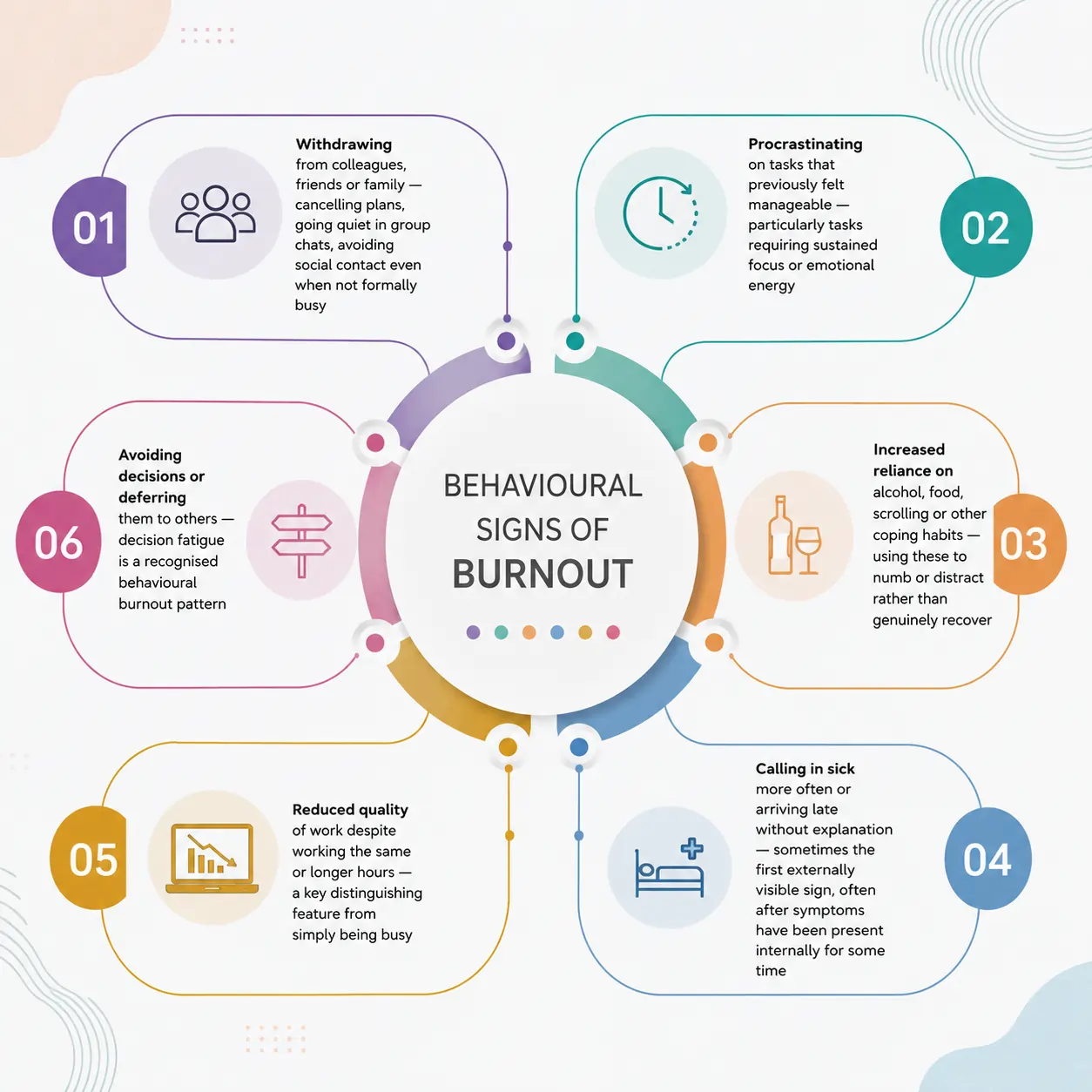
- Withdrawing from colleagues, friends or family — cancelling plans, going quiet in group chats, avoiding social contact even when not formally busy
- Procrastinating on tasks that previously felt manageable — particularly tasks requiring sustained focus or emotional energy
- Increased reliance on alcohol, food, scrolling or other coping habits — using these to numb or distract rather than genuinely recover
- Calling in sick more often or arriving late without explanation — sometimes the first externally visible sign, often after symptoms have been present internally for some time
- Reduced quality of work despite working the same or longer hours — a key distinguishing feature from simply being busy
- Avoiding decisions or deferring them to others — decision fatigue is a recognised behavioural burnout pattern
Mild, Moderate, and Severe Burnout: How Symptoms Differ by Severity
Burnout exists on a spectrum. Recognising where you sit on it can help determine the right next step — self-management, lifestyle change, or professional support.
| Severity | Typical Presentation | Recommended Response |
| Mild | Occasional fatigue, mild irritability, some loss of enthusiasm; still functioning well most days; symptoms ease somewhat over a weekend or short break. | Self-monitoring; protect recovery time; address early warning signs before they build. |
| Moderate | Persistent exhaustion most days; noticeable cynicism or detachment; declining concentration; some withdrawal from people or activities; symptoms do not meaningfully improve with a weekend off. | Structural changes (workload, boundaries) plus genuine rest; consider speaking with a GP or psychologist. |
| Severe | Pervasive exhaustion affecting daily functioning; significant withdrawal; marked cynicism or numbness; physical symptoms (sleep, immunity, digestion) significantly affected; symptoms persist despite time off. | Professional support strongly recommended — GP and/or psychologist; structural change is essential, not optional; assess for co-occurring depression or anxiety |
For a full, staged approach to addressing symptoms at any severity level, see our guide to how to recover from burnout.
Burnout Symptom Timeline: How Signs Typically Build
Burnout symptoms typically follow a recognisable pattern over time, though the exact pace varies significantly between individuals and circumstances.
| Timeframe | What Often Develops |
| Weeks 1–4 | Occasional fatigue and irritability; still largely attributed to a “busy patch”; sleep may start being affected. |
| Months 1–3 | Symptoms become more consistent; concentration and motivation begin noticeably declining; cynicism or detachment starts appearing. |
| Months 3–6 | Physical symptoms (headaches, digestive issues, lowered immunity) become more prominent; withdrawal from people and activities increases; work or task quality may begin to suffer. |
| 6+ months (unaddressed) | Symptoms become entrenched; risk of co-occurring depression or anxiety increases significantly; recovery typically takes longer the further burnout has progressed. |
ℹ️ This timeline is general, not diagnostic. Some people move through stages faster, especially under acute high-intensity stress (e.g. a major project, crisis caregiving period, or organisational change). The key principle holds regardless of pace: earlier recognition consistently shortens recovery time.
Signs of Burnout in Women
Research on signs of burnout in women suggests they are more likely to report emotional exhaustion and somatic symptoms such as headaches and sleep disruption, often layered with the unpaid mental load of caregiving and household management, which can mask burnout as “just being tired” for far longer than it should be.
Symptoms of burnout in women frequently overlap with hormonal and life-stage factors — including perimenopause, postpartum recovery, and the menstrual cycle — which can intensify or mimic burnout symptoms such as fatigue, irritability, and disrupted sleep. This overlap is part of why an individual clinical assessment matters more than a checklist alone; a GP can help distinguish hormonal contributors from burnout itself, or identify where both are occurring together.
Signs of Burnout in Men
Burnout in men is equally real but is sometimes expressed and reported differently. Research suggests men may be somewhat more likely to present with irritability, anger, and behavioural withdrawal than with overt emotional exhaustion, and may be less likely to label what they are experiencing as burnout or to seek help for it — consistent with broader patterns in men’s help-seeking for mental health concerns generally.
- Increased irritability or anger, sometimes mistaken for a personality change rather than a symptom
- Withdrawal expressed as increased work hours or busyness, rather than visible disengagement
- Physical symptoms (tension headaches, digestive issues, sleep disruption) reported without connecting them to stress
- Increased reliance on alcohol or avoidance behaviours as a primary coping pattern
The underlying physiological and psychological mechanism of burnout does not differ by gender — what differs is often presentation and likelihood of recognising or naming the experience.
Signs of Burnout in Students and Adolescents
Academic burnout in students and adolescents mirrors the same three-dimensional pattern — exhaustion, cynicism, and reduced sense of accomplishment — but is triggered by academic rather than workplace demands.
- Exhaustion specifically tied to study or school, often worse during exam periods or assessment deadlines
- Growing cynicism about the value or point of study (“why bother”), distinct from ordinary disengagement
- Declining academic performance despite continued or increased time spent studying
- Procrastination on academic tasks, specifically, even when general functioning seems intact
- Physical symptoms — headaches, sleep disruption, appetite changes — clustering around assessment periods
- Withdrawal from peer relationships and extracurricular activities previously enjoyed
Parents, educators, and university support staff are often well placed to notice early academic burnout signs before a student recognises them independently, particularly the shift from “stressed about an exam” to a more persistent, weeks-long pattern of exhaustion and detachment.
Burnout Symptoms in Neurodivergent Individuals
Autistic and ADHD individuals can experience burnout that looks meaningfully different from general burnout — including skill regression, increased sensory sensitivity, and shutdowns or meltdowns rather than the more typical cynicism-and-exhaustion pattern. The causes and recovery path differ too, centring on reducing masking and sensory load rather than simply reducing workload. See our dedicated guide to autistic and ADHD burnout for the full picture.
High-Functioning Burnout
High-functioning burnout describes people who continue to perform well, meet deadlines, and appear composed on the outside while privately experiencing every sign listed above. It is one of the hardest forms to catch because external performance does not drop until burnout is already advanced.
What High-Functioning Burnout Often Looks Like:
- Meeting deadlines and maintaining outward professionalism while feeling internally depleted
- Relying heavily on willpower, caffeine, or perfectionism to maintain output
- Appearing calm or even high-achieving to colleagues, while experiencing significant private exhaustion, cynicism, or numbness
- Difficulty recognising the problem because “I’m still getting everything done” is mistaken for “I’m fine”
- Often noticed first by a partner, close friend, or during a quiet period (holiday, illness) when the usual momentum stops and exhaustion becomes harder to outrun
Clinically, high-functioning burnout is concerning precisely because the absence of visible performance decline delays help-seeking. By the time external functioning is affected, the underlying exhaustion has often been present for months. People who identify strongly with achievement, reliability, or being “the one who copes” are statistically more likely to present this way.
Stages of Burnout
Stages of burnout syndrome typically progress through five recognisable phases. Recovery is realistic at every stage, but it becomes progressively harder the longer the underlying causes go unaddressed.
| Stage | Characteristics | Typical Duration if Unaddressed |
| 1. Honeymoon phase | High engagement, enthusiasm, and energy; some early stress is present but easily managed and even motivating. | Variable — can last months to years depending on role demands. |
| 2. Onset of stress | Occasional fatigue, mild irritability, reduced job satisfaction begin appearing; still largely manageable with rest. | Weeks to months. |
| 3. Chronic stress | Persistent exhaustion, cynicism, and procrastination become regular; physical symptoms (headaches, sleep, immunity) emerge. | Months. |
| 4. Burnout | Full presentation — significant exhaustion, detachment, and reduced effectiveness; symptoms now meet the full Maslach three-dimension pattern. | Can persist indefinitely without intervention. |
| 5. Habitual burnout | Burnout becomes embedded as a baseline state; significantly increased risk of depression or chronic physical health problems if unaddressed. | Can become a long-term pattern affecting multiple life domains. |
Burnout recovery stages tend to mirror this progression in reverse: rest first to address acute exhaustion, then boundary-setting and structural change to address the underlying mismatch, then gradual, monitored re-engagement. Recognising which stage you are in is one of the most useful things a self-assessment can offer, because it determines how urgently structural change — not just rest — is needed.
Burnout Tests and Self-Assessment
A burnout test or burnout symptoms test can be a useful starting point, but it is a screening tool, not a diagnosis.
The Maslach Burnout Inventory (MBI)
The most validated option used clinically is the Maslach Burnout Test (Maslach Burnout Inventory), which measures three dimensions: emotional exhaustion, depersonalisation (cynicism), and personal accomplishment. It was developed by researcher Christina Maslach and remains the gold-standard tool referenced in burnout research and clinical practice internationally.
Other Validated Burnout Screening Tools
- Copenhagen Burnout Inventory (CBI) — distinguishes personal, work-related, and client-related burnout; widely used in healthcare and caring-profession research
- Oldenburg Burnout Inventory (OLBI) — measures exhaustion and disengagement, with some advantages for occupations outside traditional human-services work
What a Self-Assessment Can and Cannot Tell You
A self-assessment can flag whether your symptom pattern is consistent with burnout and roughly how severe it appears. It cannot rule out depression, anxiety, a physical health condition, or determine the right treatment path — that requires a clinical conversation. If your results, or simply your gut sense, suggest burnout, the next right step is a conversation with a GP or psychologist, who can use a structured tool alongside clinical judgement to clarify what’s happening and rule out overlapping conditions.
Burnout vs Ordinary Stress, and Burnout vs Chronic Fatigue
Burnout vs Ordinary Stress
| Feature | Ordinary Stress | Burnout |
| Duration | Short-term, tied to a specific event or deadline. | Sustained over weeks or months. |
| Resolution | Resolves once the stressor passes. | Persists even during breaks or after the immediate demand eases. |
| Core feeling | Urgency, pressure, being “stretched”. | Depletion, cynicism, detachment from the role or activity itself. |
| Engagement | Often still feel engaged, even if overwhelmed. | Engagement and caring about the work/role itself diminishes. |
Burnout vs Chronic Fatigue Syndrome (ME/CFS)
Burnout and chronic fatigue syndrome (myalgic encephalomyelitis/CFS) can share the symptom of persistent exhaustion, but they are distinct. Burnout is tied to a specific source of chronic stress and includes the cynicism and reduced-accomplishment dimensions described in the Maslach model; it generally improves when the stressor changes and with rest plus structural change. Chronic fatigue syndrome is a distinct, diagnosable medical condition with specific diagnostic criteria, post-exertional malaise as a hallmark feature, and a different treatment approach. If fatigue is severe, disproportionate to exertion, or not improving despite addressing apparent stressors, a GP assessment is important to distinguish between the two.
Common Myths About Burnout Symptoms
| Myth | Fact |
| If you’re still performing well at work, you don’t have burnout | High functioning burnout is well-documented — performance is often the last thing to decline, not the first. |
| Burnout symptoms always include obvious sadness or crying | Many people experience burnout primarily as numbness, irritability, or anger rather than overt sadness. |
| Burnout only happens to people who don’t manage their time well | Burnout is driven by structural mismatches (workload, control, fairness) — time management skill does not protect against it. |
| If a weekend off helps, it wasn’t really burnout | Even genuine burnout can show temporary symptom relief from rest; the distinguishing feature is whether symptoms return once the same demands resume. |
| Burnout symptoms are the same for everyone | Symptom presentation varies meaningfully by individual, gender, neurotype, and role — see the sections above on signs in women, men, students, and neurodivergent individuals. |
Do Burnout Symptoms Differ by Profession?
The core three-dimensional pattern of burnout — exhaustion, cynicism, reduced accomplishment — is consistent across professions, but the specific triggers and presentation can differ. Healthcare workers often report compassion fatigue alongside standard burnout symptoms; teachers frequently report burnout tied closely to administrative load and classroom behaviour management; caregivers and parents often experience burnout without a clear “off switch” since caregiving roles rarely pause for rostered breaks. For the full breakdown of burnout in nursing, teaching, caregiving, parenting, and founder/small-business roles, see our guide to burnout in caring and high-stress professions.
The Bottom Line
- Burnout symptoms fall into three categories — physical, emotional/mental, and behavioural — and build gradually rather than appearing overnight
- Severity exists on a spectrum from mild to severe; the more advanced the stage, the more structural change (not just rest) is required
- High functioning burnout can hide behind strong external performance, which delays recognition and help-seeking
- Symptom presentation varies by gender, life stage, neurotype, and profession — a one-size checklist does not capture every experience
- A burnout test (such as the Maslach Burnout Inventory) is a useful screening starting point, not a diagnosis
- Burnout is a real, measurable state of exhaustion, not a personal failing
- Early recognition shortens recovery time significantly
- Recovery requires both rest and structural change, not rest alone
- Persistent symptoms beyond a few weeks warrant a conversation with a GP or psychologist
For the full burnout overview — including causes, the WHO classification, and how Australian workplace law treats burnout — see our complete pillar guide to burnout. For a staged plan to address what you’re noticing, see how to recover from burnout.
References
- Maslach C, Jackson SE, Leiter MP. Maslach Burnout Inventory Manual. 4th ed. Mind Garden; 2018.
- World Health Organization. Burnout an “occupational phenomenon”: International Classification of Diseases. WHO; 2019.
- Australian Psychological Society. Workplace stress and burnout fact sheet. APS; 2025.
- Kristensen TS, et al. The Copenhagen Burnout Inventory: a new tool for the assessment of burnout. Work & Stress. 2005;19(3):192-207.