
Everyday Anxiety: Causes, Patterns, and Wellness Strategies
Anxiety shows up in ordinary moments more often than most people expect. A racing heart before a big meeting. A restless night before a difficult conversation. A tight chest during a busy week at work. These experiences are common, and for many Australians, they form part of everyday life rather than a diagnosed condition.
Anxiety often behaves this way, showing up in ordinary situations rather than dramatic ones. It shares a lot in common with everyday stress, building slowly through poor sleep and disrupted routines rather than arriving without warning.
Recognising these patterns changes how anxiety feels. Once a response starts to make sense, it tends to feel less alarming and more manageable.
This article explains what typically drives everyday anxiety, how the nervous system responds under stress, and which lifestyle habits are commonly associated with better outcomes. It won’t diagnose anything or replace a conversation with a GP. If anxiety feels persistent, disproportionate, or hard to shake, that conversation is worth having.
What’s Happening in the Body: Anxiety Patterns and the Nervous System
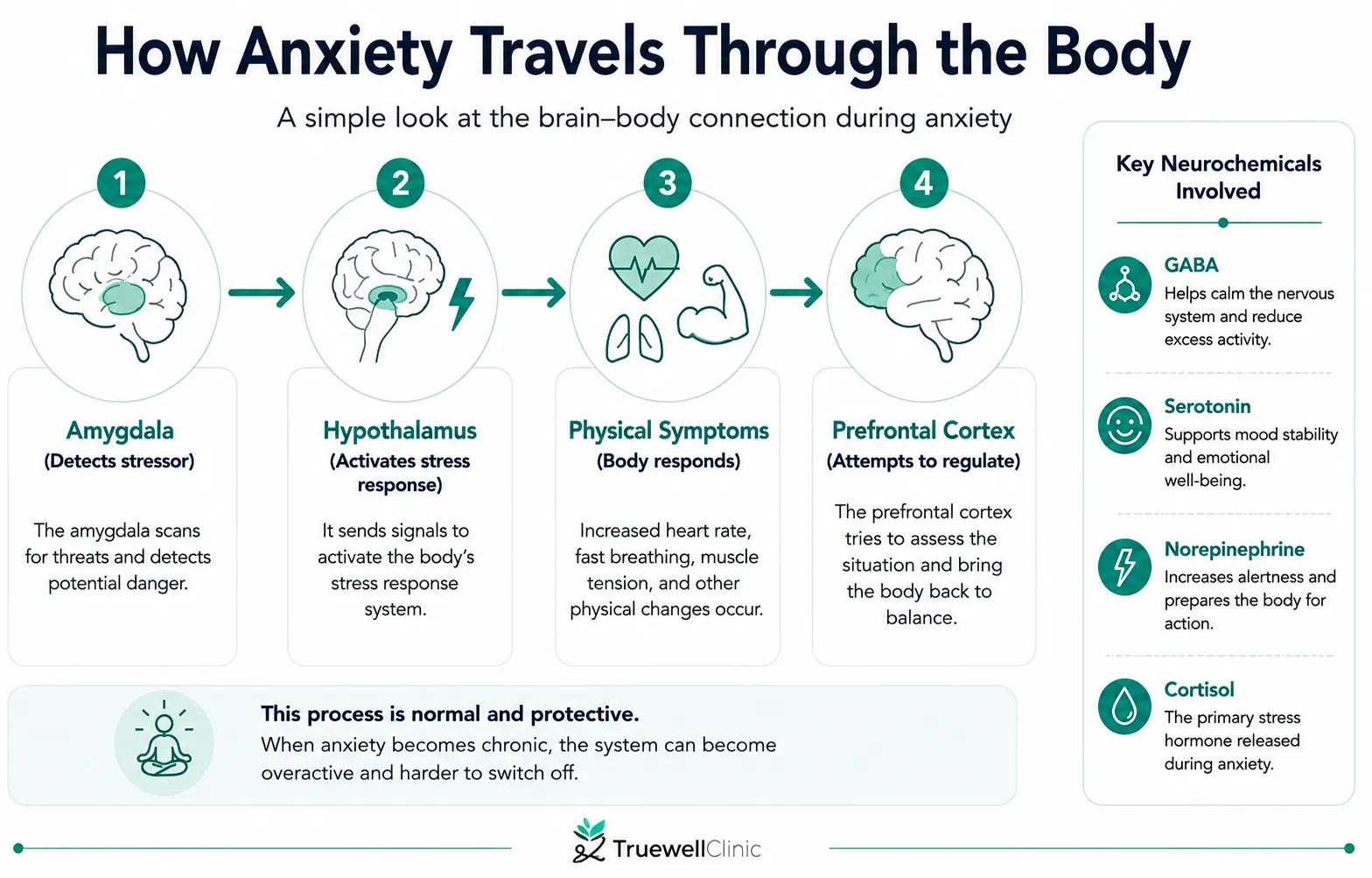
Anxiety is not just a mental experience. It begins as a physical response, shaped by several interconnected structures in the brain.
The amygdala acts as an early warning system. When it detects something stressful, real or perceived, it triggers a fear signal almost instantly.
The hypothalamus picks up that signal and activates the body’s stress response. This is what sends heart rate and breathing into overdrive.
The prefrontal cortex (PFC) acts like the brain’s rational control centre. It evaluates whether a threat is real and sends calming signals to the amygdala when there’s no actual danger. During intense anxiety, this control weakens, making it harder to switch off the brain’s alarm system.
The hippocampus adds another layer. It processes memory and can sometimes apply past stressful experiences to situations that are actually safe, reinforcing anxious patterns over time.
Alongside these structures, brain chemistry plays a role. Changes in GABA signalling, a calming neurotransmitter, may reduce the brain’s natural ability to settle after a stress response. Serotonin availability is linked to mood regulation, and shifts here are associated with persistent worry. Norepinephrine drives the physical alertness experienced during anxious moments, while cortisol, released through the body’s stress axis, can keep the body in a prolonged state of high alert when stress continues.
This is a normal, if uncomfortable, function of the nervous system. Understanding it is often the first step toward managing anxiety more effectively.
 Everyday Anxiety vs. Clinical Anxiety: Understanding the Difference
Anxiety exists on a spectrum. Most people feel it occasionally, and it settles once the situation passes.
What Everyday Anxiety Looks Like
Everyday anxiety is a normal, short-term response to stress. It shows up before events like exams, interviews, or difficult conversations.
It doesn’t usually require treatment. It also isn’t a sign that something is medically wrong.
Common features include:
- Tied to a specific event or situation
- Fades once the stressor passes
- Doesn’t disrupt daily routines in a lasting way
- Manageable through rest, movement, or simple coping habits
How Clinical Anxiety Appears
Clinical anxiety disorders differ in scale. They are not simply a stronger version of everyday worry.
According to the Australian Institute of Health and Welfare, anxiety disorders affect around 17% of Australians aged 16 to 85 in any given year. This makes anxiety the most commonly reported mental health condition in the country.
A diagnosis generally requires anxiety to be:
- Persistent over weeks or months
- Disproportionate to the actual situation
- Disruptive to work, relationships, or routines
- Present even without a clear trigger
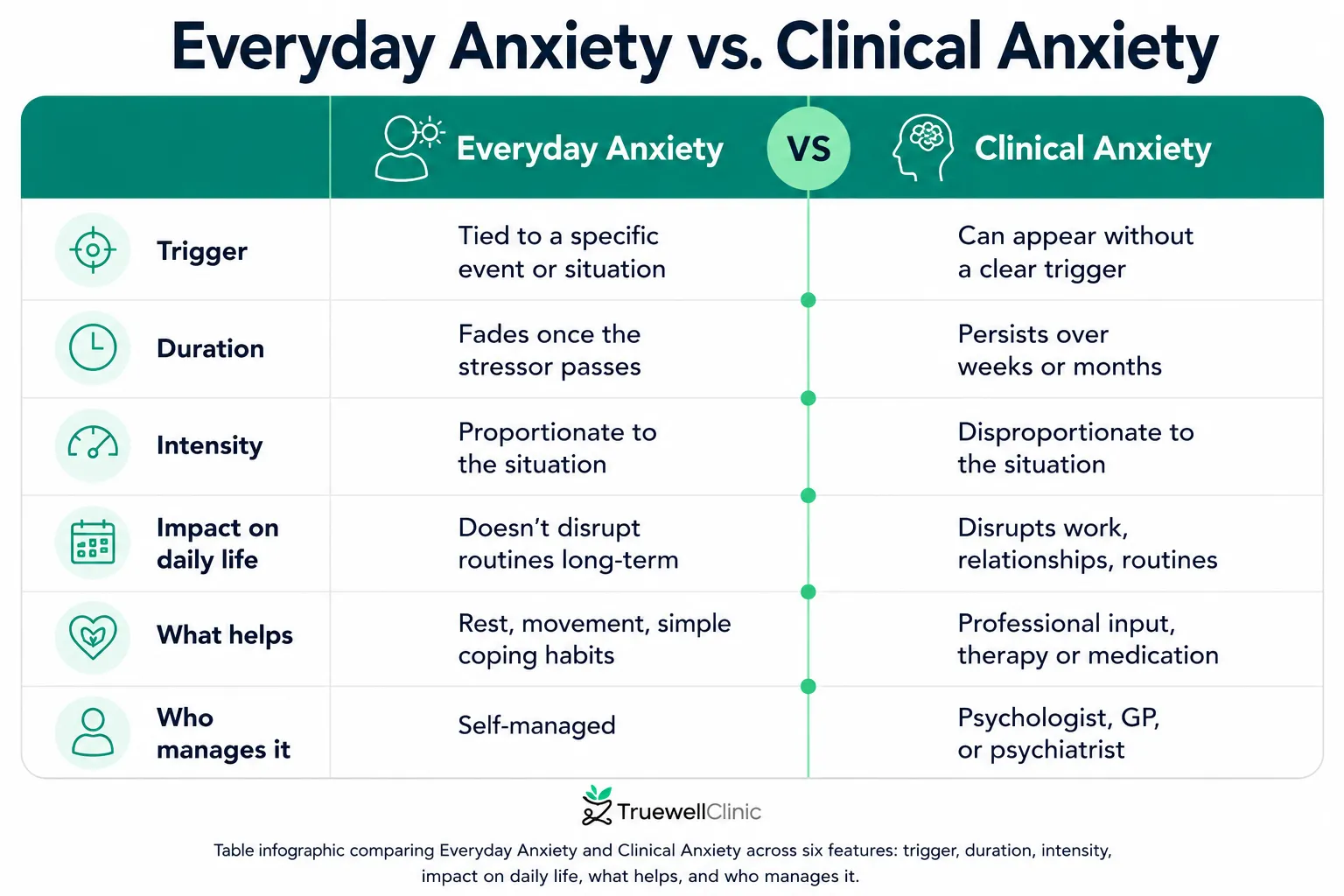
Everyday Anxiety vs. Clinical Anxiety at a Glance
| Feature | Everyday Anxiety | Clinical Anxiety |
| Trigger | Tied to a specific event or situation | Can appear without a clear trigger |
| Duration | Fades once the stressor passes | Persists over weeks or months |
| Intensity | Proportionate to the situation | Disproportionate to the actual situation |
| Impact on daily life | Doesn’t disrupt routines in a lasting way | Disrupts work, relationships, or routines |
| What helps | Rest, movement, simple coping habits | Professional input; therapy or medication |
| Who typically manages it | Self-managed | Psychologist, GP, or psychiatrist |
Why the Distinction Matters
The two forms of anxiety need different kinds of support.
Everyday anxiety often improves with lifestyle changes. Sleep, movement, and understanding the stress response can help.
Clinical anxiety usually needs professional input. A psychologist, GP, or psychiatrist may recommend therapy or medication.
There is no fixed line between the two. Anxiety can shift depending on other pressures in someone’s life. Duration and daily impact matter more than symptoms alone.
Common Worry Cycles and How They Build
Picture a work email left unanswered. By 6 pm, it’s forgotten. By 11 pm, it’s replaying on a loop, dragging three other unfinished tasks along.
That’s how worry tends to operate. It rarely stays contained to the moment that triggered it, and left alone, one small concern has a way of pulling in several others.
Why the Cycle Repeats
Worry often feels productive in the moment. The brain treats it as a form of problem-solving, even when nothing is actually being resolved.
This creates a loop:
- A concern arises
- The mind runs through possible outcomes
- No clear resolution appears
- The same concern resurfaces later, often with more intensity
Over time, this loop wears down more than mood. Research examining the connection between stress, rumination, and sleep found that unresolved worry can disrupt the ability to switch off at night, which in turn makes daytime anxiety harder to manage. Poor sleep and looping worry tend to reinforce each other, which is part of why sleep quality plays such a large role in breaking the cycle.
Interrupting the Pattern
Worry cycles usually respond better to interruption than to force. Trying to simply ‘stop worrying’ rarely works. Shifting attention, even briefly, tends to be more effective.
Common approaches include:
- Setting aside a specific time to worry, rather than letting it spread across the day
- Writing thoughts down instead of replaying them mentally
- Returning attention to a physical task or the immediate surroundings
- Addressing sleep disruption directly, since poor sleep tends to intensify worry the next day
These steps don’t make worry disappear. They just stop it from taking over the whole day.
Lifestyle Strategies That Support Everyday Anxiety
There’s not any single habit that can tackle anxiety on its own. What tends to help is a combination of small, consistent changes that ease pressure on the nervous system over time. None of these strategies work as a quick fix, but layered together, they can meaningfully shift how anxiety shows up day to day.
Movement and Exercise
Physical activity changes the body’s chemistry in ways that directly affect anxiety. Movement burns off some of the excess adrenaline and cortisol built up during a stress response, which is part of why a walk can settle a racing mind faster than sitting still with it.
Regular physical activity might be an effective way to help prevent or manage mild anxiety, alongside supporting better sleep and overall mood. The Australian Government’s physical activity guidelines recommend most adults aim for at least 30 minutes of moderate activity on most days of the week, though the guidelines note that any amount of movement is better than none for someone starting from a low baseline.
Not all exercise works the same way for everyone. Aerobic activity, such as brisk walking, swimming, or cycling, tends to have the strongest evidence behind it for reducing anxious symptoms. Even short sessions, around 20 to 30 minutes, can make a noticeable difference when done regularly. For someone who hasn’t exercised in a while, starting small matters more than starting hard. A short walk around the block, some light stretching, or even brisk housework counts as a genuine starting point, not a lesser substitute for ‘real’ exercise.
Strength-based activity also has a role, though the research behind it for anxiety specifically is less extensive than for aerobic exercise. Some people find resistance training useful less for the physical effect and more for the sense of structure and accomplishment it brings to a week.
Sleep and Nervous System Regulation
Sleep and anxiety influence each other in both directions. Poor sleep increases reactivity to stress the next day, and heightened anxiety makes it harder to fall asleep that night. Over time, this becomes a loop of its own, similar to the worry cycles covered earlier in this article.
A few habits tend to support better sleep quality:
- Keeping a consistent wake time, even on weekends
- Limiting screens in the hour before bed
- Avoiding caffeine in the afternoon and evening
- Reserving the bed for sleep rather than work or scrolling
- Winding down with a low-stimulation activity, such as reading, rather than checking messages one last time
Perfect sleep isn’t the goal here. Fewer disruptions to the nervous system’s ability to settle usually is.
Breathing and Relaxation Techniques
Slow, controlled breathing activates the parasympathetic nervous system, the part responsible for calming the body down after stress. Techniques like box breathing or extended exhales can shift physical symptoms within a few minutes, often before a conscious thought has caught up with what the body is already doing.
These techniques work best when practised regularly, not just pulled out during a crisis. Familiarity makes them far more effective in the moment they’re actually needed, in much the same way a habit only becomes automatic after enough repetition.
Cognitive Reappraisal
Cognitive reappraisal involves reframing how a situation is interpreted rather than trying to suppress the anxious feeling itself. Instead of ‘this presentation will go badly,’ a reappraised version might be ‘I’m prepared, and some nerves are normal before speaking.’
This isn’t about forced positivity. It’s a practical shift in perspective that can reduce how intensely the body reacts to a stressful thought. Over time, practising this shift can change the default interpretation someone brings to a stressful situation, rather than requiring conscious effort every time.
Everyday Lifestyle Anxiety Management
Beyond specific techniques, broader lifestyle anxiety management often comes down to routine and connection. Structure gives the day predictability, which reduces the mental load of constant decision-making. Regular contact with supportive people also appears to buffer against the physical effects of chronic stress, partly because social connection gives the nervous system a signal of safety that solitude doesn’t always provide.
Diet plays a smaller but still relevant role. Reducing caffeine and alcohol, both of which can heighten physical anxiety symptoms, is a modest but practical adjustment for people who notice a pattern between intake and symptom flare-ups.
Small, sustainable habits tend to outperform occasional intense efforts. Consistency matters more than intensity here, and it’s usually easier to sustain five small habits than one demanding overhaul.
Anxiety Self-Help Resources in Australia
Most people don’t need a clinical program to manage everyday anxiety. Small, consistent habits often do more than an overhauled routine ever could.
Australia has several government-backed services built specifically for this. Head to Health, run by the Australian Government, connects people to free or low-cost mental health support based on individual need, rather than pointing everyone toward the same service. It’s accessible online at headtohealth.gov.au. healthdirect operates a similar function, alongside a 24-hour nurse line on 1800 022 222 for anyone unsure what kind of support fits their situation.
For anxiety centred on excessive worry specifically, the Centre for Clinical Interventions in Perth publishes structured self-help workbooks written by clinical psychologists, free to access online.
For anyone in crisis or needing to talk immediately, Lifeline is available 24/7 on 13 11 14.
Self-help works best when it’s specific rather than general. A short list of go-to strategies tends to hold up better under stress than a vague intention to ‘manage anxiety better.’ A practical starting point might include:
- One grounding technique for acute moments, such as slow breathing or naming five things in the room
- One outlet for worry that isn’t just mental replay, like writing or talking it through
- A consistent wind-down routine before bed
- A short list of trusted people or services to reach out to, so the decision is already made before it’s needed
Self-help resources are designed to support everyday anxiety, not replace care for anxiety that’s become persistent or disruptive. If symptoms continue for weeks, worsen, or start affecting work and relationships, a conversation with a GP is a reasonable next step
When Everyday Anxiety May Need Professional Support
Lifestyle strategies help most people most of the time. But there’s a point where anxiety moves beyond something to manage alone.
Signs Worth Paying Attention To
A few patterns tend to signal that professional input would help:
- Anxiety that lasts for weeks rather than settling within days
- Worry that feels disproportionate to what’s actually happening
- Avoidance of situations, people, or responsibilities because of anxious feelings
- Physical symptoms that persist even when nothing stressful is happening
- Anxiety that starts interfering with work, sleep, or relationships
A single item on this list rarely confirms a diagnosis on its own. Seeing several together, and noticing them stick around, is a reasonable prompt to speak with someone qualified.
What That Support Can Look Like
Professional support doesn’t always mean intensive treatment. A GP can assess symptoms, rule out other causes, and refer to a psychologist if needed. Many people start with just one conversation to understand what they’re dealing with.
If you’re unsure whether what you’re experiencing fits the everyday or clinical end of the spectrum, our team at TrueWell Clinic can help point you toward the right next step.
Disclaimer:
This article provides general information and isn’t a substitute for individual medical advice. Anyone concerned about their anxiety should speak with a GP or another suitably qualified health professional.