

If you’ve ever felt a burning, shooting, or electric-shock sensation somewhere in your body, you may have wondered whether it’s nerve pain. Also called neuropathic pain, this type of pain happens when nerves are damaged or not working the way they should. It can feel very different from the ache of a pulled muscle or a sore joint, which is one reason people often struggle to describe it to a doctor.
Nerve pain can show up almost anywhere, though it’s commonly felt in the hands, feet, legs or face. For some people it fades on its own. For others, it lingers and becomes part of daily life. Research suggests nerve pain affects a significant number of Australians, and understanding what it typically feels like can make it easier to recognise and talk about with a GP.
This article looks at the common nerve pain symptoms, where it tends to occur, what may cause it, and when it’s worth seeking medical advice. If your symptoms are persistent or worsening, a healthcare professional can help assess what’s going on.
What Is Nerve Pain?
Nerve pain is also known as neuropathic pain or neuralgia. Either way, it means the same thing: the nerves themselves have been damaged or irritated, and that’s what’s producing the pain, not a pulled muscle, not a sore joint, not the usual suspects.
That’s really the key difference. A sprained ankle throbs. A bruise feels tender when you press on it. Nerve pain doesn’t follow those rules. It might feel like a burning sensation under the skin, or a sudden shooting pain that catches you off guard. Sometimes it’s closer to a jolt, like touching a live wire. Some people get tingling along with it, or patches of numbness that come and go. It can hit suddenly, right after an injury, or creep in slowly if there’s any health condition behind it.
Whether it sticks around depends a lot on the cause. Some cases resolve in days or weeks. Others become a long-term, ongoing issue. Post-herpetic neuralgia is one example general practitioners (GPs) see fairly often, where pain continues in the skin long after a shingles rash has cleared up. Trigeminal neuralgia is another, causing sharp, sudden bursts of pain across the face or jaw. And then there’s peripheral neuropathy, frequently tied to diabetes, which affects the nerves running out to the hands and feet.
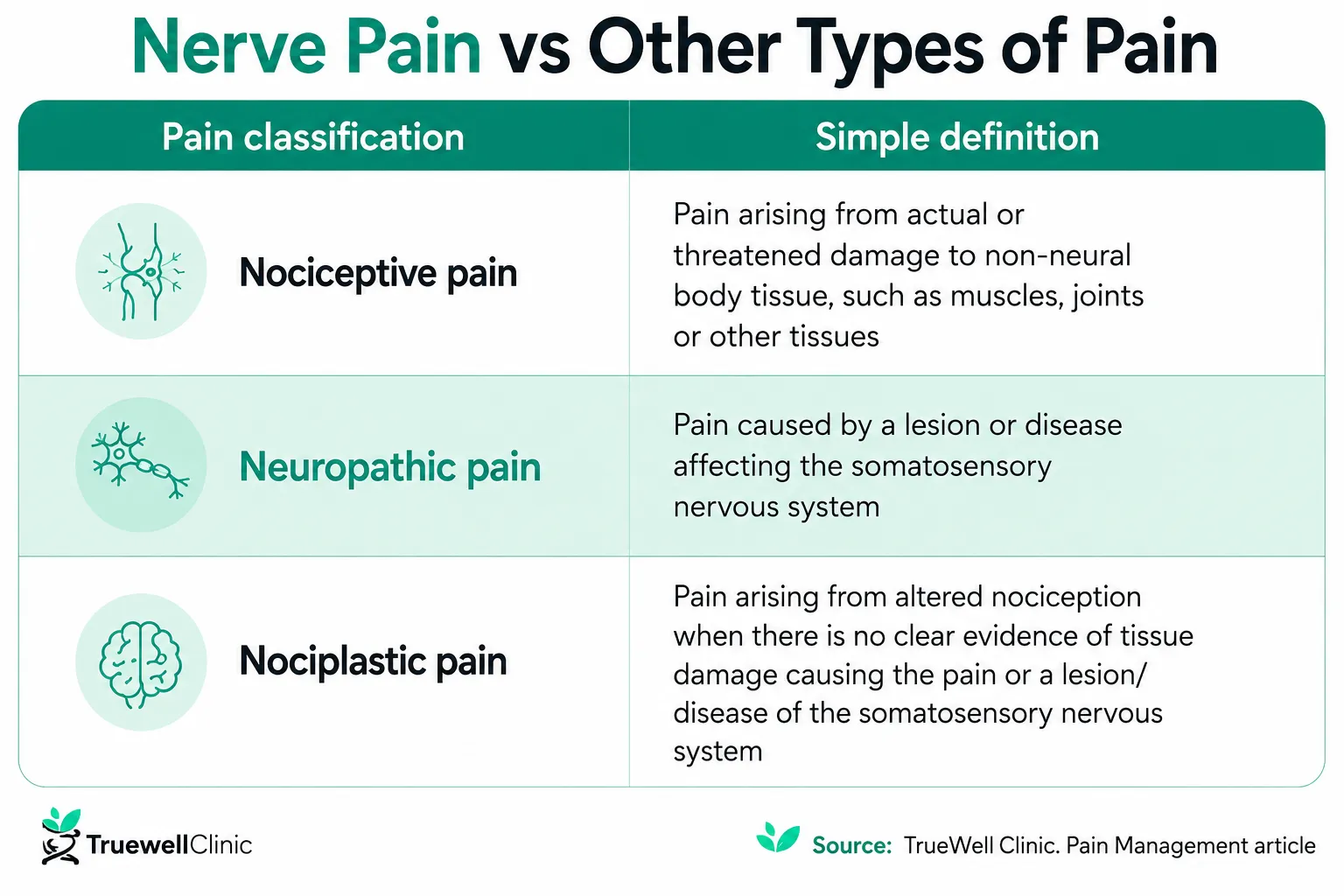
It can help to know that clinicians generally sort pain into three broad groups. Seeing them side by side makes it clearer why nerve pain feels so unlike other aches.
Nerve pain vs other types of pain
| Pain classification | Simple definition |
| Nociceptive pain | Pain arising from actual or threatened damage to non-neural body tissue, such as muscles, joints or other tissues. |
| Neuropathic pain | Pain caused by a lesion or disease affecting the somatosensory nervous system. |
| Nociplastic pain | Pain arising from altered nociception when there is no clear evidence of tissue damage causing the pain or a lesion/disease of the somatosensory nervous system. |
Pain can involve more than one mechanism. For example, a person may experience both nociceptive and neuropathic pain at the same time. These classifications describe underlying pain mechanisms rather than serving as diagnoses on their own.
This distinction matters because nerve pain doesn’t always respond to standard pain relief in the way other types of pain might. Recognising the pattern can be a useful first step before speaking with a doctor about what could be causing it.
What Does Nerve Pain Feel Like?
This is usually the question people want answered first. They search for just: does what I’m feeling actually sound like nerve pain?
There’s no single answer, because nerve pain doesn’t feel the same for everyone. But certain sensations come up again and again in how people describe it.
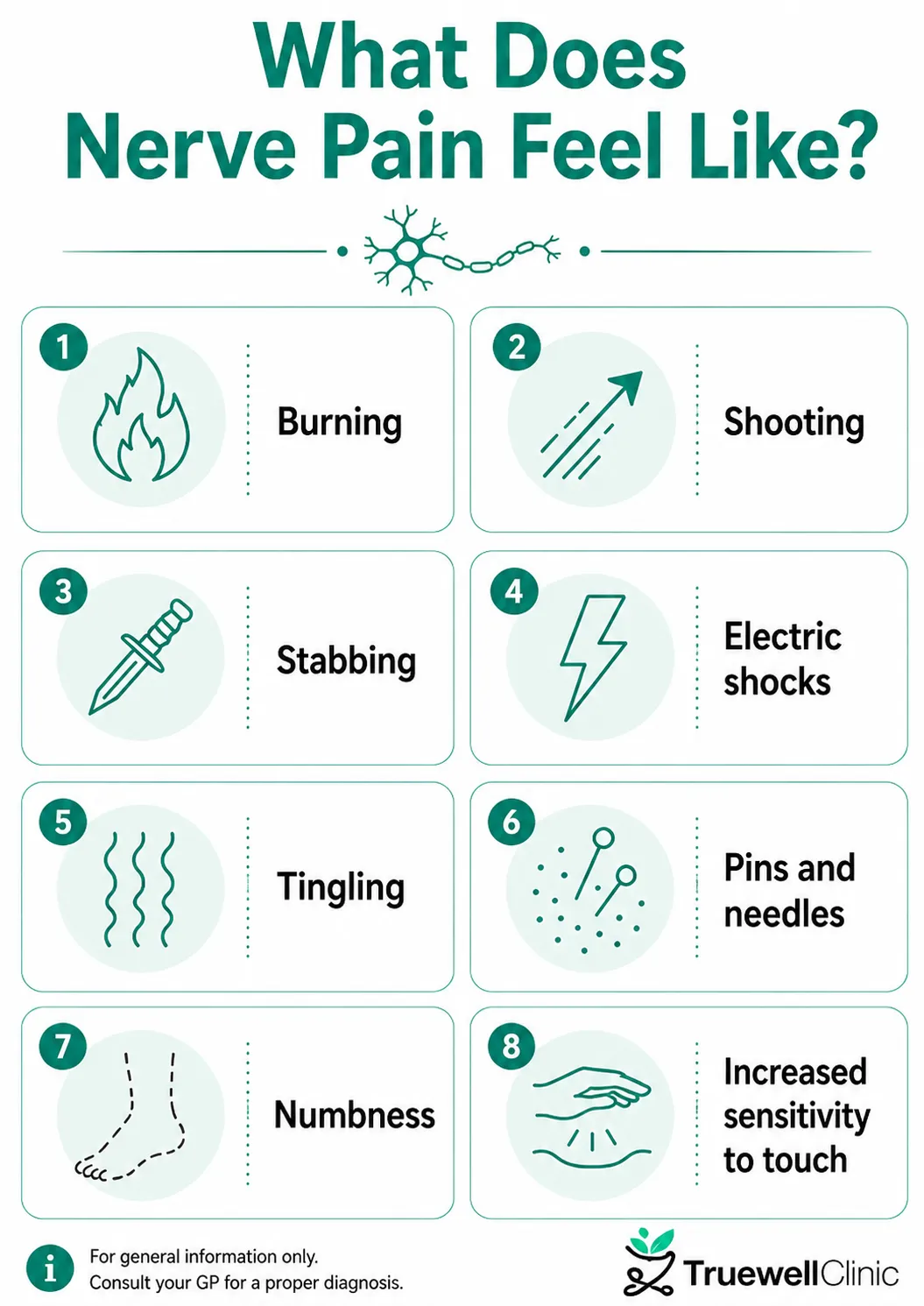
Burning nerve pain is common, sometimes constant, sometimes only in flashes. Others describe something sharper: a stabbing or shooting pain that seems to travel along a specific path, almost like it’s following the nerve itself. Then there’s the electric-shock type, sudden and brief, gone before you’ve had time to react to it. Pins and needles show up too, along with a more general tingling that can feel like static under the skin.
Numbness is something different, though it doesn’t always arrive alongside the pain. Some people lose sensation in an area entirely. Others notice the opposite: skin that’s become oddly sensitive, where even a light touch, a bedsheet, a sleeve, feels uncomfortable or outright painful. That heightened sensitivity can be one of the more confusing symptoms to explain, since it doesn’t fit the usual idea of what pain “should” feel like.
Timing matters too. Nerve pain at night is something a lot of people notice, which can affect sleep on top of everything else.
Common nerve pain sensations may appear as
- Burning
- Shooting
- Stabbing
- Electric shocks
- Tingling
- Pins and needles
- Numbness
- Increased sensitivity to touch
Where nerve pain tends to show up
Nerve pain can affect almost any part of the body, but certain areas come up more often than others, depending on which nerves are involved.
| Location | Sensations often reported |
| Feet and legs | Burning, tingling, numbness |
| Hands and arms | Pins and needles, weakness, shooting pain |
| Back and neck | Shooting or radiating pain |
| Face | Sudden, sharp episodes of pain |
Everyone’s experience looks a little different, and it doesn’t always stay the same over time either. Some people notice symptoms in just one spot. For others, it moves around or spreads gradually. As the range of symptoms of nerve damage is so broad, and they can overlap with other conditions, it’s worth having any new or ongoing symptoms checked by a doctor rather than trying to match them to a checklist.
What Causes Nerve Pain?
Understanding nerve pain causes can be difficult, since nerve pain doesn’t have a single cause. There are several situations in which nerves have been damaged, irritated, or aren’t functioning the way they normally would, and that damage can come from a wide range of sources.
Research suggests nerve pain is more common than many people realise. Work led by researchers at NeuRA, published in The Lancet Neurology, points to up to 1 in 10 Australians living with some form of neuropathic pain. That study pulled together data from over 300 clinical trials involving close to 50,000 adults, making it one of the more comprehensive reviews on the topic to date.
Some causes relate directly to the nerves themselves. These may include:
- An injury to a nerve, or ongoing pressure on one
- Poor blood flow reaching the affected area
- Heavy alcohol use over a long period, which may affect nerve health
- Low levels of vitamin B12 or thiamine
- Certain medicines, in some cases
- Phantom limb pain, which can occur after an amputation
Other cases are linked to a broader health condition. Nerve pain has been associated with:
- Diabetes, where consistently high blood sugar may damage nerves over time. Nerve pain in feet and legs is a common pattern
- Shingles, which can sometimes lead to lingering nerve pain after the rash has healed
- Conditions such as multiple sclerosis, stroke, and HIV
- Cancer treatment involving radiation, surgery, or chemotherapy
- Carpal tunnel syndrome and sciatica, both involving pressure on a specific nerve
It’s worth saying clearly: having one of these conditions doesn’t mean nerve pain is guaranteed, and for some people, a clear cause is never identified. That uncertainty can be frustrating, but it’s a normal part of how nerve pain presents. Working out what’s behind it usually takes a proper assessment. That’s best left to a GP or specialist, rather than something to work out from a list of symptoms alone.
What Can Make Nerve Pain Feel Worse?
Alongside what originally causes nerve damage, some people notice their symptoms shift depending on the day or the situation. This isn’t universal, and not every trigger applies to everyone, but a few patterns come up often enough to be worth mentioning.
- Pressure or touch
- Certain movements or positions
- Prolonged sitting or standing
- Poor sleep
- Stress
- How well an underlying condition, like diabetes, is being managed
If you notice a pattern in what seems to worsen your symptoms, it’s worth mentioning to your GP. It can help guide both diagnosis and day-to-day management.
How Is Nerve Pain Diagnosed?
There’s no single test that identifies nerve pain outright. It usually comes down to a conversation first, an examination second, and then further testing only if something specific needs ruling in or out.
Expect your GP to ask a fair number of questions: where the pain sits, how long it’s been going on, whether it’s constant or comes in waves, and what it actually feels like to you. They’ll probably ask about your general health too, and go through your current medicines, since a few of them can have a bearing on how nerves behave.
The physical exam is intended to check a handful of things. Muscle strength. Coordination. Reflexes. How you respond when something touches your skin, or when the temperature changes on the affected area. Small details, but they help a doctor work out which nerves might be involved and how.
From there, testing depends entirely on what’s suspected. A blood test might be ordered to look for diabetes or a vitamin deficiency. Nerve conduction studies are sometimes used, checking how well electrical signals move along the nerve. In certain cases, imaging like a CT or MRI scan comes into play, particularly if there’s a need to look more closely at what’s going on structurally.
Not every person needs every test, and a GP will usually only order what fits the picture in front of them. Depending on what turns up, a referral to a neurologist or pain specialist might follow.
One thing worth keeping in mind: getting a clear answer doesn’t always happen in a single visit. Sometimes it takes a bit of back and forth before the cause becomes obvious, and that’s a normal part of the process rather than something going wrong.
Can Nerve Pain Go Away?
This is one of the most common questions people have, and the honest answer is: it depends on what’s causing it. Nerve pain doesn’t follow one single pattern, so the outlook varies from person to person.
When nerve pain may ease on its own
If nerve pain follows a minor injury, or develops because a nerve is being compressed, it can sometimes improve once the underlying issue resolves. For example, pain caused by temporary pressure on a nerve may ease naturally as swelling reduces or the nerve recovers. Recovery timelines vary, and some people notice improvement within weeks, while for others it takes longer.
When nerve pain becomes ongoing
In other cases, nerve pain is linked to a condition that doesn’t fully go away, such as diabetes-related nerve damage or a chronic nerve disorder. According to Australian resources, nerve pain can be difficult to treat, and the first step is usually identification and treatment of the underlying cause where possible. When a condition is long-term, the focus tends to shift from eliminating pain to reducing its impact and improving day-to-day functioning.
What can influence the outcome?
Treating the underlying cause, where this is possible, can make the most meaningful difference. Well-managed blood sugar levels, for instance, may help with diabetes-related nerve pain, and prompt treatment of shingles may lower the chance of lingering pain afterwards. Where a clear cause isn’t identified, or can’t be fully treated, a GP or specialist can still help explore a range of approaches that may reduce symptoms over time
Setting realistic expectations
It’s worth being cautious of anything promising a guaranteed cure, since individual responses to treatment vary considerably. A more realistic expectation is that, with the right support and often some patience, many people do see improvement, even if progress looks different from one person to the next.
Nerve Pain in Everyday Life and Everyday Ways to Cope
Ongoing nerve pain rarely stays contained to just the physical symptoms. When it persists, it can gradually affect sleep, concentration, work performance, and the ability to stay active or social in the way you’d normally like to be. Some people find their mood is affected too, particularly if pain becomes disruptive over an extended period. Sometimes showing up as living with everyday anxiety. These changes reflect how closely physical and mental wellbeing are connected when discomfort becomes a daily presence.
Recognising this impact matters, because it shifts the conversation from simply “managing pain” to supporting overall quality of life. A GP can help with both, and there’s no need to wait until symptoms feel unmanageable before raising how they’re affecting you day to day.
There are also practical steps that may help alongside any treatment a doctor recommends.
Staying gently active. Where appropriate, regular movement can help maintain flexibility and general wellbeing. This doesn’t need to be intense; even light, consistent activity may be more sustainable than periods of inactivity followed by overexertion.
Pacing daily tasks. Breaking activities into smaller steps, rather than trying to complete everything in one go, can reduce strain on the body and help maintain a more even energy level throughout the day.
Prioritising sleep. Since nerve pain often feels worse at night, sleep can be one of the first things affected. A GP may be able to suggest strategies suited to your specific situation if pain is consistently disrupting rest.
Using relaxation techniques. Approaches such as breathing exercises, meditation, or yoga are sometimes used alongside other management strategies, and some people find they help with both pain and associated stress.
Caring for areas with reduced sensation. If numbness affects a hand or foot, extra care with everyday activities, such as checking for injuries you might not otherwise feel, can help prevent complications.
Keeping track of symptoms. Noting when pain occurs, how severe it feels, and anything that seems to influence it can be genuinely useful information to bring to a GP appointment, particularly if patterns aren’t obvious day to day.
Staying connected with your healthcare team. Nerve pain can take time to manage well, and adjustments are often part of the process. Regular check-ins with a GP allow the approach to be reviewed and refined as needed.
None of these steps replace a formal treatment plan, but they can complement one where appropriate, and many people find that a combination of approaches works better than relying on any single strategy alone.
When Should You See a Doctor About Nerve Pain?
Nerve pain can range from mild and occasional to persistent and disruptive, and knowing when to seek medical advice is an important part of managing it well.
Book an appointment if:
- Symptoms persist for more than a few weeks, or keep returning
- You notice new or unexplained numbness, tingling, or weakness
- The pain is starting to get in the way of sleep, work, or things you’d normally do
- Symptoms seem to be gradually getting worse
- You have a condition, such as diabetes, that’s known to affect nerve health
A GP, such as the Truewell Clinic, can assess your symptoms, consider possible causes, and determine whether further tests or a specialist referral would be helpful. If you’re already managing a broader condition involving chronic pain, it may also be worth reading our guide on chronic pain management for a wider look at long-term pain support.
Seek urgent medical attention if:
A few symptoms shouldn’t wait for a routine booking; they need to be looked at sooner. These include sudden or rapidly worsening weakness, loss of movement, or loss of bladder or bowel control, as these can occasionally signal a more serious underlying issue that needs immediate assessment.
This isn’t intended to cause alarm. Most nerve pain isn’t an emergency, and the vast majority of cases are appropriately managed through a standard GP visit. The guidance above is simply there to help you recognise the less common situations where faster action matters.
If you’re ever unsure whether your symptoms need urgent care or can wait for a routine appointment, it’s always reasonable to contact your GP or call a health advice line for guidance.
Disclaimer:
This article is general information only and is not a substitute for professional medical advice. If you’re experiencing nerve pain symptoms, speak with your GP or a qualified healthcare professional for guidance specific to your situation.