

Medically reviewed | Last updated: 2026 | Reading time: ~13 minutes
Quick Answer: Burnout is especially common in caring professions and unpaid caring roles — nursing, teaching, caregiving, parenting and small business ownership — because these roles combine high emotional labour with limited control, recognition or recovery time. Signs of professional burnout mirror general burnout but are frequently dismissed as part of the job, which delays recognition and worsens outcomes.
Key Takeaways
- Caring professions carry elevated burnout risk due to emotional labour, not hours alone.
- Compassion fatigue and burnout are distinct conditions — understanding the difference improves treatment.
- Each profession has unique early warning signs and recovery pathways.
- Moral injury — the distress from acting against one’s values — is a distinct but overlapping risk in healthcare and education.
- Recovery requires both individual strategies and structural change in the role itself.
- Australian support services exist specifically for nurses, teachers, carers and parents.
- Symptoms persisting beyond a few weeks warrant a GP or registered psychologist consultation.
Why Caring Professions Carry Higher Burnout Risk
Career burnout symptoms in caring roles tend to develop faster than in other occupations because of the emotional labour involved: holding other people’s distress, illness or learning needs, often with limited time, staffing or recognition. Signs of professional burnout in these fields are frequently normalised as ‘just part of the job,’ which delays recognition and treatment.
Three mechanisms drive the elevated burnout risk in helping professions:
- Emotional labour — the sustained effort of managing one’s own emotions while responding to others’ needs — depletes psychological resources over time
- Vicarious trauma and secondary traumatic stress — indirect exposure to distressing events experienced by clients, patients or students
- Moral injury — the psychological distress that results from acting, or failing to act, in ways that conflict with core professional or personal values, common in healthcare and education when systemic pressures override clinical or teaching judgement
Compassion Fatigue vs Burnout
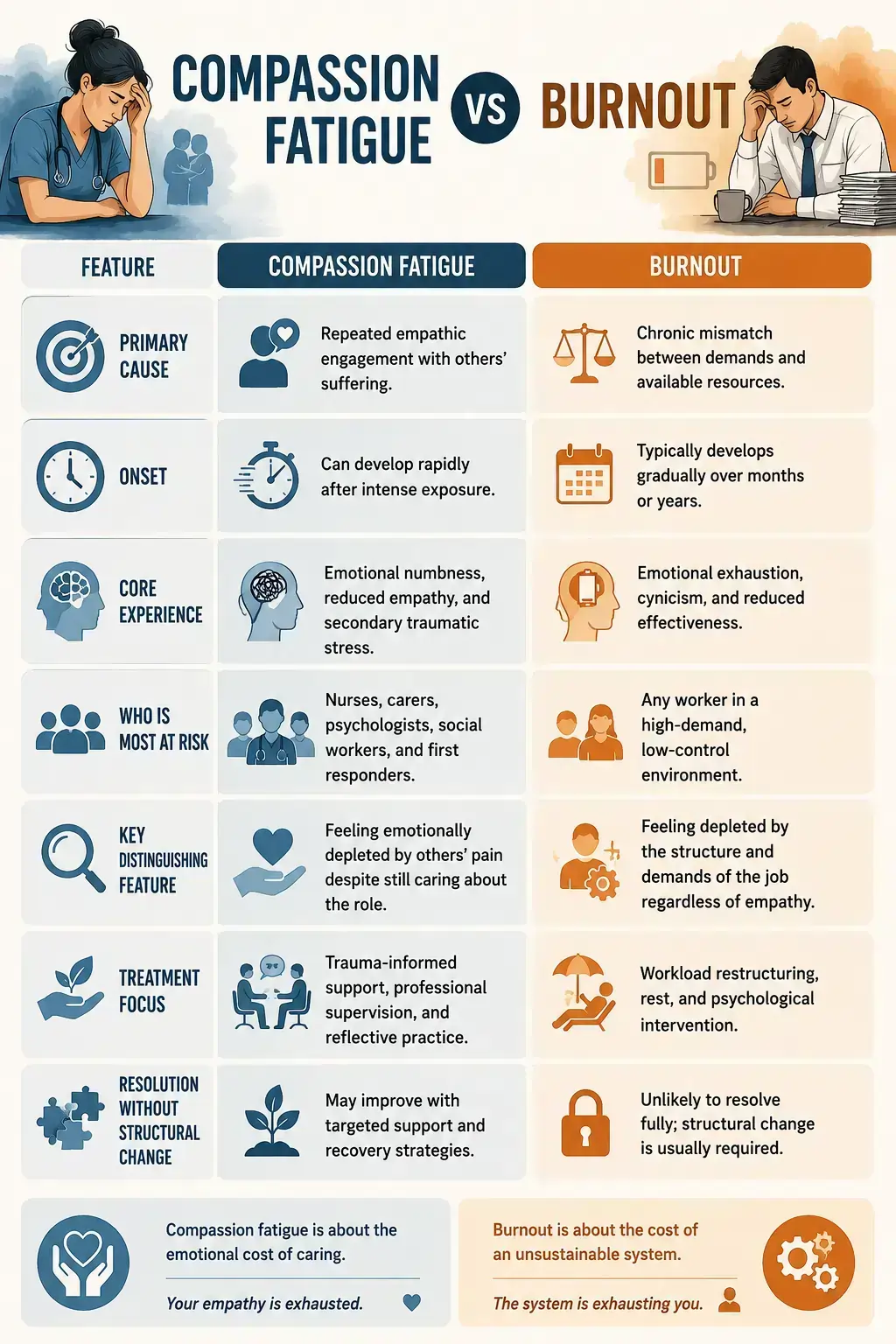
These terms are frequently used interchangeably, but they describe distinct conditions with different causes and treatment implications. Understanding the difference helps professionals and carers identify what they are actually experiencing.
| Feature | Compassion Fatigue | Burnout |
| Primary Cause | Repeated empathic engagement with others’ suffering. | Chronic mismatch between demands and resources. |
| Onset | Can develop rapidly after intense exposure. | Typically develops gradually over months to years. |
| Core Experience | Emotional numbness, reduced empathy, secondary traumatic stress. | Emotional exhaustion, cynicism, reduced effectiveness. |
| Who Is Most at Risk | Nurses, carers, psychologists, social workers, first responders. | Any worker in high-demand, low-control environments. |
| Key Distinguishing Feature | Feeling emptied by others’ pain despite caring about the role. | Feeling emptied by the job structure regardless of empathy. |
| Treatment Focus | Trauma-informed support, professional supervision, reflective practice. | Workload restructuring, rest, psychological intervention. |
| Resolution Without Structural Change | Possible with targeted support. | Unlikely — structural change is usually required. |
Burnout Risk by Profession
The following comparison draws on Australian and international occupational health research to summarise key burnout risk factors across caring and high-stress professions.
| Profession | Primary Risk Factors | Key Burnout Signals | Burnout Risk Level |
| Nurses / Midwives | Shift work, rotating rosters, understaffing, high patient acuity, limited debrief time. | Emotional exhaustion, compassion fatigue, presenteeism, intent to leave. | Very High |
| Teachers / Educators | Administrative load, behaviour management, large class sizes, limited preparation time. | Cynicism about the profession, decision fatigue, reduced sense of accomplishment. | High |
| Carers (Family) | No formal breaks, 24/7 demand, social isolation limited respite, financial strain. | Physical exhaustion, resentment, emotional numbness, health neglect. | Very High |
| Parents (Parental Burnout) | Chronic demand, societal pressure, loss of personal identity, limited recovery time. | Emotional distancing from children, loss of parenting confidence, exhaustion. | High |
| Founders / Small Business Owners | Financial risk, decision fatigue, no manager buffer, blurred work-life boundary. | Reluctance to delegate, withdrawal from business relationships, chronic fatigue. | High |
| Early Childhood Educators | Low pay relative to emotional demand, staff shortages, behavioural complexity. | High attrition intent, reduced work engagement, occupational exhaustion. | Very High |
| Social Workers / Psychologists | Vicarious trauma, caseload volume, systemic inadequacies, secondary traumatic stress. | Emotional numbness, reduced therapeutic alliance quality, absenteeism. | High |
Nurse Burnout and Nursing Burnout
Nurse burnout, or burnout in nursing, is one of the most extensively researched forms of occupational burnout. Burnout and nursing research consistently links high patient-to-nurse ratios, shift work, rotating rosters and high-stakes decision-making under time pressure with elevated emotional exhaustion scores on the Maslach Burnout Inventory (MBI). To recognise these early warning signs, read our guide on Signs and symptoms of burnout.
Healthcare worker burnout in nursing is compounded by direct exposure to patient suffering — a primary driver of compassion fatigue and secondary traumatic stress — alongside systemic pressures that can create moral injury when nurses are unable to provide the standard of care their professional values demand.
Early Warning Signs: Nurses
- Dreading shifts that would previously have felt manageable
- Emotional numbness or reduced empathy toward patients — a compassion fatigue signal
- Increasing medication errors or near-misses from cognitive fatigue
- Persistent physical fatigue that does not resolve between shifts
- Cynicism about the healthcare system or institutional processes
- Elevated absenteeism, or presenteeism — present but not functioning effectively
Recovery Strategies: Nurses
- Access structured clinical supervision or professional debriefing through your health service
- Raise staffing and workload concerns through formal WHS channels — nurses have legal protections
- Contact Nurse & Midwife Support (1800 667 877) — free, confidential, 24/7 support
- Engage your Employee Assistance Program (EAP) for confidential psychological support
- Request roster review if shift work patterns are a primary driver — rotating shifts have particular impact on occupational health
- Seek a GP referral for a Mental Health Treatment Plan if symptoms persist beyond 2–3 weeks
Teacher Burnout
Teacher burnout — burnout teaching, burnout of teachers, educator burnout — is driven by a combination of large class sizes, administrative workload, behaviour management complexity and limited preparation time. Australian teacher burnout surveys consistently link rising attrition to exhaustion rather than loss of professional interest, with teaching workload identified as the primary structural driver.
Burnout among educators extends beyond classroom teachers to early childhood educators, university staff and academic researchers, each facing distinct combinations of demand and control mismatch.
Early Warning Signs: Teachers
- Increasing cynicism about the value or impact of teaching — a core burnout dimension
- Reduced patience with students or colleagues that contrasts with your normal baseline
- Using evenings and weekends for administrative catch-up rather than genuine recovery time
- Physical fatigue or recurrent illness during term time
- Reduced sense of professional accomplishment despite continued effort
- Dreading Monday morning or the return from school holidays
Recovery Strategies: Teachers
- Establish explicit workload boundaries with school leadership — document requests and flag unsustainable demands formally
- Contact your union for advice on workload rights and formal escalation pathways
- Access school-based EAP services or beyond blue’s dedicated educator support resources
- Request administrative support or duty redistribution where class-related administration is the primary driver
- Consult a GP if burnout is affecting functioning outside school — particularly sleep, relationships or physical health
Academic Burnout
Academic burnout — burnout in academics — affects university staff and students. Among staff, high publication pressure, casualisation, grant dependency and teaching-plus-research demands combine to create chronic occupational stress. Among students, academic burnout typically peaks during thesis completion, exam periods or when academic identity becomes tightly coupled with performance outcomes.
The three-dimensional model applies: emotional exhaustion, cynicism toward study or the institution, and a reduced sense of academic accomplishment. Burnout in academics is associated with elevated absenteeism, reduced research output and staff attrition from the sector. Learn more in our guide on Adrenal fatigue and emotional burnout.
Caregiver and Carer Burnout
Caregiver burnout and carer burnout describe the exhaustion experienced by people supporting a family member with illness, disability or age-related needs — most often unpaid and without formal breaks. Because caring responsibilities rarely fully pause, recovery strategies for carers must focus on accessing respite rather than simply ‘taking time off.’
A carer burnout scale — a short validated self-report tool — can flag rising strain before it becomes a crisis, measuring fatigue, emotional load and perceived support. Psychological wellbeing in carers is strongly associated with access to respite services, peer support and practical assistance. Without these, caregiver stress typically escalates into clinical burnout.
Early Warning Signs: Carers
- Resentment toward the person being cared for — a common but rarely discussed signal
- Neglect of your own health, medical appointments or basic self-care
- Social withdrawal and increasing isolation from friends and community
- Emotional numbness or feeling like you are ‘going through the motions’
- Physical symptoms: chronic fatigue, sleep disruption, recurrent illness
- Guilt about feeling exhausted — a carer-specific barrier to seeking support
Recovery Strategies: Carers
- Contact the Carer Gateway (1800 422 737) — Australia’s national carer support service providing free respite, counselling and peer support
- Request a carer needs assessment through your GP or local health service
- Access Carer Allowance and other Centrelink entitlements to reduce financial strain
- Engage peer support groups through Carers Australia or state-based carer organisations
- Seek a GP referral for psychological support — carer burnout carries elevated depression and anxiety risk
Parental Burnout and Working Mothers Burnout
Parental burnout is now a recognised area of psychological research — distinct from general occupational stress — marked by emotional distancing from parenting, a loss of parenting confidence, and a pervasive sense of contrast between the parent one was and the parent one feels able to be. Research by Mikolajczak and Roskam identifies parental burnout as a distinct clinical entity with its own measurement scale.
Working mothers burnout reflects the compounding effect of paid work demands alongside a disproportionate share of household and caregiving labour, leaving limited structural space for psychological recovery between roles. Parental burnout is associated with elevated risk of anxiety, depression and — when severe — harm to parent-child relationships.
Early Warning Signs: Parents
- Emotional distancing from children — going through parenting motions without connection
- A persistent sense of exhaustion at the thought of parenting tasks, not the children themselves
- Loss of parenting confidence and frequent self-comparison to perceived standards
- Chronic irritability or emotional outbursts that exceed the situation
- Physical and emotional fatigue that does not resolve with sleep
Recovery Strategies: Parents
- Share caregiving responsibilities explicitly — not just tasks but decision load and mental load
- Access parental support through PANDA (Perinatal Anxiety and Depression Australia) if relevant: 1300 726 306
- Seek peer support through parenting groups that normalise difficulty without judgement
- Consult a GP if emotional distancing from children persists — this symptom warrants clinical assessment
- Consider couples or family therapy if parental burnout is affecting the co-parenting relationship
Founder and Small Business Owner Burnout
Founder burnout in small business stems from the combination of financial risk, long hours, decision fatigue and the absence of a manager or team buffer to absorb uncertainty. Unlike employed workers, founders rarely have access to EAP, clinical supervision or workload redistribution — making recognition and help-seeking harder.
Founder burnout often presents as chronic fatigue, reluctance to delegate despite available capacity, and withdrawal from business relationships and networks. Decision fatigue — the deterioration in decision quality after sustained high-volume decision-making — is a specific and often-missed feature. Learn more about the differences in our guide to Burnout vs depression anxiety.
Early Warning Signs: Founders
- Avoidance of business decisions that previously felt manageable
- Withdrawal from founder networks, mentors or business advisors
- Financial risk-taking or risk-aversion that is out of character — both can be burnout signals
- Inability to switch off from the business during evenings or weekends
- Loss of passion or meaning in the business — distinct from strategic doubt
Recovery Strategies: Founders
- Engage a business coach or mentor to distribute strategic decision load
- Implement structured delegation — founder burnout frequently persists because delegation is intellectually accepted but not actually practiced
- Access the Beyond Blue Heads Up workplace mental health resources (headsup.org.au)
- Separate personal identity from business performance — a common source of values mismatch in founders
- Consult a psychologist with experience in occupational or entrepreneur stress
What Helps Across All High-Burnout Roles
Despite profession-specific differences, several strategies have consistent evidence across caring and high-stress roles:
Universal Recovery Checklist — Caring and High-Stress Professions
- Name the structural cause — resist framing burnout as a personal weakness or resilience failure
- Build protected, non-negotiable recovery time, even in roles that never fully stop
- Access clinical supervision, reflective practice or professional debriefing where available
- Engage peer support from others in the same profession who understand the specific demands
- Access your EAP or profession-specific support service (see Australian Support Services below)
- Speak with a GP if symptoms persist beyond 2–3 weeks or are affecting daily functioning
- Request a Mental Health Treatment Plan for Medicare-subsidised psychology sessions
- Seek a registered psychologist — CBT, ACT and trauma-informed approaches all have evidence in this population
When to Seek Professional Help
In caring and high-stress roles, burnout is frequently normalised as expected. The following indicators warrant professional support regardless of how common burnout is in your profession:
- Emotional exhaustion that does not improve with leave or time off
- Compassion fatigue symptoms — emotional numbness, reduced empathy, secondary traumatic stress
- Symptoms that are affecting functioning outside your role — relationships, physical health, daily activities
- Signs of anxiety disorder or clinical depression co-occurring with occupational burnout
- Any sense of moral injury — distress from being required to act against your professional values
- Thoughts of leaving the profession entirely (rather than the current role or workplace)
A GP is the first clinical port of call. They can assess for co-occurring depression or anxiety, provide a Medical Certificate for leave if needed, and refer to a registered psychologist via a Mental Health Treatment Plan. To explore practical next steps, read our Burnout recovery and treatment guide for evidence-based recovery strategies and treatment options.
⚠ Emergency Red Flags — Seek Immediate Support
- Suicidal thoughts or thoughts of self-harm
- Inability to function in daily life — not eating, not leaving home, not managing basic tasks
- Severe panic attacks or acute psychological crisis
If you are in crisis: Lifeline 13 11 14 (24/7) | Beyond Blue 1300 22 4636 | Emergency services 000
Australian Support Services by Profession
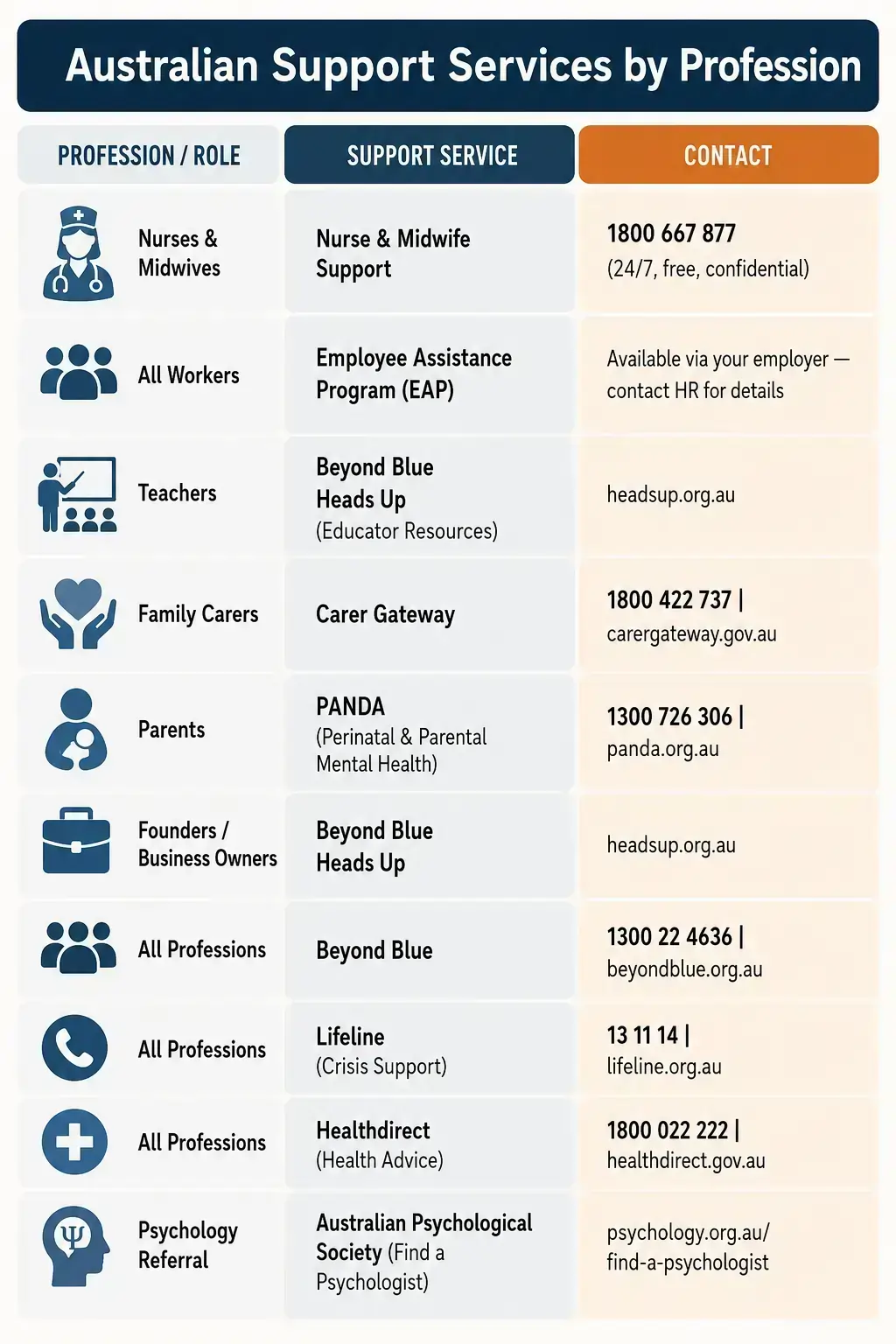
| Profession / Role | Support Service | Contact |
| Nurses & Midwives | Nurse & Midwife Support | 1800 667 877 (24/7, free, confidential) |
| All Workers | Employee Assistance Program (EAP) | Via your employer — ask HR |
| Teachers | Beyond Blue Heads Up (educator resources) | headsup.org.au |
| Family Carers | Carer Gateway | 1800 422 737 | carergateway.gov.au |
| Parents | PANDA (perinatal & parental mental health) | 1300 726 306 | panda.org.au |
| Founders / Business Owners | Beyond Blue Heads Up | headsup.org.au |
| All Professions | Beyond Blue | 1300 22 4636 | beyondblue.org.au |
| All Professions | Lifeline (crisis support) | 13 11 14 | lifeline.org.au |
| All Professions | Healthdirect (health advice) | 1800 022 222 | healthdirect.gov.au |
| Psychology Referral | Australian Psychological Society (find a psychologist) | psychology.org.au/find-a-psychologist |
The Bottom Line
Professional burnout in caring and high-stress roles is a real, measurable state — not a personal failing. Early recognition shortens recovery time significantly. Compassion fatigue and moral injury are distinct conditions that overlap with burnout and require targeted responses. Recovery requires both rest and structural change. If symptoms persist beyond a few weeks or are affecting functioning outside your role, speak with your GP or a registered psychologist — early support prevents symptoms becoming more severe.
References
- Maslach C, Leiter MP. Understanding the burnout experience: recent research and its implications for psychiatry. World Psychiatry. 2016;15(2):103-111.
- Mikolajczak M, Roskam I. Parental burnout: what is it, and why does it matter? Clinical Psychological Science. 2018;6(6):788-797.
- Australian Institute of Health and Welfare. Carer wellbeing and burnout. AIHW; 2025.
- Safe Work Australia. Managing Psychosocial Hazards at Work: Model Code of Practice. SWA; 2022.
- Beyond Blue. Burnout in the workplace. beyondblue.org.au
- Australian Psychological Society. Compassion fatigue and professional burnout. psychology.org.au
- Black Dog Institute. Workplace mental health resources. blackdoginstitute.org.au
- Carer Gateway. Supporting carers. carergateway.gov.au
- PANDA. Parental mental health resources. panda.org.au
- Healthdirect Australia. Burnout. healthdirect.gov.au
Last reviewed: 2026. This article is for general information only and does not replace personalised advice from a qualified health professional. If you are experiencing distress, please contact Lifeline on 13 11 14 or Beyond Blue on 1300 22 4636.