

Most of us are used to the kind of discomfort that comes and goes. A long shift on your feet, a poor night’s sleep, a tense neck after hours at a desk, it shows up, you rest, and it fades within a few days. But what happens when that physical discomfort doesn’t fade? When it lingers for weeks, settles into your routine, and starts shaping how you move, sleep, and show up for the people around you?
For a large number of adults across Australia, ongoing physical discomfort isn’t an occasional inconvenience. It’s a near-daily companion. According to the Australian Institute of Health and Welfare, one in five Australians aged 45 and over lives with persistent discomfort that affects their daily life, work, and ability to enjoy the things they care about.
This article won’t diagnose anything or point you toward a specific treatment. Instead, it explores what’s actually happening body discomfort signals persists, why it doesn’t always match the size of the original issue, and which everyday, evidence-informed habits genuinely support physical ease and holistic wellness.
What Keeps Persistent Discomfort Going After the Initial Cause?
It’s a fair question, and one that confuses a lot of people: why does discomfort sometimes outlast the original bump, strain, or illness that started it? Before getting into that, it helps to be clear on what persistent discomfort actually means. It generally refers to physical discomfort that continues well beyond the usual healing window, sometimes for months, even when there’s no clear ongoing damage driving it.
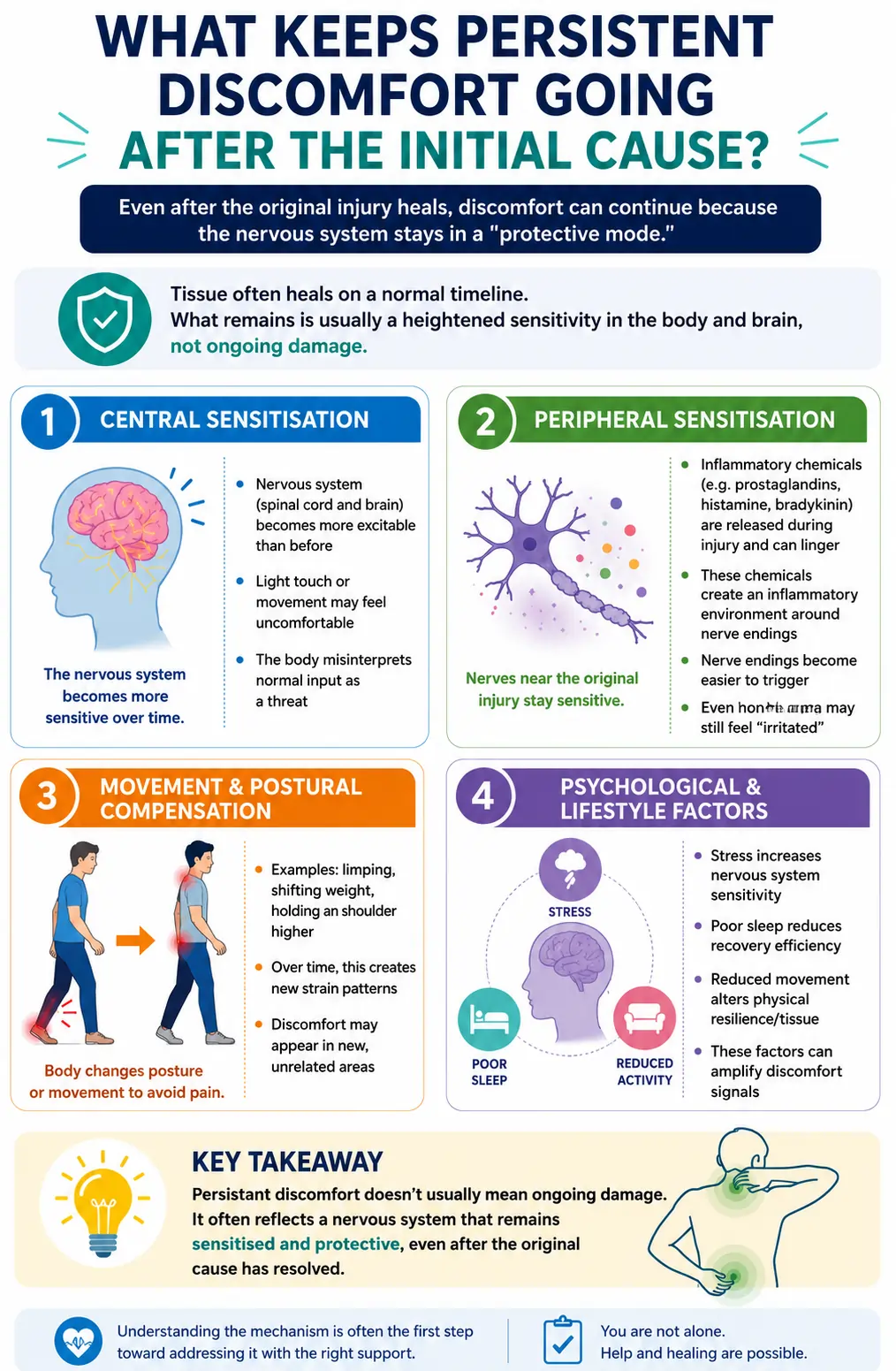
Looking at the chronic discomfort causes researchers have identified, tissue itself tends to heal on a fairly predictable timeline. What lingers afterwards usually isn’t damage; it’s a body still treating the area as a threat, long after the original trigger has settled (Woolf, 2011).
Researchers point to a handful of overlapping mechanisms that explain why this happens. None of them suggests ongoing harm; they describe a nervous system and a body that have simply adapted in ways that outlast their usefulness.
- Central sensitisation. Repeated or sustained signalling from an injury can leave neurons in the spinal cord and brain more excitable than before. Once this happens, the nervous system starts treating ordinary input, such as a light touch or a normal stretch, as something worth flagging, even when nothing harmful is occurring (Woolf, 2011; Physiopedia, n.d.).
- Peripheral sensitisation. Right where the original irritation happened, things can stay a little “switched on” even after everything looks healed on the surface. Part of the reason is chemical: substances like prostaglandins, histamine, and bradykinin are released during the initial injury. They tend to hang around nearby nerve endings, creating an inflammatory soup that supports the nerve ending and lowers the bar for what counts as a trigger (PMC, “Update on Peripheral Mechanisms of Pain”).
- Movement and postural compensation. When something hurts, people naturally start moving around it without even noticing. They might favour one leg, hold a shoulder higher, or walk a bit differently. Do that for long enough, and the new posture can cause its own problems. Weeks later, you might feel stiffness or tightness somewhere else entirely, with no obvious link back to where the pain started.
- Psychological and lifestyle load. Stress, disrupted sleep, and reduced activity can all influence how readily the nervous system responds to everyday input.
None of this means that something is broken. It means the link between an old trigger and ongoing discomfort is rarely a straight line and understanding the mechanism is often the first step toward addressing it with the right support.
How Does the Nervous System Contribute to Ongoing Discomfort?
Central sensitisation is worth slowing down on, because it changes how you think about discomfort that won’t quit. The usual assumption is that if something still hurts, something must still be wrong underneath. But a sensitised nervous system can keep sending signals long after the tissue involved has settled down completely.
What’s actually shifted isn’t the body part. It’s the wiring. The spinal cord and brain have effectively turned up their own volume, so smaller and smaller inputs get treated as significant. A normal stretch, a bit of pressure, even temperature changes can start to register as discomfort, not because anything is being damaged, but because the system has become more reactive than it needs to be.
This is also where the biopsychosocial model becomes useful. Discomfort isn’t purely a biological signal arriving from one location. It’s shaped at the same time by what’s going on physically, mentally, and in daily life. Two people can have a near-identical injury history and end up with very different experiences of ongoing discomfort, because sleep, mood, stress, and muscle tension all feed into how sensitised that system becomes.
Understanding Body Signals Through a Biopsychosocial Lens
The biopsychosocial (BPS) model dates back to 1977, when it was introduced as a way of looking at health through three interacting lenses: bio (physical and physiological factors), psycho (thoughts, emotions, and mental state), and social (relationships, environment, and culture) (Engel, 1977). The core idea is that a person isn’t simply a biological machine with a fault to find and fix. Physical, mental, and social factors are constantly influencing each other, and discomfort is one of the places where that interaction shows up most clearly.
In practice, that means sleep, mood, relationships, work stress, and the physical issue itself all feed into one another rather than acting alone. It’s also why two people with a similar ongoing discomfort can end up with very different experiences. It isn’t a question of who’s tougher; it reflects how varied the contributing factors really are.
What Lifestyle Factors Tend to Amplify Physical Discomfort?
Daily habits don’t operate separately from discomfort. They actively shape how the nervous system responds. A few patterns show up again and again:
- Poor sleep and discomfort feed each other. Bad sleep heightens sensitivity, and discomfort makes good sleep harder to get, creating a loop worth breaking gently.
- Stress tightens muscles. Even non-physical stress, like a looming deadline, can trigger shallow breathing and reflexive muscle tension that adds strain over time.
- Avoiding movement backfires. Protecting a sore area feels safer, but inactivity usually stiffens joints and weakens muscles, making the body more reactive to movement, not less.
- Diet and hydration matter quietly. Processed food and low water intake tend to push inflammation up, which can lower the threshold for managing discomfort naturally.
- Other habits add up unnoticed: erratic activity levels, drinking or smoking, long stretches sitting still, and pulling away from people, which removes a layer of support that normally helps.
Here’s the good news, though: almost all of these can be changed. Small, steady shifts in daily routine tend to do more for physical wellbeing than any single big intervention ever does.
How Do Emotions and Stress Affect the Experience of Physical Discomfort?
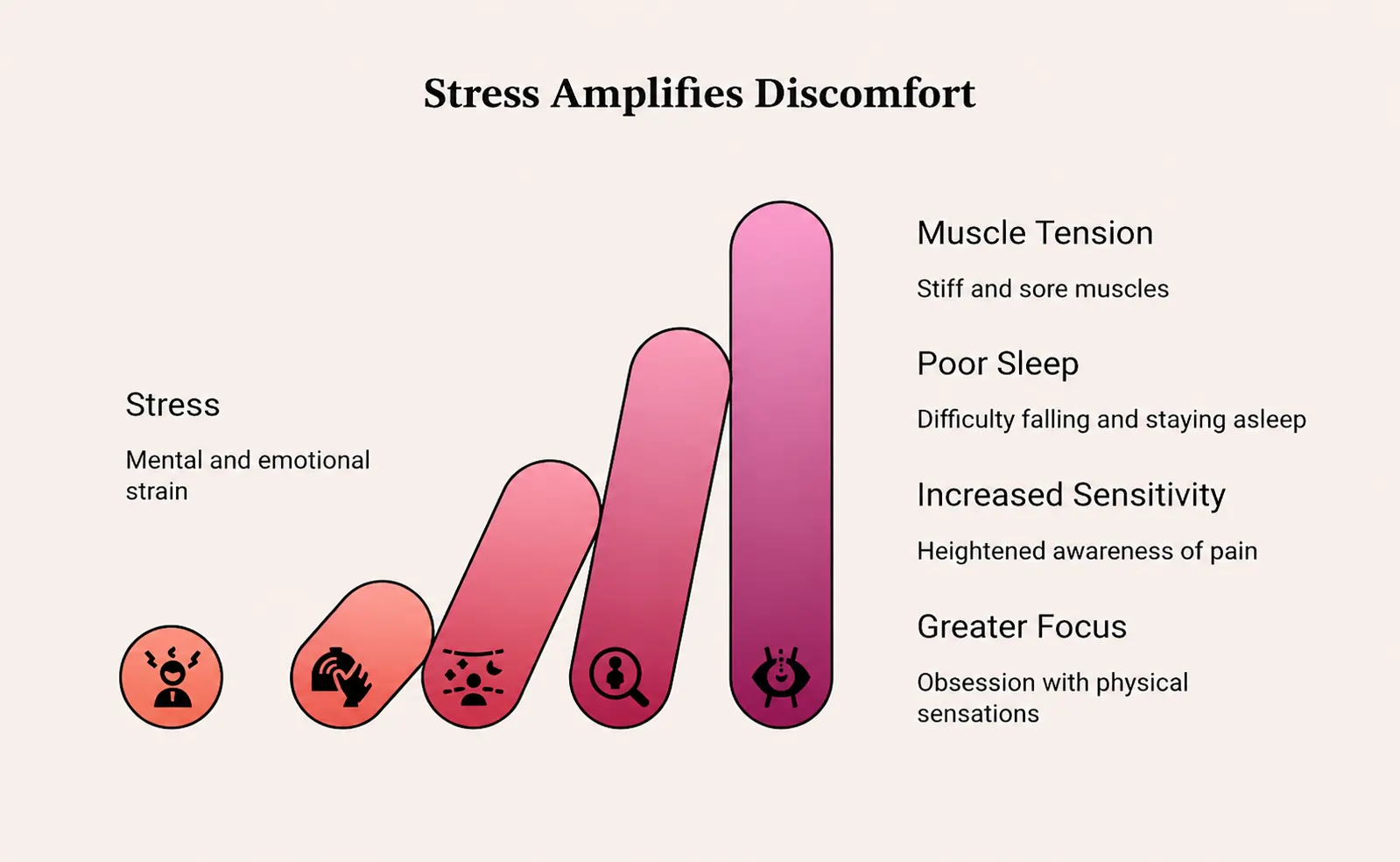
Mind and body aren’t really separate systems when it comes to discomfort. The same stress response that speeds up your heart rate also reaches into your muscles, your immune system, and how your brain interprets pain signals. The American Psychological Association explains that stress hormones like cortisol and adrenaline cause muscles to tighten as part of the body’s protective response, and when stress is ongoing, that tension doesn’t get the chance to release the way it normally would.
A few specific ways this plays out:
- Muscles stay switched on. Stress causes muscles to tense up, and over time this can lead to pain and soreness almost anywhere in the body, often showing up first in the neck, back, and shoulders.
- The cycle feeds itself. Discomfort raises stress, and stress raises muscle tension and sensitivity, which then makes the original discomfort feel stronger again.
- Sleep and mood take a hit too. Ongoing stress can disrupt rest and concentration, and poor sleep on its own is enough to make the body more reactive to discomfort the next day.
- Attention amplifies sensation. When someone is anxious or preoccupied with how their body feels, otherwise minor sensations can start to feel far more noticeable and distressing than they would on a calmer day.
None of this means discomfort is “just stress.” It means stress is one of several real, physical inputs that shape how strongly the body experiences and reports discomfort.
Is It Safe to Stay Active When Experiencing Persistent Physical Discomfort?
Resting a sore area feels like the obvious move, and most people do it instinctively. But for ongoing, low-grade discomfort that isn’t tied to a fresh injury, sitting still for too long usually backfires. The body that doesn’t move tends to get more sensitive over time, not less, and flare-ups can start showing up more often rather than fading away.
This isn’t just anecdotal advice. The UK’s National Institute for Health and Care Excellence reviewed the evidence and now lists exercise as one of the first things worth trying for ongoing discomfort, ahead of many other approaches, and Australian exercise science bodies have pointed to the same research in shaping local guidance.
What actually helps is staying active in a way that’s paced sensibly. A short walk, some light stretching, or a gentle swim can ease things in the hours right after, and doing this consistently over weeks tends to build a kind of tolerance. The nervous system gradually stops treating ordinary movement as something to worry about.
Getting the pacing right tends to come down to a few habits:
- Start smaller than feels necessary, and build up slowly.
- Notice how your body feels later that day or the next morning, not just mid-activity.
- Don’t skip rest days. Sleep is when the body actually recovers, and poor sleep quality keeps cortisol and other stress hormones elevated, which works against the calming effect exercise is supposed to have.
- Get input from a general practitioner (GP), physiotherapist, or accredited exercise physiologist before changing your routine, especially if discomfort has been going on for a while.
What’s appropriate looks different for everyone, so this is genuinely worth a conversation with a qualified health professional who can map out something suited to your situation.
When Should You Talk to a Health Professional?
Most persistent discomfort is something to manage and understand over time, not something to panic about. That said, it’s worth booking in with a GP or other qualified health professional if discomfort is new, getting worse, spreading to new areas, or showing up alongside anything that feels out of the ordinary for you. A professional can properly assess what’s going on and rule out anything that needs more targeted attention, which isn’t something a general wellbeing article can do.
Bringing It Together: Supporting Everyday Comfort and Well-being
Persistent discomfort rarely comes from one cause, and it rarely responds to one fix. Sleep, stress, movement, and the original physical trigger all sit tangled together, which is exactly why looking at the whole picture matters more than chasing a single answer.
If discomfort has been hanging around longer than expected, or it’s starting to shape your daily routine more than you’d like, that’s worth talking through with someone qualified. The team at True Well Clinic takes time to understand what’s going on for you and talk through options that suit your situation. Contact us to book a conversation.
Disclaimer: This article is general information only and does not constitute medical advice. It is not intended to diagnose, treat, or replace professional healthcare guidance. Please consult a qualified healthcare professional for advice tailored to your individual circumstances.
Sources:
- Woolf, C.J. (2011). Central sensitization: Implications for the diagnosis and treatment of pain. Pain, 152(3 Suppl), S2–S15: https://pubmed.ncbi.nlm.nih.gov/20961685/
- Physiopedia – Central Sensitisation: https://www.physio-pedia.com/Central_Sensitisation
- PMC – Update on Peripheral Mechanisms of Pain: Beyond Prostaglandins and Cytokines: https://pmc.ncbi.nlm.nih.gov/articles/PMC3132049/
- Australian Institute of Health and Welfare (AIHW) – Chronic Pain in Australia: https://www.aihw.gov.au/reports/chronic-disease/chronic-pain-in-australia/summary
- Better Health Channel (Victoria) – Living with Persistent Pain
- Painaustralia – Painful Facts: https://www.painaustralia.org.au/about-pain/painful-facts
- Chronic Pain Australia: https://chronicpainaustralia.org.au/
- healthdirect Australia – Chronic Pain: https://www.healthdirect.gov.au/chronic-pain
- https://www.apa.org/topics/stress/body