

Pain that won’t go away, even after an injury has technically healed, can be genuinely disorienting. Most of us grow up expecting pain to follow a fairly predictable script: something hurts, it heals, the pain fades. Chronic pain doesn’t follow that script. It’s generally defined as pain lasting three months or more, or continuing beyond the point where healing should reasonably be complete.
Sometimes there’s a clear reason behind it. Sometimes there isn’t, and that can be one of the more frustrating parts of living with it. Either way, chronic pain rarely stays contained to just the physical. It can wear down sleep, mood, concentration, and the small routines that make up a normal week.
This guide explores what chronic pain actually is, the different forms it can take, and when it’s worth bringing to a doctor’s attention.
What is Chronic Pain?
Chronic pain is pain that sticks around well past the point where it should have eased off. Healthcare professionals generally define it as pain lasting three months or longer, or continuing beyond the normal healing time for an injury or illness. It’s different from the pain most of us are used to, the kind that fades as a cut heals or a sprain settles down, because chronic pain can carry on even after the body has done all the repairing it’s going to do.
How long does pain have to last to be chronic?
Three months is the commonly used benchmark, though it’s more of a general guide than a strict cutoff. Healing time varies depending on the injury and the person. What tends to define chronic pain isn’t the exact day count so much as the fact that it persists once the expected recovery window has passed, sometimes with little or no visible tissue damage left to explain it.
Chronic pain vs acute pain
Comparing the two side by side can make the difference easier to understand.
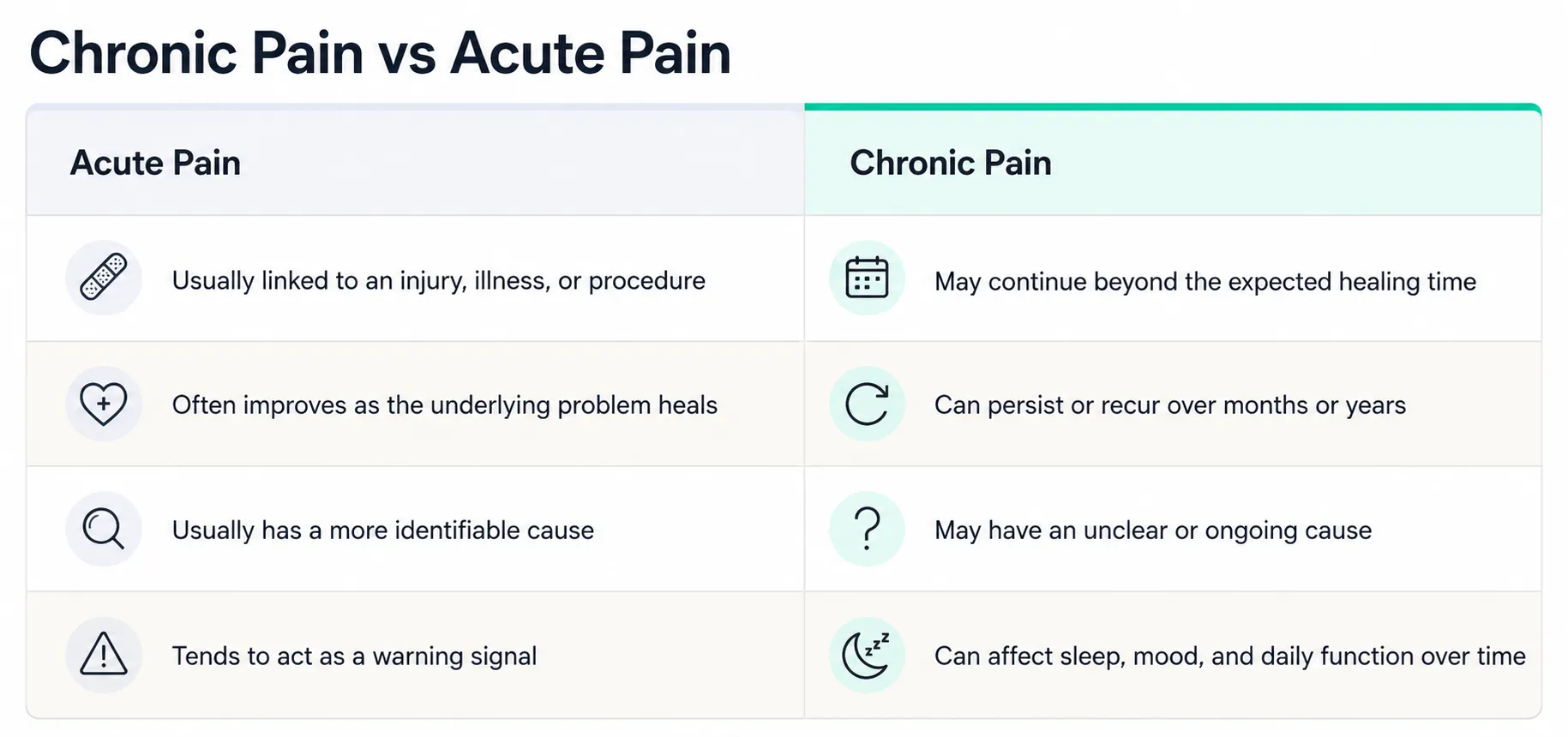
| Acute pain | Chronic pain |
| Usually linked to an injury, illness, or procedure | May continue beyond the expected healing time |
| Often improves as the underlying problem heals | Can persist or recur over months or years |
| Usually has a more identifiable cause | May have an unclear or ongoing cause |
| Tends to act as a warning signal | Can affect sleep, mood, and daily function over time |
What Causes Chronic Pain?
There’s rarely one single answer to what causes chronic pain in Australia, and that’s part of what makes it different from more straightforward, short-term pain. Chronic pain is common in Australia. According to AIHW’s national analysis, 1 in 5 Australians aged 45 and over live with persistent, ongoing pain, a figure that rises further with age, reaching around 1 in 4 among Australians aged 85 and over.
According to the literature, ordinarily, an injury sends signals through the nerves to the brain, and the brain reads those signals as pain until the underlying problem heals. In chronic pain, this process can change: the nervous system may become more sensitive and amplify pain signals, even after the original injury has healed. Some clinical literature describes this as a form of neuroplastic change. (Source: Healthdirect)
Musculoskeletal conditions
Pain linked to bones, joints, and muscles is among the most common categories. This includes:
- Chronic back and neck pain
- Arthritis and other joint-related conditions
- Joint injuries or ligament damage that seemed to heal but didn’t fully resolve
Nerve-related conditions
Nerve damage or ongoing inflammation is behind chronic pain for some people, producing what’s often called neuropathic pain. This includes conditions like diabetic neuropathy and pain following nerve injury during trauma or a medical procedure.
Headache disorders
Migraine and other chronic headache conditions are a distinct category, involving their own set of triggers and mechanisms separate from musculoskeletal or nerve pain.
Pelvic pain conditions
Endometriosis and other forms of persistent pelvic pain fall into their own category, often involving inflammatory processes specific to reproductive organs.
Widespread pain conditions
Fibromyalgia and similar conditions are associated with pain across multiple areas of the body rather than a single, localised source, and are generally understood to involve altered pain processing rather than damage in one specific spot.
Persistent pain without an identifiable cause
Sometimes chronic pain starts after an injury or surgery, and sometimes there’s no clear trigger at all. This absence of an obvious explanation can be genuinely frustrating, both for the person living with it and, at times, for the clinicians trying to help. It’s worth being clear that unexplained pain isn’t the same as imaginary or exaggerated pain. Pain is a subjective, individual experience, and not every case has a structural cause that shows up on a scan or test.
What Are the Different Types of Chronic Pain?
Chronic pain isn’t a single, uniform experience. Researchers generally group it into a few broad categories based on what seems to be driving it, and understanding the difference can help explain why one approach might work for one person and not another.
Nociceptive pain
This is pain linked to actual or threatened tissue damage, the kind that comes from inflammation, an injury to muscle or bone, or ongoing joint wear. It’s the most familiar type, since it works similarly to how pain usually functions after an acute injury, except in chronic cases it continues well past the point where healing would normally be expected.
Neuropathic pain
Neuropathic pain stems from a problem with the nervous system itself, either a lesion or a disease affecting the nerves that carry pain signals. It often feels different from other types of pain, sometimes described as burning, shooting, or electric. This is the type covered in more depth in our companion guide, neuropathic pain.
Nociplastic pain
This is a newer term in pain research, used to describe pain that seems to come from altered pain processing in the nervous system, without clear evidence of tissue damage or a nerve lesion to explain it. Conditions like fibromyalgia are often discussed in this context. It can be a harder concept to grasp, partly because there’s no visible injury to point to, but that doesn’t make the pain any less genuine.
Can chronic pain involve more than one type?
Yes, and this is fairly common. Someone with chronic back pain, for example, might have a nociceptive component from joint changes alongside a neuropathic component if a nerve is involved. Recognising that pain can be layered like this is part of why chronic pain sometimes takes longer to fully understand and manage.
What Does Chronic Pain Feel Like?
Chronic pain symptoms don’t show up the same way for everyone, and even within one person it can shift from day to day, or flare in response to things like stress, weather, activity levels, or poor sleep. Some people describe it as a chronic ache, a dull, constant pain that sits in the background most of the day. Others describe something sharper or more unpredictable, appearing without an obvious trigger and disappearing just as suddenly.
Common descriptions include:
- Aching, a dull and persistent discomfort
- Burning, often associated with nerve involvement
- Stabbing or shooting sensations
- Throbbing, sometimes linked to inflammation
- Stiffness, particularly after rest or in the mornings
- Tingling or numbness
- Sensitivity to touch, where normally painless contact feels uncomfortable
- Pain that feels widespread rather than confined to one area
What chronic pain feels like often depends on both the underlying cause and the type of pain involved. Nerve-related pain, for example, tends to produce burning, tingling, or electric-type sensations, while pain linked to joints, muscles, or connective tissue is more likely to feel like a dull ache or stiffness that worsens with movement or after long periods of inactivity. Pain from inflammatory conditions can also fluctuate noticeably, feeling worse during a flare and easing during quieter periods.
It’s also common for the intensity and character of the pain to change over the course of a single day, sometimes feeling manageable in the morning and building through the afternoon, or the reverse. Keeping a general sense of these patterns, even informally, can be genuinely useful information to bring along to a GP appointment.
Chronic pain can feel different for each person, and even change from day to day for the same person. This makes it harder to describe clearly, including to a doctor, which is one of the reasons many pain assessment tools ask about several different qualities of pain rather than relying on intensity alone.
Where Can Chronic Pain Occur?
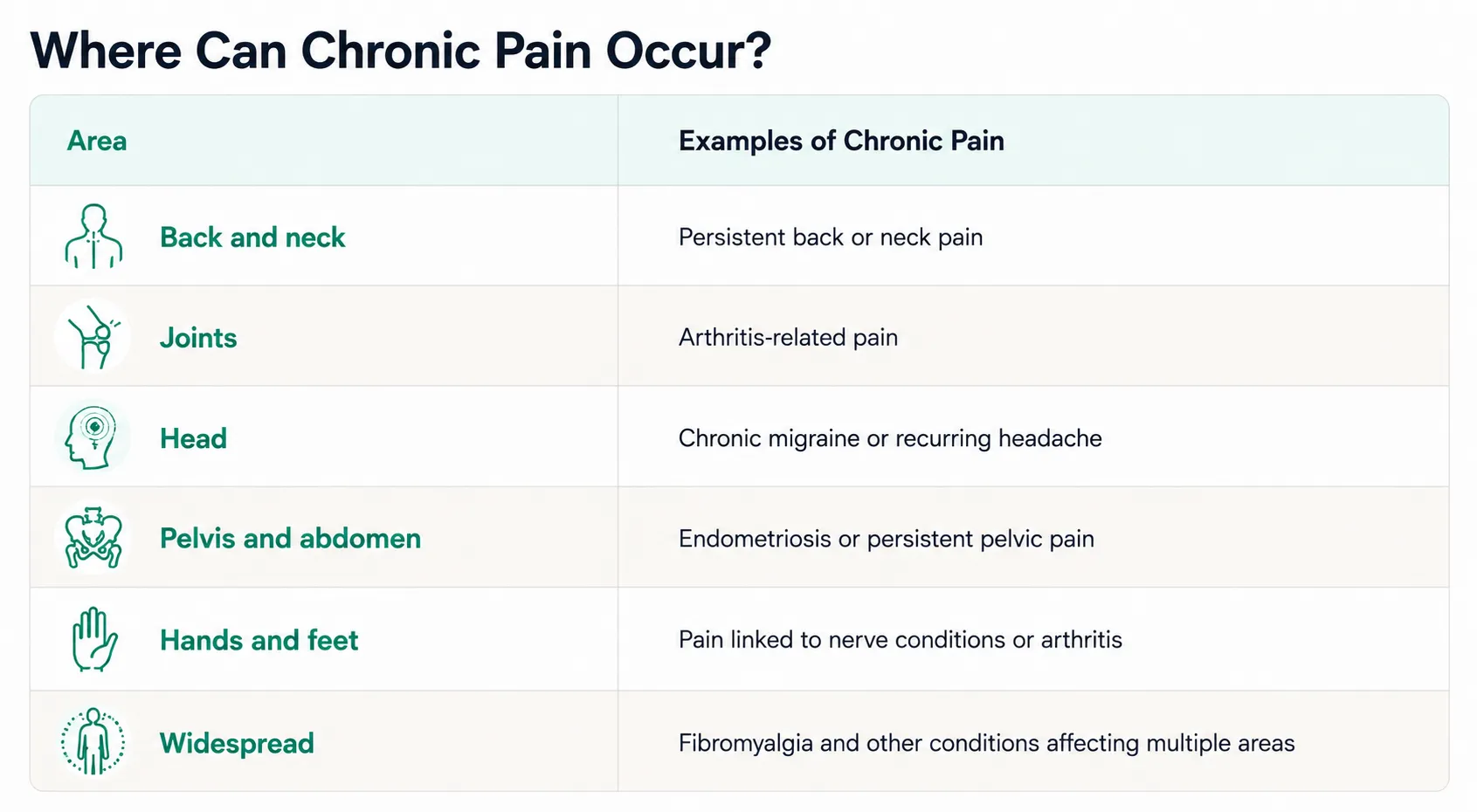
Chronic pain isn’t limited to one part of the body, and where it shows up often points to what might be behind it.
| Area | Examples of chronic pain |
| Back and neck | Persistent back or neck pain |
| Joints | Arthritis-related pain |
| Head | Chronic migraine or recurring headache |
| Pelvis and abdomen | Endometriosis or persistent pelvic pain |
| Hands and feet | Pain linked to nerve conditions or arthritis |
| Widespread | Fibromyalgia and other conditions affecting multiple areas |
Some people experience pain in a single, well-defined area. Others notice it shifting or spreading over time, or affecting several areas at once. Neither pattern is unusual, and the location can be one of several clues a doctor uses when working out next steps.
How Does Chronic Pain Affect Everyday Life?
Chronic pain rarely stays confined to the body. It tends to ripple outward, touching sleep, work, mood, and relationships in ways that aren’t always obvious until they’ve been going on for a while.
Sleep
Persistent pain can make it harder to fall asleep or stay asleep, and poor sleep can, in turn, make pain feel more intense. It’s a cycle that’s frustrating to be in and not always easy to break without support.
Work and daily activities
Pain can affect concentration, mobility, and energy levels, all of which play into work performance and the small daily tasks that tend to be taken for granted, like cooking, cleaning, or running errands.
Mood and mental wellbeing
Living with ongoing pain can affect mood over time, and research suggests it’s linked to a higher likelihood of experiencing stress or anxiety. This connection tends to run both ways: pain can affect mood, and mood can affect how pain is experienced.
Relationships and social activities
Chronic pain can make it harder to keep up with social plans or maintain the same level of involvement in relationships, which can add an emotional weight on top of the physical one.
When Should You See a Doctor About Chronic Pain?
Knowing when persistent pain crosses the line from ‘something to keep an eye on’ into ‘worth getting checked’ isn’t always obvious, especially when the pain has been building gradually rather than appearing suddenly. As a general guide, it’s worth booking a GP appointment if the pain has been present for a while, seems to be getting worse, or is starting to interfere with things that matter, like sleep, work, or time with family and friends.
When to book a GP appointment
Consider seeing a GP if:
- Pain has lasted three months or longer, or continued well beyond the expected healing time
- Pain keeps returning after seeming to settle down
- Symptoms appear to be getting worse rather than improving
- Pain is affecting sleep, concentration, or daily activities
- New numbness, tingling, or weakness has developed alongside the pain
- Pain is starting to affect work, relationships, or overall quality of life
- Previous pain relief methods that used to help no longer seem to be working
None of these on their own necessarily point to something serious, but taken together, or if any one of them is significantly disrupting daily life, they’re a reasonable prompt to check in with a GP rather than waiting it out.
When to seek urgent medical attention
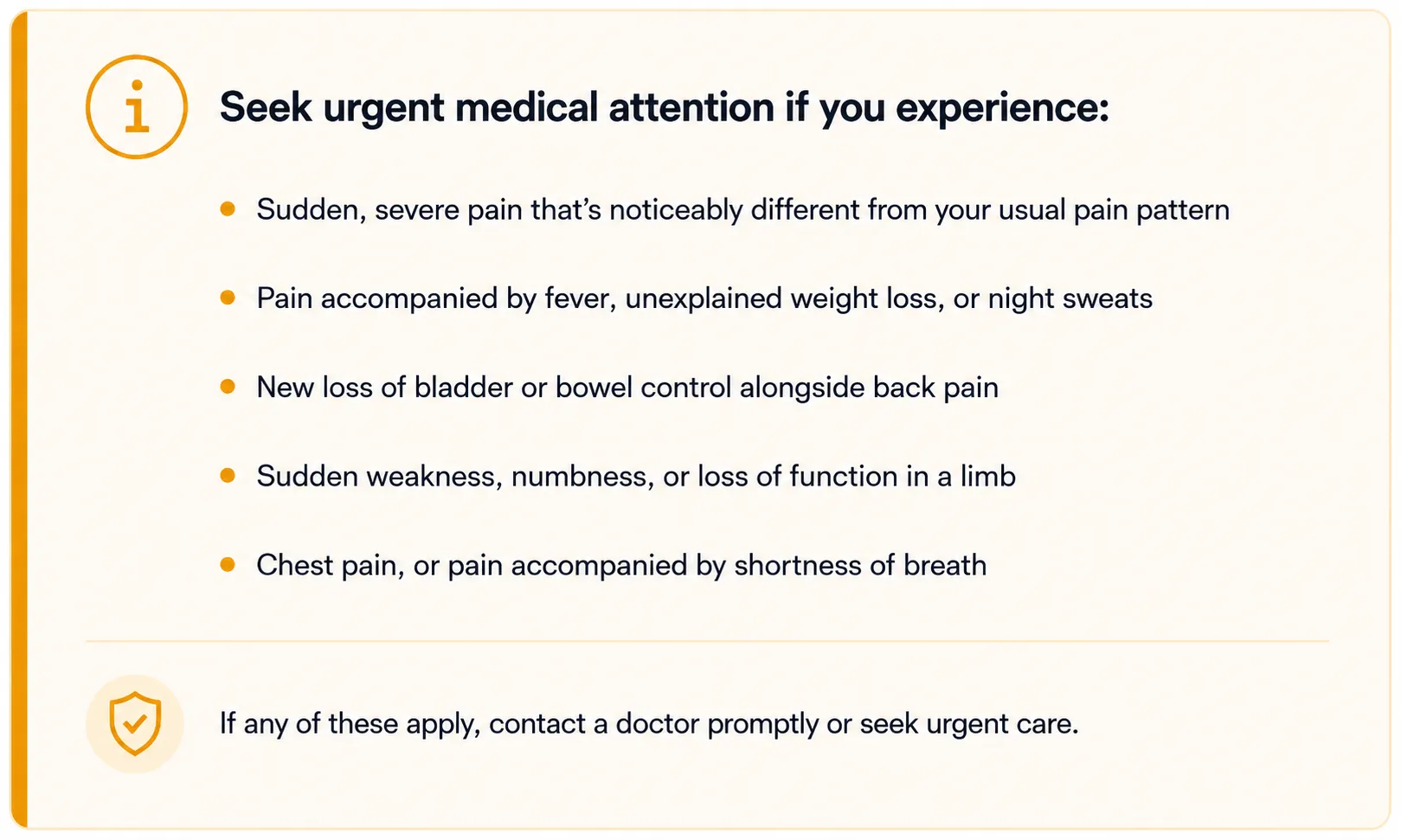
Some symptoms warrant more immediate attention rather than a routine GP booking. These include:
- Sudden, severe pain that’s noticeably different from the person’s usual pain pattern
- Pain accompanied by fever, unexplained weight loss, or night sweats
- New loss of bladder or bowel control alongside back pain
- Sudden weakness, numbness, or loss of function in a limb
- Chest pain, or pain accompanied by shortness of breath
These aren’t intended as an exhaustive emergency list, but as a general guide to symptoms that fall outside the usual pattern of chronic pain and may need prompt assessment. If any of these apply, contacting a doctor promptly or seeking urgent care is the safer course of action.
Living With Chronic Pain
When it comes to chronic pain and pain management, there isn’t a single strategy so much as a set of skills that tend to work best in combination, often refined over time with input from different healthcare professionals.
Understanding the pain-activity cycle
A common pattern in chronic pain is what’s sometimes called the boom-bust cycle: pushing through on a good day, overdoing it, then being forced into extended rest once pain flares in response. Over time, this cycle tends to shrink the number of good days rather than expand them.
As per research analysis, pacing, breaking activities into smaller, manageable steps, and resting before pain demands it rather than after is a widely recommended alternative. It’s often described as an essential technique for managing chronic pain, and may reduce both the severity and duration of flare-ups.
Role of movement and physiotherapy
Physiotherapists and exercise physiologists can teach safe ways to move the body, and some have specific training in chronic pain management. Rather than avoiding activity altogether or pushing through significant discomfort, working with one of these professionals to build a tailored, gradual movement plan tends to produce better results than either extreme. What’s appropriate varies considerably depending on the underlying cause, which is why this is usually approached individually instead of generic exercise advice.
Psychological approaches
Mood and mindset can influence how pain is experienced, and this works in both directions: pain affects mood, and mood affects the experience of pain. Psychological techniques such as cognitive behavioural therapy (CBT) and mindfulness may help reduce unhelpful thought patterns around pain, which can change how pain is experienced and responded to. These are typically delivered by a psychologist, sometimes as part of a broader pain management plan alongside physical strategies.
Setting mood and social goals
It’s easy for chronic pain to gradually shrink a person’s world: less socialising, fewer activities, reduced routine, as pain becomes the main organising factor of the day. Some pain management plans deliberately include mood and social goals alongside physical ones, such as aiming for a set amount of time socialising with friends or family each day. Framing management this way, rather than purely around pain reduction, is a deliberate shift some clinicians use to protect quality of life alongside symptom control.
Building a care team over time
Chronic pain often responds better to a coordinated approach than to any single intervention. Depending on the cause, this might involve a physiotherapist, exercise physiologist, psychologist, or specialists relevant to the underlying condition, working alongside a treating doctor who holds the full picture. Because chronic pain management tends to be an ongoing process rather than something resolved in one visit, continuity with a single treating doctor who can track what’s working over time is generally more effective than starting fresh with a new practitioner each visit.
Chronic Pain in Australia
Where Can Australians Seek Help?
The typical starting point is a treating doctor, usually a GP, who can begin investigating the underlying cause and coordinate any referrals that may be needed. From there, the path varies depending on what’s suspected: a GP might refer some people to a specialist relevant to their condition, others to allied health professionals such as physiotherapists or psychologists, and in some cases to a dedicated multidisciplinary pain clinic, particularly where pain has been persistent or complex to manage.
A range of support Organisations such as offer additional resources for finding support services and understanding what coordinated pain care can look like in practice.
Telehealth has also broadened how this pathway looks. For people in regional or remote parts of Australia, or anyone finding it difficult to access in-person specialist care, online consultations can provide a way to begin that first conversation and get appropriate guidance without the barrier of travel or long wait times. Learn how our telehealth consultations work. If persistent pain has been affecting your daily life, get in touch with our team.
Disclaimer:
This article is general information and isn’t a substitute for personalised medical advice. If persistent pain is affecting your daily life, speaking with a GP or another qualified healthcare professional is the best way to understand your options.