

Overview:
Most people have felt it at some point: a tight jaw before a difficult meeting, a knotted stomach ahead of a big decision, or shoulders that never quite seem to drop after a stretch of demanding weeks. These sensations are not imagined. They reflect a genuine, well-documented relationship between the brain, the nervous system, and the body. As conversations about workplace stress and mental wellbeing become more open across Australia, understanding this mind-body connection is an increasingly important part of everyday physical comfort. This article looks at how stress and emotional load can influence the body, and which evidence-informed habits may support a more balanced sense of wellbeing.
How the Brain and Body Communicate
You don’t usually notice it happening. A thought crosses your mind, an emotion hits, and somewhere in the body something shifts: jaw, gut, heartbeat, without you ever deciding it should. The Australian Defence Force’s Cove resource traces a lot of this back to what’s called the Central Autonomic Network. It’s the wiring that ties brain areas like the prefrontal cortex and amygdala to activities like heart rate, blood pressure, and breathing.
The prefrontal cortex is the planner. Decision-making, focus, weighing things up; that’s its job. The amygdala works differently and faster. It doesn’t wait for permission. If something reads as a threat, safe or not, it can trigger a reaction before the rest of the brain has even finished processing what happened.
Then there’s interoception, which is just a technical name for something fairly intuitive: your ability to notice what’s going on inside you. A racing heart. A tight chest. A stomach that suddenly feels off. Researchers keep coming back to this as a piece of how people regulate their emotions. Healthdirect Australia’s take on mindfulness fits here too; they describe it as giving full, non-judgemental attention to whatever’s happening right now, and tie it to better focus, better sleep, and steadier emotions.
Stress runs the same wiring, just in reverse. A stressful thought fires down through the nervous system, hormones follow, and almost immediately, something changes in the muscles, the gut, the heart (see ref. 2).
None of this is fringe thinking anymore; taking psychosomatic wellness seriously, treating physical symptoms as something the mind can genuinely influence, is now a standard part of how general healthcare approaches patient care. Mental health and physical health were never two separate lanes. They run through the same system.
The Physical Toll of Ongoing Stress
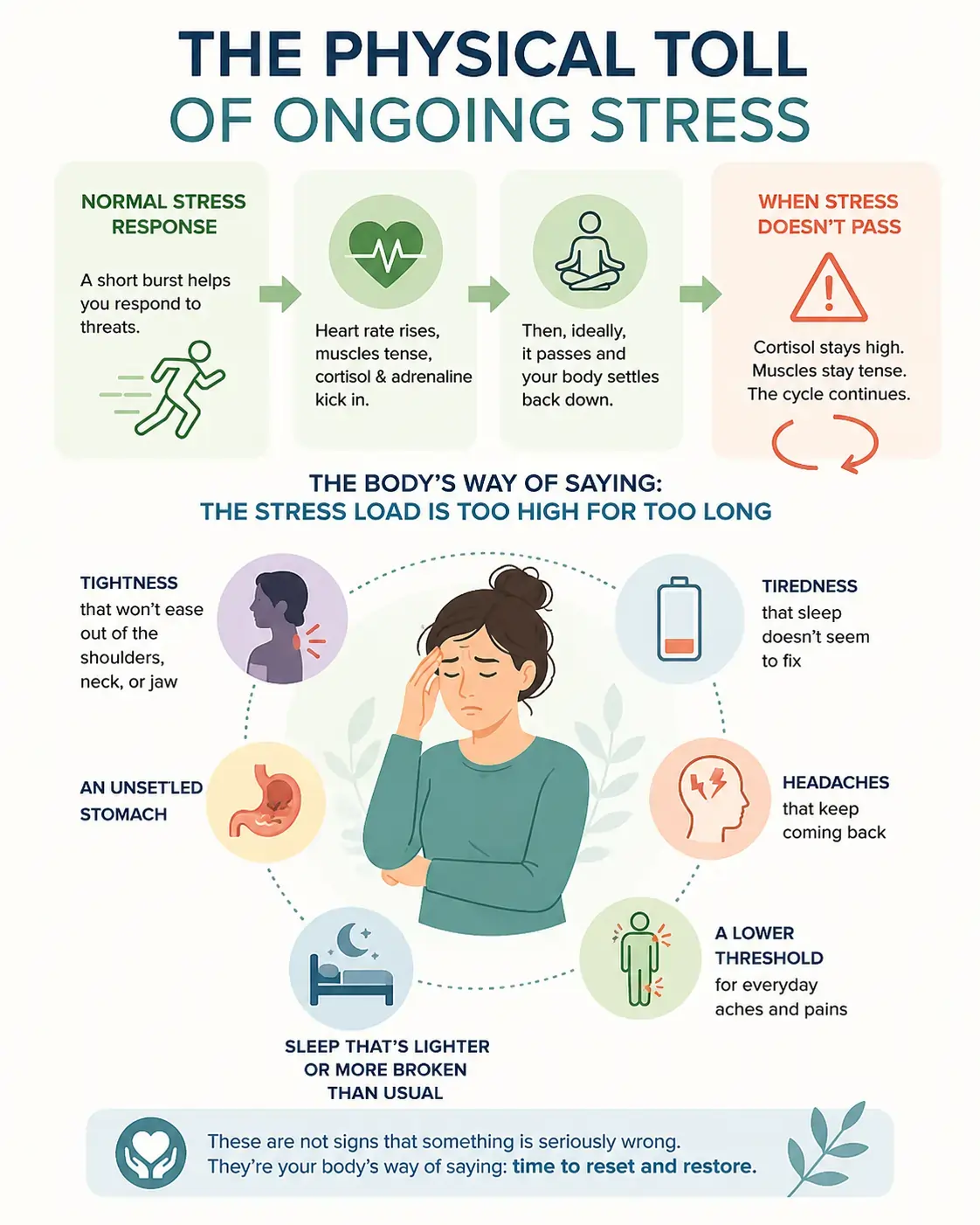
Stress isn’t inherently a problem. A short burst is exactly how the body is built to respond to sudden threats, the so-called fight-or-flight reaction. Heart rate climbs, muscles tighten, cortisol and adrenaline flood in to get you moving. Then, ideally, it passes, and the body settles back down.
Trouble starts when it doesn’t pass. Work pressure, money worries, relationship strain, or ongoing health concerns can keep the body geared up far longer than it was designed for. Cortisol stays elevated, muscles stay tense, and the two feed into each other. People often notice it as:
- Tightness that won’t ease out of the shoulders, neck, or jaw
- Tiredness that sleep doesn’t seem to fix
- Headaches that keep coming back
- An unsettled or upset stomach
- Sleep that’s lighter or more broken than usual
- A lower threshold for everyday aches and pains
A lot of this comes down to emotional load and body tension building together rather than separately. The heavier the emotional load someone’s carrying, the more likely that tension shows up somewhere physical, even when the original stressor has nothing to do with the body at all.
None of these points to anything being seriously wrong by itself. This is what chronic stress and the body look like when they’ve been in conflict for too long, and recognising stress and physical discomfort early usually makes it easier to address before it settles in.
Looking at the Bigger Picture: Biological, Psychological, and Social Factors
Physical comfort rarely comes down to one thing. That’s the idea behind the biopsychosocial model, which healthcare has leaned on more heavily in recent years instead of chasing a single cause for every symptom. It splits things into three areas that keep bumping into each other: biology (genetics, hormones, physical health), psychology (thought patterns, stress, how well someone regulates emotion), and the social side: relationships, work, whether there’s a community around you or not.
That last piece gets overlooked a lot. The number and strength of a person’s relationships affects both mental and physical wellbeing throughout life, and loneliness in particular has been linked to disrupted sleep, higher blood pressure, and elevated cortisol (see ref. 3). Isolation tends to work against a settled nervous system. When someone doesn’t have that support, their stress response often has a harder time switching off.
Two people can go through nearly identical stress and come out with completely different physical symptoms. The biopsychosocial model is one way of explaining why; biology alone rarely tells the whole story.
The Nervous System and Somatic Awareness
Stress doesn’t just live in your head; it runs through the nervous system, which splits broadly into two modes:
- Sympathetic: the alert setting, geared for action
- Parasympathetic: the opposite: rest, digestion, recovery
Neither mode is wrong on its own. Good nervous system regulation just means being able to move between the two as needed, rather than getting stuck in sympathetic mode and struggling to find the way back down.
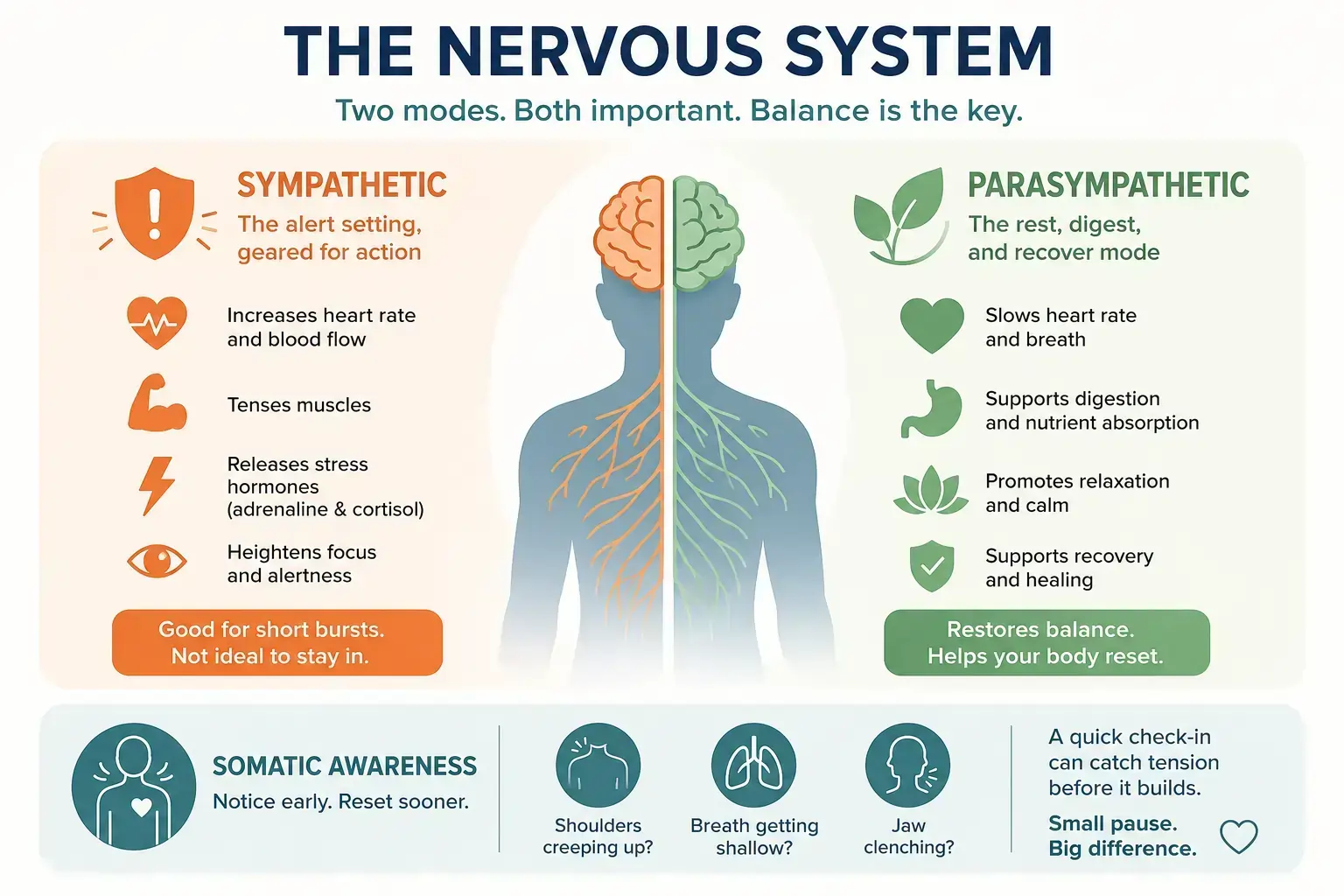
Healthdirect explains this in fairly plain terms: stress triggers the release of hormones like adrenaline and cortisol, useful in the moment, but if the stress doesn’t let up, the nervous system never really gets the chance to reset. That’s often where other symptoms start creeping in.
Somatic awareness is basically paying attention to what’s happening physically before it escalates: shoulders creeping up toward the ears, breath getting shallow, that kind of thing. It’s not a skill that needs training. A quick check-in during the day is often enough to start. Do it consistently, and tension gets caught earlier, well before it turns into something harder to shake.
Lifestyle Habits That May Support Mind-Body Wellbeing
While no single habit resolves stress on its own, a combination of everyday practices may support a healthier relationship between mind and body over time.
- Regular movement. Physical activity, even in moderate amounts, is associated with lower stress hormone levels and improved mood regulation. This does not need to be intense; walking, stretching, or gentle strength work can all contribute.
- Sleep quality. Sleep and stress influence each other in both directions. Poor sleep can heighten the body’s stress response, while ongoing stress can make restful sleep harder to achieve, so consistent sleep routines are often a useful starting point.
- Mindfulness and breathing practices. Mindfulness and physical ease are frequently linked in research, with slow, intentional breathing shown to help activate the parasympathetic nervous system and support a return to a calmer physical state.
These strategies are general wellbeing approaches rather than treatments, and what works well can vary from person to person.
When Physical Symptoms Should Be Assessed
The link between stress and physical discomfort is real, but it isn’t automatic. Not every ache or pain traces back to stress, and it’s worth being careful about assuming that connection too quickly. If something’s persistent, severe, new, or getting worse, that’s a job for a qualified healthcare professional, not a guess. The mind-body connection is a useful lens for everyday wellbeing. It’s not a substitute for getting checked out when something feels off.
Ready to Talk About Your Comfort and Wellbeing?
Reading about stress and the body is one thing. Figuring out what it actually means for your own mind-body health is another. Everyone carries stress differently, and what helps one person settle doesn’t always work for someone else. If you’d like to talk through your own comfort, mood, or general wellbeing with someone who can look at the full picture, our team at TrueWell Clinic is here for that conversation. Get in touch today, and we’ll go from there.
Disclaimer:
This article is general in nature and does not constitute personalised medical or mental health advice. The mind-body strategies discussed are general well-being approaches and are not intended to diagnose, treat, or replace professional healthcare. If you are experiencing persistent or worsening physical or psychological symptoms, consult a qualified healthcare professional. All health information is provided in accordance with Australian Health Practitioner Regulation Agency (AHPRA) guidelines.
References
- https://cove.army.gov.au/article/brain-body-connection-why-it-important-resilience-and-cognition
- https://www.healthdirect.gov.au/mindfulness
- https://www.betterhealth.vic.gov.au/health/healthyliving/Strong-relationships-strong-health
- https://www.healthdirect.gov.au/relaxation-techniques-for-stress-relief